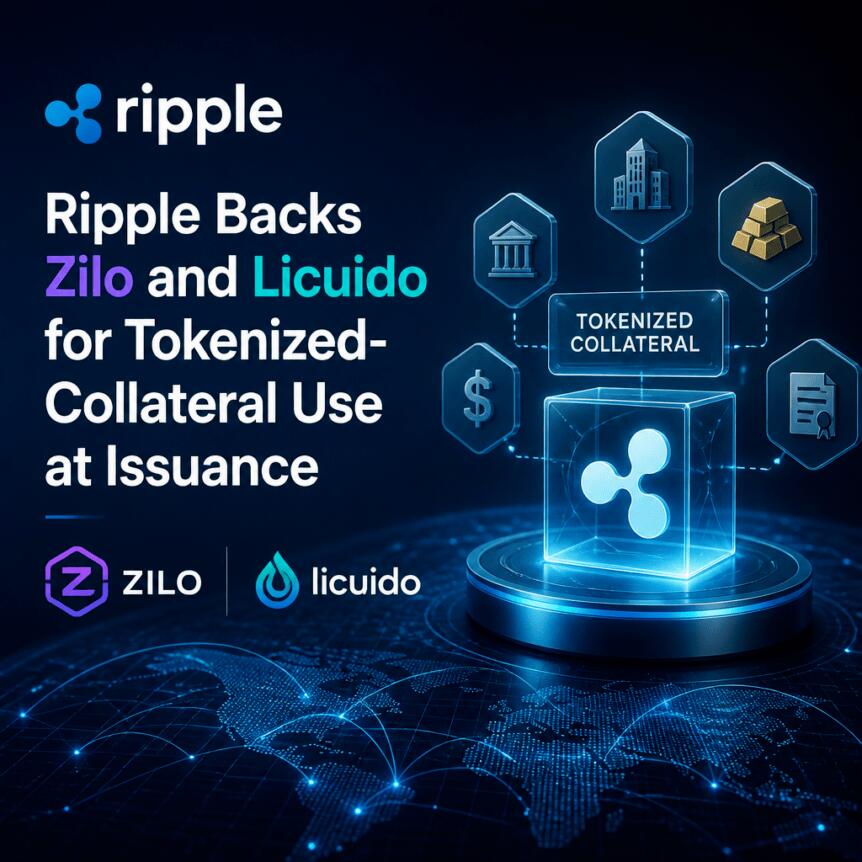
Ripple said it has made two strategic investments aimed at expanding the infrastructure behind tokenized financial assets on its XRP Ledger (XRPL). In an announcement released Monday, the company disclosed funding into Zilo, a global transfer agency provider for wealth managers, and Licuido, a tokenization solutions firm regulated by the UK’s Financial Conduct Authority.
While Ripple did not provide deal sizes or investment terms, the move signals a continued effort to reduce friction in tokenized markets—particularly around how collateral can move and be reused across issuance and settlement.
Key takeaways
- Ripple announced strategic investments in Zilo and Licuido to support tokenized asset workflows on XRPL.
- The company expects the partnerships to improve regulated transfer agency, issuance, and collateral mobility on its ledger.
- Ripple’s stated focus is addressing “idle collateral” by enabling tokenized funds to be used as collateral from issuance.
- The announcements follow recent XRPL-related product and adoption milestones, including Aviva Investors’ tokenized fund launch and Ripple Mint for RLUSD.
Why Ripple is tying tokenization to regulated market plumbing
For institutional tokenization to scale, networks need more than smart-contract functionality—they require operational layers such as issuance controls, transfer agency services, and mechanisms that support compliance and collateral management. Ripple framed its investments as part of that broader stack.
According to the company’s announcement, Ripple expects the Zilo and Licuido investments to bring “regulated transfer agency, issuance, and collateral mobility” to XRPL infrastructure. That positioning matters because the capital markets bottlenecks that slow adoption are often less about token mechanics and more about how assets move through regulated processes.
Zilo and Licuido: transfer agency and FCA-regulated tokenization
Ripple said it invested in Zilo, which provides global transfer agency asset solutions for wealth managers. The UK-based company has reportedly raised $58.7 million in total equity funding, based on data compiled by Traxcn.
Ripple also announced an investment in Licuido, a tokenization solutions provider based in the UK and regulated by the Financial Conduct Authority. The combination of Zilo’s transfer agency orientation and Licuido’s regulated tokenization role suggests Ripple is targeting multiple stages of a tokenized asset’s lifecycle—from issuance through custody-related and operational handling.
Collateral mobility and the “idle collateral” problem
Ripple’s announcement tied the investments to a specific market issue: collateral that sits unused. The company said that by combining the investments, it aims to help address problems related to idle collateral by enabling tokenized funds to be used as collateral from the point of issuance.
In practical terms, this is the type of improvement that could reduce inefficiencies in leveraged trading, structured financing, or other institutional strategies where capital availability matters. If tokenized instruments can be deployed as collateral more directly, it may reduce the need to lock value in separate pools for different steps of the workflow.
However, the company did not provide implementation timelines or technical details in the announcement, leaving open questions about exactly how quickly these partnerships translate into new product capabilities on XRPL. Investors and ecosystem participants will likely want to watch for concrete rollout plans or integrations that demonstrate the promised shift from token issuance to usable collateral.
XRPL adoption momentum: RLUSD tooling and tokenized fund activity
Ripple’s investment news arrives shortly after other XRPL-related developments highlighted momentum in institutional tokenization.
One week prior to the announcement, London-based asset manager Aviva Investors launched a tokenized share class of its US Dollar Liquidity Fund on XRPL after receiving approval from the Central Bank of Ireland, according to earlier coverage from Cointelegraph. That example illustrates how regulatory clearance and asset-manager participation are becoming central to XRPL’s institutional narrative.
In addition, Ripple last month introduced Ripple Mint, a platform designed to give institutions new ways to access, mint, redeem, and manage its US dollar-pegged stablecoin, Ripple USD (RLUSD). By building tools around stablecoin operations and management, Ripple has been advancing the practical infrastructure institutions need for on-chain settlement and token issuance workflows.
Taken together, these efforts point to a broader strategy: pair ledger-level capabilities with real-world finance counterparts—asset managers, transfer agency providers, and regulated tokenization services—so that tokenized assets can be issued, moved, and operationally managed under compliance expectations.
Tokenized assets onchain: growth, concentration, and what to watch
The broader tokenized real-world assets (RWA) market has continued to expand, reinforcing why firms are investing in infrastructure. According to data compiled by RWA.xyz, XRPL is the 11th-largest blockchain network with $368 million in tokenized RWAs. Ethereum ranks first with $17.1 billion in tokenized RWAs.
RWA.xyz data also showed that total RWA holders increased by 50% to 1.57 million over the past 30 days, while the total value of tokenized assets rose by 1.5% to $37.3 billion. Those figures suggest that, despite concentration at the top, the sector is not standing still—participation and capital have both been trending upward.
For XRPL participants, the key takeaway is that growth in tokenization demand may increasingly depend on the maturity of the operational layer. Ripple’s stated goal—improving collateral mobility and transfer agency and issuance capabilities—directly targets a set of constraints that can limit institutional use even when tokenization technology exists.
Next, market observers will likely focus on whether Ripple can translate these investments into measurable product outcomes on XRPL—especially around regulated issuance workflows and the ability for tokenized funds to function as collateral from issuance, as Ripple described. Concrete integrations, pilot deployments, and partner announcements will be the clearest indicators of how quickly the strategy moves from concept to capability.