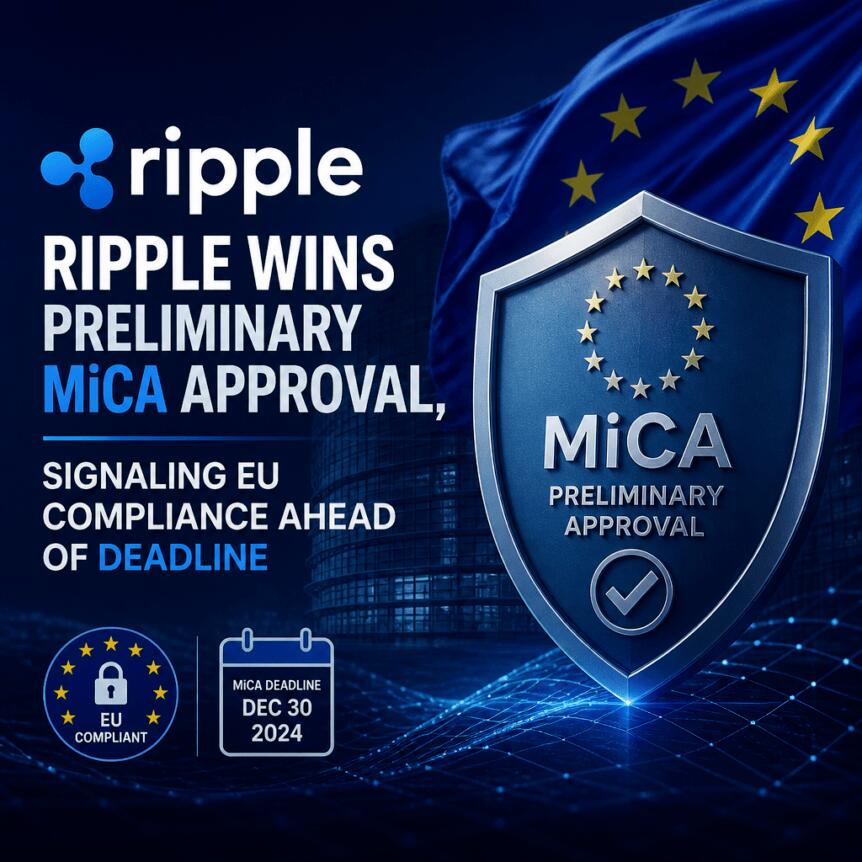
Luxembourg’s financial supervisor has granted Ripple preliminary approval for a crypto asset service provider (CASP) license under the EU’s Markets in Crypto-Assets Regulation (MiCA), the company said. If the approval is finalized, it would position Ripple to provide regulated crypto services across the European Economic Area (EEA) using the MiCA “passporting” mechanism.
The development matters for compliance and market access. For firms seeking to work with banks, fintechs, and corporate clients across multiple EU member states, MiCA licensing and passport rights are intended to reduce the need for separate, country-by-country authorizations—provided the authorization is granted and conditions are met.
Key takeaways
- Ripple said it received preliminary Luxembourg approval for a MiCA CASP license, subject to final authorization.
- If finalized, the CASP license would support regulated crypto services across the EEA via passporting.
- Ripple’s MiCA-related progress builds on an existing Electronic Money Institution (EMI) license in Luxembourg.
- The timing aligns with MiCA’s July 1 transitional deadline for full application across EU member states.
- Europe continues to function as a key regulatory test case as crypto firms race to obtain MiCA approvals.
Ripple’s CASP approval and what passporting enables
Ripple stated that Luxembourg granted it preliminary approval for a CASP license under MiCA. Once finalized, the authorization would allow the company to offer regulated crypto asset services to eligible clients—such as banks and fintechs—across all 30 EEA countries through a single authorization framework.
In practice, MiCA’s passporting approach is designed for supervised cross-border operations. Instead of obtaining distinct permissions in each jurisdiction, firms with an authorization in one EEA member state can typically rely on that status to operate throughout the bloc, subject to ongoing compliance and adherence to applicable requirements.
Ripple said the move complements its existing standing in Luxembourg as well as its broader efforts to align crypto-related offerings with EU regulatory expectations.
How the EMI license may support broader payments integration
The announcement also ties the CASP update to Ripple’s existing Electronic Money Institution (EMI) license in Luxembourg. Ripple said this EMI authorization—issued in February 2026—enables regulated cross-border payments and electronic money services across the EEA.
Ripple characterized the combination of its EMI license and the pending CASP approval as enabling a “full crypto asset and stablecoins payments infrastructure” through a single integration. While the exact scope of services depends on the terms of the final CASP authorization, the compliance significance is clear: supervised roles across both payments and crypto asset activities can reduce operational fragmentation for regulated customers.
The approach also reflects how EU supervision is increasingly framed around business models rather than underlying technology alone. For institutional providers, aligning licensing footprints across payments, custody-like services, and crypto asset exchange or transfer functions can be a prerequisite for working with regulated counterparties subject to their own governance and risk controls.
MiCA’s timeline and the broader European enforcement and licensing landscape
Ripple’s CASP update arrives just before the July 1 transitional deadline, when EU member states begin fully applying MiCA rules. The deadline is a focal point for the industry because MiCA is intended to harmonize requirements across the EU for crypto asset issuance and related services, including consumer protection, market integrity, and anti-money laundering and counter-terrorist financing (AML/CTF) obligations.
As firms prepare for full MiCA application, major exchanges have faced uncertainty around the readiness and timing of approvals. Cointelegraph reported that Europe has become a regulatory test case as the MiCA framework takes effect.
Media reporting has indicated that some regulators may be considering restrictive outcomes for certain applications. Reuters, for example, has reported that Greek regulators may be preparing to deny Binance’s EU license bid (reported with sources), underscoring that MiCA authorization is not automatic and that member state supervisors retain discretion within the new framework.
Ripple said it currently holds more than 75 regulatory licenses globally, including a UK authorization received in January 2026. Such multi-jurisdiction licensing experience may influence how firms interpret MiCA requirements, but EU authorization processes remain distinct and can involve detailed assessments of governance, controls, and risk management.
Institutional compliance implications: licensing, controls, and audit readiness
For banks, fintechs, and other regulated counterparties, MiCA-aligned CASP status can materially affect due diligence processes. Institutional compliance teams typically evaluate whether a service provider is authorized to conduct the relevant regulated activities, whether it implements AML/KYC controls consistent with EU expectations, and whether its operational controls can withstand audits and supervisory review.
Ripple’s preliminary CASP approval, if finalized, would also likely support structured onboarding for European clients seeking regulated pathways for crypto asset-related payments and services. This could reduce legal uncertainty for counterparties that prefer to transact only with entities operating under recognized EU supervision.
At the same time, preliminary approvals highlight the residual uncertainty that compliance teams must manage. Until authorization is finalized and any conditions are clarified, institutions may treat the status as conditional for contracting, governance, and risk acceptance purposes—particularly where product scope, service terms, or asset types could affect regulatory classifications.
Regulatory frameworks across Europe also remain dynamic as supervisors gain experience under MiCA. That evolution can lead to updated guidance, supervisory priorities, or enforcement actions that affect how firms operationalize compliance, including monitoring, incident reporting, and customer asset handling standards.
Closing perspective
Ripple’s preliminary MiCA CASP approval signals continued momentum toward a supervised crypto payments ecosystem in Europe, but the immediate priority for market participants will be final authorization details and the scope of permitted activities under the license. With MiCA now moving into full application, firms and their institutional counterparties should track how regulators translate the law into authorization outcomes and ongoing supervisory expectations across member states.