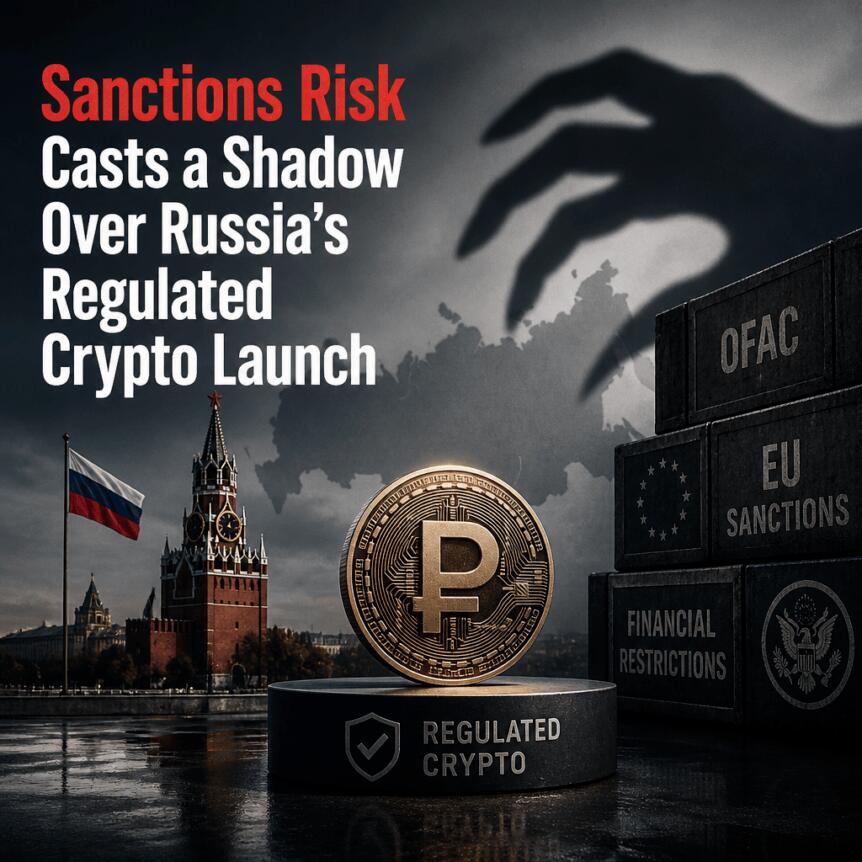
Russia’s latest effort to bring cryptocurrency trading under stricter government oversight is expanding the official footprint of compliant crypto businesses—but it is also triggering quiet pushback from some industry players who worry that public visibility can increase the risk of sanctions.
According to Cointelegraph, a person familiar with the regulator discussions said some companies are reluctant to join the Bank of Russia’s public registry of authorized crypto exchange operators. The concern is that a transparent list could make firms more exposed to international enforcement measures. The central bank, however, reportedly rejected calls to keep the registry private, arguing that crypto firms should meet the same disclosure and compliance expectations as traditional financial service providers.
Key takeaways
- The Bank of Russia’s exchange operator registry has reached 30 authorized listings as of Wednesday, following new retail trading rules that took effect Monday.
- Registration does not automatically indicate that firms are already able to offer end-to-end retail services such as trading, settlement, and custody.
- Some companies reportedly sought a non-public registry to reduce sanctions exposure, but the regulator declined.
- Russia’s planned crypto trading launch on MOEX (via brokers) is set for Dec. 1, just as the EU prepares additional sanctions measures.
- Broader crypto activity in Russia has reportedly declined despite the push toward a regulated trading venue.
A public registry expands—access to retail trading remains unclear
Russia’s new framework for retail participation in crypto markets began rolling out on Monday. Under the rules, retail investors can buy Bitcoin, Ether, and Tether’s USDt (USDT). Cointelegraph reports that the Bank of Russia’s registry has since listed 30 authorized exchange operators as of Wednesday.
The list includes large banking groups such as Sberbank and VTB, suggesting the regime is attracting established financial institutions. Still, the existence of a registration entry does not clarify whether customers can immediately complete trades.
Alexander Nam, an HSE University researcher affiliated with the Center for Decentralized Finance and Digital Financial Assets Research, told Cointelegraph that the market still faces technical and regulatory obstacles. He pointed to the practical steps required to serve investors—ranging from investor testing and order execution to settlement and custody arrangements.
“Being included in the registry does not in itself mean readiness to fully serve investors,” Nam told Cointelegraph.
That perspective was echoed by Alexander Brazhnikov, of the Russian Association of Cryptocurrency and Blockchain, who said he could not identify a registered operator offering confirmed retail access as of Monday.
Why transparency can become a sanctions risk
The reported reluctance from some firms highlights a tension at the heart of Russia’s regulatory approach: expanding compliance and legitimacy while operating under tightening geopolitical constraints.
Cointelegraph reports that industry representatives asked the Bank of Russia to keep the registry private, arguing that a publicly available list would make it easier for external authorities to identify and target participants. The central bank’s position, as described by the source, was that crypto businesses should follow the same requirements as other financial service providers—meaning public oversight mechanisms should not be treated as optional.
For investors and market participants, the implication is straightforward: even when rules exist on paper and firms appear on official lists, the path from authorization to usable consumer access may be slower than expected. For firms, the trade-off may be sharper—joining a public registry can help with local credibility and compliance, but it may also increase the chance of being singled out by international sanctions regimes.
EU sanctions preparations add pressure ahead of MOEX
As Russia accelerates its retail trading rollout, the EU is preparing additional sanctions. Cointelegraph notes that the European Union is reportedly working toward its 22nd sanctions package against Russia. The package is expected to include new restrictions affecting crypto platforms, and it is anticipated to be presented ahead of a Nov. 26–27 European Council summit—days before Russia’s scheduled crypto trading launch on MOEX.
MOEX, Russia’s main securities trading venue, is planning to launch crypto trading on Dec. 1. Cointelegraph reports that investors are expected to access the market through brokers rather than trading directly on the exchange.
Cointelegraph said it contacted VTB, T-Invest Lab, and MOEX for details on their respective launch plans but had not received responses by the time of publication. The broader timing makes that uncertainty notable: if sanctions risk intensifies around crypto-linked intermediaries, broker readiness and operational implementation could be affected even if authorization steps have already been completed.
Separately, Russia’s political leadership continues to frame sanctions as ineffective. Cointelegraph reports that President Vladimir Putin told participants at the Asia-Pacific Economic Cooperation summit in Shenzhen that Western sanctions have backfired and strengthened Russia’s economy.
Regulation advances, but activity reportedly falls
While Russia is building a more formalized crypto trading pipeline, the underlying usage trend has reportedly been weaker than the policy push would suggest.
According to Chainalysis data cited by Cointelegraph, the value of cryptocurrency transactions fell 14.7% to $284.1 billion in the year ended June 2026. Chainalysis also estimated that Russia accounted for roughly 44% of Eastern Europe’s crypto activity, underscoring that the market remains significant within the region—even as it contracts.
That combination—declining transaction value alongside new regulatory infrastructure—raises an important question for market watchers: will the regulated trading channel reverse the contraction, or will sanctions and operational constraints continue to weigh on participation?
With MOEX’s Dec. 1 launch approaching and EU sanctions developments potentially targeting crypto intermediaries, the next signals to watch are practical: which registered operators (and brokers) actually complete readiness steps for retail execution, settlement, and custody, and whether the public registry expansion accelerates adoption or quietly discourages additional firms from participating.