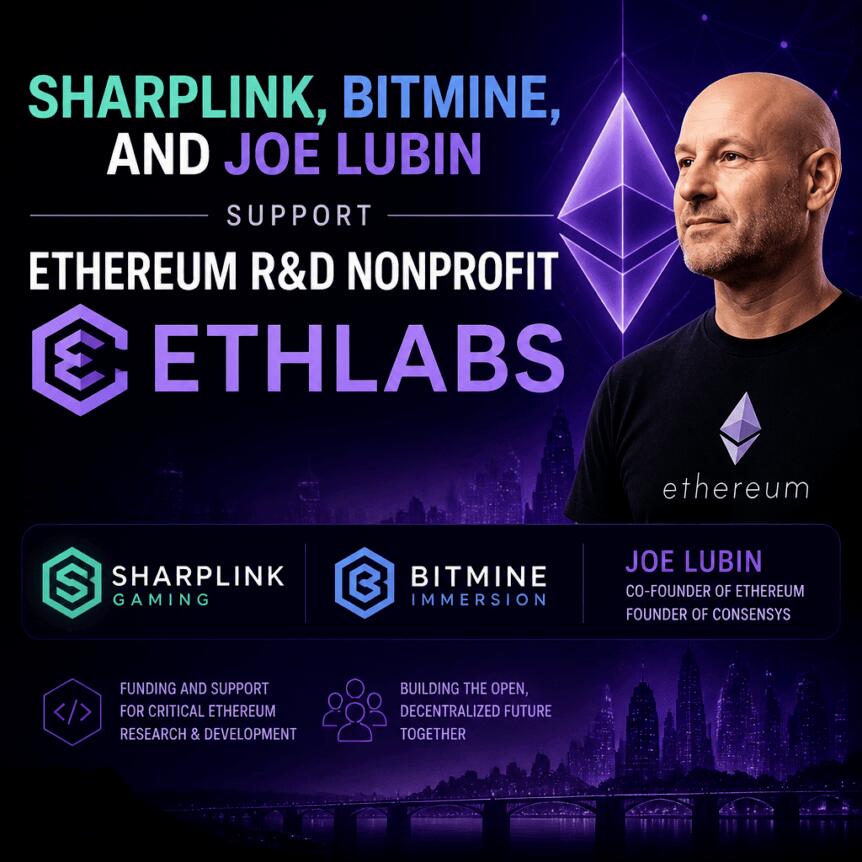
Former Ethereum Foundation contributors and ETH treasury firms Bitmine and Sharplink have launched a new research and development nonprofit, Ethlabs, with the stated goal of preparing Ethereum for what they describe as the next phase of institutional adoption.
Sharplink said on Monday that Ethlabs is intended to “ready Ethereum for the next phase of institutional adoption,” positioning the organization as a long-term home for core research and development work. The initiative is backed by Sharplink and Bitmine, alongside Ethereum co-founder Joe Lubin and other Ethereum contributors.
Key takeaways
- Ethlabs is a new nonprofit focused on Ethereum core research and development aimed at supporting large-scale institutional use.
- Sharplink frames the move around growing on-chain settlement demand from stablecoins, tokenized real-world assets, and other financial activity.
- Ethlabs is co-founded by five former senior Ethereum Foundation researchers, signaling an attempt to preserve continuity in technical stewardship.
- The launch arrives amid renewed criticism around Ethereum Foundation funding capacity and leadership departures.
- Joe Lubin links the project to expanding “steward nodes” and increasing network utilization, tying research goals to practical adoption.
Why Ethlabs says it exists
In its announcement, Sharplink argued that several categories of financial activity are converging on Ethereum as a settlement layer. The company specifically pointed to stablecoins, tokenized real-world assets, funds, and “autonomous AI commerce” moving on-chain, describing Ethereum as “neutral” and “credibly permissionless” for that role.
On that basis, Sharplink said Ethlabs exists to ensure the network can absorb this demand “at scale.” The organization’s pitch is less about changing Ethereum’s direction in a political sense and more about building technical capacity—through stable funding—for research and development that supports the network’s next growth phase.
Backers and founding team
Ethlabs was co-founded by five former senior Ethereum Foundation researchers: Ansgar Dietrichs, Barnabé Monnot, Caspar Schwarz-Schilling, Josh Rudolf, and Julian Ma. The involvement of former EF researchers is notable because many ecosystem upgrades over Ethereum’s lifecycle have relied on specialized technical work that is difficult to replicate quickly.
Sharplink also said Ethlabs brings together technologists who have guided the network through “its most consequential upgrades over the past decade,” adding that the initiative provides “stable, long-term funding” in what it calls an institutional context.
Joe Lubin—Ethereum co-founder—told supporters that Ethereum “is entering its next stage of evolution.” He also said there should be “a number of steward nodes of Ethereum” aimed at growing utilization of the blockchain.
Lubin further stated that Ethlabs, by giving researchers and developers an “independent home,” will be instrumental in preparing for a “next major wave of adoption.” The language underscores an expectation that technical work and operational participation (such as steward nodes) should move in tandem.
Launch timing: funding concerns and Foundation leadership departures
Ethlabs’ debut lands shortly after warnings about Ethereum Foundation funding constraints resurfaced. In May, Vitalik Buterin said the Ethereum Foundation’s resources were limited, noting that it held only about 0.16% of the total supply of Ether (ETH).
More recently, former Ethereum Foundation contributor Trenton Van Epps warned that Ethereum could be heading toward a “slow-burning funding crisis.” The concern centered on the risk that ongoing asset selling by the Foundation could undermine long-term support for core development.
The launch also coincides with an ongoing wave of leadership exits from the Ethereum Foundation, including the reported departure of co-executive director Hsiao-Wei Wang, which was described as leaving last week in earlier coverage.
Institutional readiness vs. what remains uncertain
Ethlabs’ stated mission—ensuring Ethereum is ready to scale for major on-chain financial and settlement activity—raises a practical question for market participants: how will this new funding and organizational structure translate into concrete technical deliverables?
Sharplink’s message is clear about the direction—capacity for institutional-grade adoption—but the announcement provides limited detail on specific engineering timelines or near-term protocol milestones. For investors and developers, the next signals to watch are the organization’s published research agenda and how it coordinates with existing Ethereum ecosystem contributors, particularly in areas such as scalability, security, and the infrastructure needed for higher-throughput settlement use cases.
It is also worth noting that Ethlabs is being positioned as a stable “institutional home” for core technology work, while critics have argued that the Foundation’s financial situation may be limiting its ability to sustain that same role. However, whether Ethlabs’ model becomes a substitute for the EF or a complementary structure will likely depend on its governance, funding durability, and its ability to attract ongoing developer participation.
Ether market backdrop
The policy and funding narrative is playing out against a softer market environment for Ether. Ether is trading about 65% below its reported peak around $1,700, with those levels last seen in October 2023 and April 2025, according to the figures referenced in the announcement context.
That backdrop can matter because periods of weaker sentiment often reduce risk appetite and slow down spending across the ecosystem—making stable funding for core development more salient. Even so, the immediate relevance for users will hinge on whether research efforts lead to improvements that directly affect performance and reliability.
For now, the key question is whether Ethlabs can convert its “long-term, independent home” framing into measurable progress on Ethereum readiness for institutional settlement demand—and how that effort interacts with the Ethereum Foundation’s evolving role amid continued leadership and funding debates.