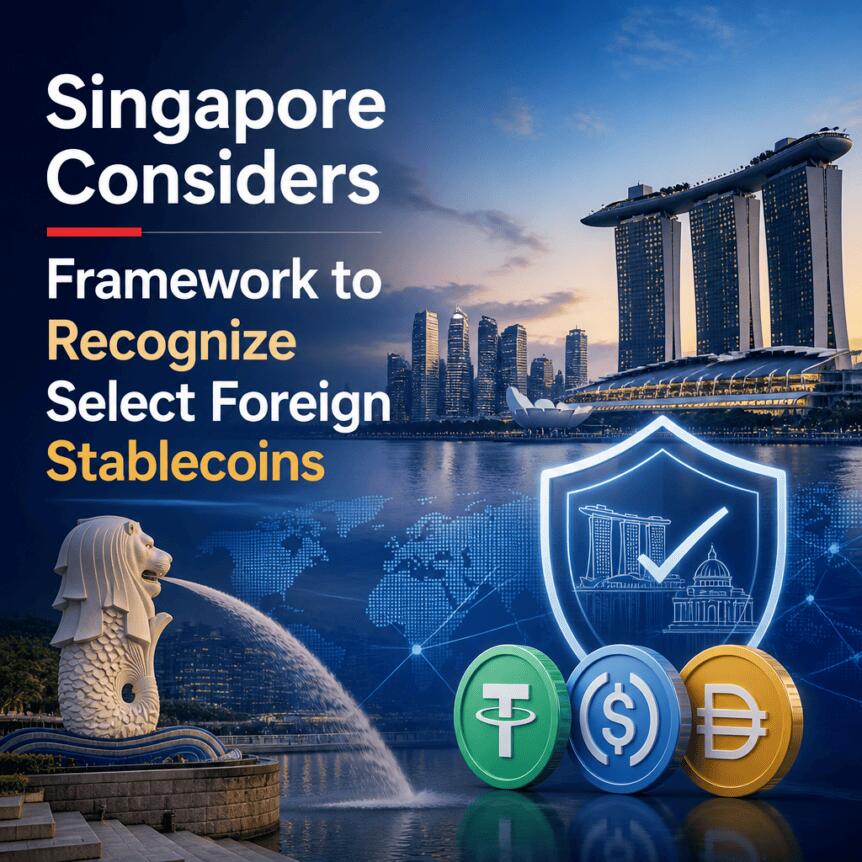
The Monetary Authority of Singapore (MAS) has moved to reconsider a key element of its stablecoin stance from 2023, launching a public consultation on proposed amendments to the Payment Services Act (PSA) that could allow certain stablecoins issued with foreign partners to fall under Singapore’s regulatory framework.
According to MAS, the consultation—opened Tuesday—also reflects policy developments since 2023 and introduces additional safeguards for issuers seeking to market tokens as “MAS-regulated stablecoins.” MAS is also evaluating whether a limited set of foreign-issued stablecoins, supervised under comparable overseas regimes, could be recognized for specific cross-border wholesale uses.
Key takeaways
- MAS is consulting on PSA amendments that would translate its 2023 stablecoin framework into law, with conditions for “MAS-regulated stablecoins.”
- One proposal would allow stablecoins jointly issued by a Singapore issuer and a foreign issuer to qualify—if risks are sufficiently mitigated.
- MAS is also considering recognition of a limited number of foreign-issued stablecoins regulated under comparable frameworks for cross-border wholesale transactions.
- The consultation revisits MAS’s earlier requirement that qualifying stablecoins be issued solely in Singapore, citing prior concerns around regulatory equivalence and tracing commingled reserves.
- Public comments are open until Oct. 16.
From a “Singapore-only” rule to a more flexible model
MAS’s consultation effectively revisits its 2023 position that stablecoins eligible for its regulatory framework had to be issued solely in Singapore. In 2023, MAS finalized a stablecoin regulatory framework for single-currency stablecoins issued in Singapore and pegged to the Singapore dollar or a G10 currency.
MAS said at the time that expanding eligibility beyond Singapore raised practical difficulties—particularly around establishing regulatory equivalence and cooperation with other jurisdictions. The regulator also pointed to technical issues related to tracing where commingled stablecoins originated, as well as determining whether overseas reserves would be sufficient to meet redemption requests.
Now, MAS is asking for input on approaches that could reduce those earlier barriers while still keeping the core objective of regulated redemption and reserve-backed stability.
How “MAS-regulated stablecoins” could work with foreign issuers
Under one of MAS’s main proposals, stablecoins jointly issued by a Singapore issuer and a foreign issuer could be brought within the PSA framework and labeled “MAS-regulated stablecoins,” provided that MAS determines the associated risks are sufficiently mitigated.
The regulator frames the broader consultation around implementing the 2023 framework through legislative amendments to the PSA, Singapore’s main law governing payment services and operators.
MAS’s requirements for issuers would cover reserve-backed value stability, capital arrangements, and redemption mechanisms at par. The proposals also include issuer disclosure requirements and restrict branding: only issuers licensed under the framework would be able to market themselves as “MAS-regulated stablecoin issuers” and describe their tokens as “MAS-regulated stablecoins.”
MAS also proposes additional controls that focus on resilience and governance. Issuers would be prohibited from paying interest on regulated stablecoins. They would also need to conduct stress tests and maintain recovery and orderly wind-down plans.
To protect customers, MAS proposes safeguards covering customer money received before the corresponding stablecoins are issued. MAS also indicates that stablecoins outside the dedicated framework would continue to be treated as digital payment tokens under existing Singapore rules.
Recognition of certain foreign-issued stablecoins
Beyond jointly issued tokens, MAS is also considering whether to recognize a limited number of foreign-issued stablecoins that are regulated under comparable overseas frameworks.
In MAS’s description of the idea, the motivation for recognition is tied to practical utility: such tokens could be used for cross-border wholesale transactions. However, MAS’s consultation suggests it is not moving toward open-ended endorsement; rather, it is assessing a constrained approach, limiting recognition to a small set of stablecoins that meet standards similar to those expected under MAS oversight.
Why MAS’s shift matters for markets and compliance
For stablecoin issuers and liquidity providers, MAS’s consultation signals a willingness to accommodate real-world issuance structures—particularly where reserve management, issuance operations, or distribution links may involve multiple jurisdictions. Under the earlier 2023 framework, firms faced a simpler but narrower pathway: eligible stablecoins had to be issued solely in Singapore.
By introducing the possibility of qualifying joint issuance and conditional recognition of certain foreign-issued stablecoins, MAS is effectively balancing two competing realities: the need for strong redemption and reserve oversight, and the operational fact that cross-border settlement increasingly relies on interoperable, internationally used digital dollar and G10-pegged instruments.
At the same time, MAS is signaling that flexibility will come with tighter issuer obligations—reserve and capital requirements, stress testing, and structured wind-down planning—along with limits on marketing claims. The consultation’s focus on legal labeling (“MAS-regulated stablecoins”) also points to an emphasis on consumer clarity, not just technical compliance.
Next steps for MAS and the industry
MAS is accepting public comments on the consultation until Oct. 16, and the proposals’ details will be closely watched by issuers planning Singapore-related stablecoin product roadmaps—especially those considering cross-border distribution, joint issuance, or reserve arrangements involving foreign entities.