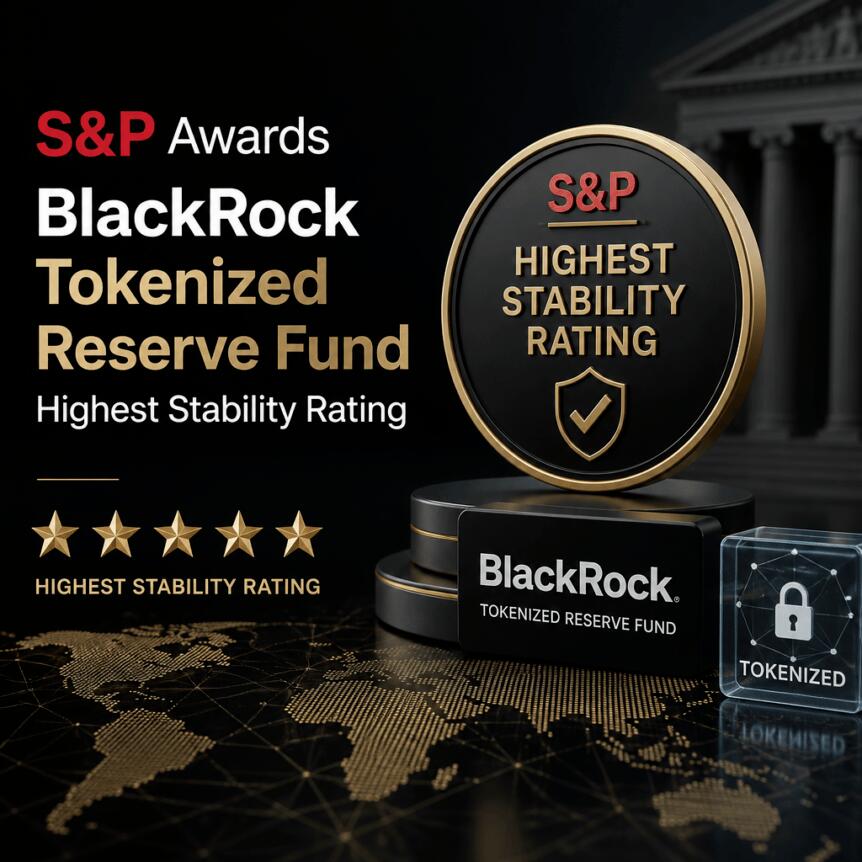
BlackRock’s newly launched tokenized money market fund, the BlackRock Daily Reinvestment Stablecoin Reserve Vehicle (BRSRV), has received the highest principal stability fund rating from S&P Global Ratings. The decision underscores how major TradFi players are attempting to translate money-market fundamentals—credit quality, liquidity, and short maturities—into tokenized structures aimed at stablecoin ecosystems.
At the same time, S&P’s latest Stablecoin Stability Assessments show limited upward movement across the stablecoin market: two of the 11 stablecoins it covers saw their scores revised lower over the prior three quarters, while the rest were unchanged. Notably, Tether’s USDt (USDT) remains among the lowest-rated assets in S&P’s framework.
Key takeaways
- S&P Global Ratings assigned an “AAAm” principal stability fund rating to BlackRock’s tokenized stablecoin reserve fund, BRSRV, on Monday.
- The AAAm assessment cited factors including investment and counterparty creditworthiness, short maturity design, and management’s ability to maintain a stable net asset value.
- S&P reported it found “no weaknesses” in its qualitative review of BlackRock Advisors’ management and organization, credit analysis, risk management, and compliance.
- S&P’s separate Stablecoin Stability Assessments framework still places USDT in the weakest category (“weak,” score of 5), and two other assessments were lowered during the previous three quarters.
S&P awards top principal stability rating to BlackRock’s tokenized reserve
S&P Global Ratings awarded BRSRV its highest principal stability fund rating—“AAAm”—emphasizing the fund’s focus on preserving principal rather than chasing yield. According to S&P, the rating was supported by the creditworthiness of the fund’s investments and counterparties, its maturity structure, and the demonstrated capacity of management to maintain a stable net asset value.
In addition, S&P said its qualitative assessment of BlackRock Advisors identified “no weaknesses,” covering areas such as management and organizational setup, credit research and analysis, risk management, and compliance practices.
S&P also highlighted the fund’s tokenization approach as “operationally resilient,” pointing to controls designed to mitigate cyber, smart contract, and blockchain network risks. The fund uses a permissioned architecture that restricts transactions to whitelisted wallets, a design choice intended to limit the operational surface area that public network tokenization can introduce.
What BRSRV holds—and how the fund is structured to support stability
BRSRV launched on Monday as an open-end management investment company, with the explicit goal of operating so that its shares may qualify as eligible reserve assets for payment stablecoin issuers under the GENIUS Act. The article of record notes that this linkage is part of a broader policy push to formalize how reserve assets can support stablecoin redemption expectations.
Per the fund’s described investment policy, BRSRV will hold cash, U.S. Treasury securities maturing in 93 days or less, and overnight repurchase agreements secured by Treasury instruments. The fund will also target a weighted average maturity of no more than 60 days and a weighted average life of no more than 120 days.
For market participants, these constraints matter because they directly influence how quickly risk can be re-priced and how sensitive the portfolio is to longer-duration credit and interest-rate dynamics. In principal stability frameworks, those short-duration characteristics typically play a central role in limiting exposure that could threaten stable net asset value.
Why “principal stability” is different from S&P’s stablecoin scores
While BRSRV’s “AAAm” rating is tied to the fund’s ability to keep a stable net asset value and limit principal losses from credit risk, S&P’s stablecoin scores are not the same product. The company’s Stablecoin Stability Assessments evaluate stablecoins themselves—how well they can maintain their pegs to fiat currencies—using a wider set of considerations.
S&P said that its stablecoin assessment framework currently covers 11 stablecoins. In its latest summary, six of those stablecoins have an “adequate” or stronger ability to maintain their pegs, while the remaining five do not meet that bar. S&P also noted that two assessments were revised lower over the previous three quarters, while the other nine stayed unchanged.
USDT remains in S&P’s lowest category, but several major coins score higher
According to S&P’s Stablecoin Stability Assessments, Tether’s USDt (USDT) remains at a score of 5, described as “weak.” This is despite S&P lowering its assessment from 4 (“constrained”) in November 2025. In the same section, TrueUSD (TUSD) and Ethena USD (USDe) are also assessed at 5.
By contrast, several widely used stablecoins fall into stronger categories. S&P assigned a score of 2 (“strong”) to Euro Coin (EURC), USD Coin (USDC), Global Dollar (USDG), and Paxos USD (USDP). Gemini USD (GUSD) and EUR Convertible (EURCV) received a score of 3 (“adequate”).
Other constrained outcomes still appear for First Digital USD (FDUSD) and Sky Dollar/Dai (USDS/DAI), each assessed at 4 (“constrained”).
S&P launched this assessment framework in December 2023, and the methodology—based on the summary provided—considers backing assets, liquidity, governance, redemption arrangements, legal and regulatory protections, technology dependencies, and the issuer’s track record. Assessments range from 1 (“very strong”) to 5 (“weak”).
For readers trying to interpret what these scores mean operationally, the key point is that the principal-stability rating applied to BRSRV does not directly translate into a stablecoin’s peg robustness. A reserve fund can be highly rated on principal stability even if a stablecoin’s broader system design, redemption mechanisms, and governance introduce additional peg risk.
What investors and builders should watch next
BRSRV’s AAAm outcome suggests tokenized reserve vehicles can meet stringent principal-stability expectations when portfolio composition, counterparty quality, and operational controls are tightly defined. Investors should watch whether additional tokenized reserve providers achieve comparable ratings—and whether S&P’s stablecoin assessments for top issuers move materially in subsequent quarters, especially given that some scores were revised lower despite an otherwise largely unchanged assessment set.