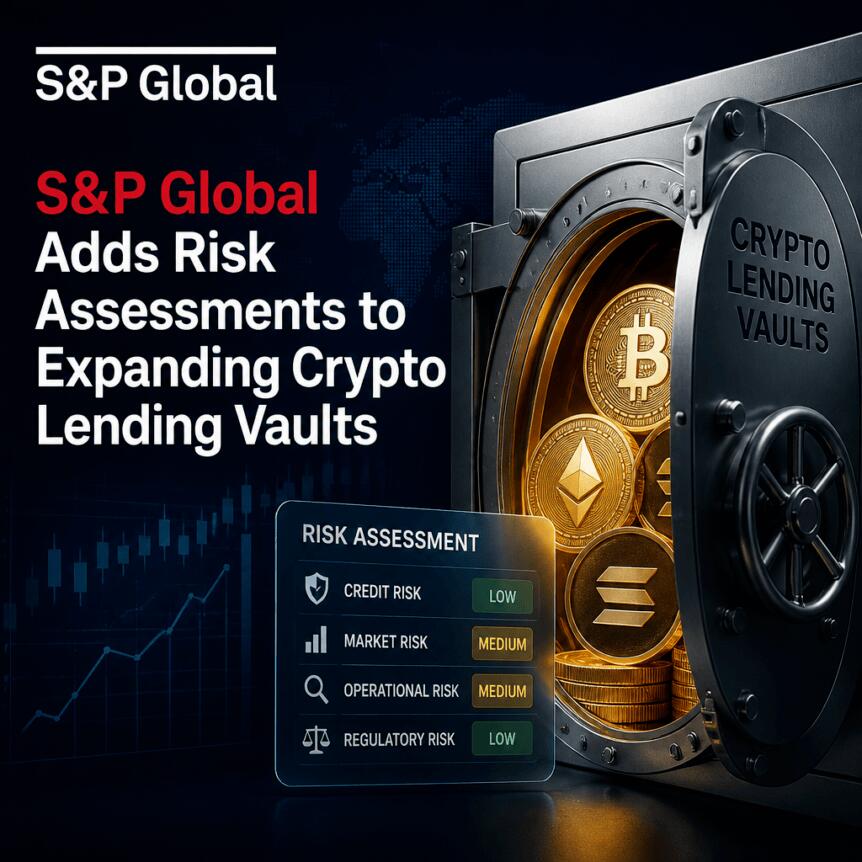
S&P Global Ratings has introduced a new risk assessment framework aimed at digital asset lending vaults, as packaged onchain yield products continue to attract mainstream attention from exchanges and wallets. The framework—described in an announcement released Monday—breaks vault risk down into six distinct categories and is designed to help market participants understand how and where losses to investors could materialize.
Importantly, S&P said the Vault Risk Assessment (VRA) is not a credit rating and does not evaluate prospective yields. Instead, it focuses on how vulnerable a lending vault’s structure and operations may be to different types of failure, from liquidity gaps to governance weaknesses.
Key takeaways
- S&P’s Vault Risk Assessment framework evaluates lending vaults across six risk areas, including credit quality, liquidity mismatch, curator risk, blockchain risk, protocol risk, and security & governance.
- The assessments are meant to estimate the risk of investor losses, not to determine creditworthiness or rate the yield a vault may generate.
- S&P says a strong score in one category cannot compensate for a significant weakness in another, reflecting the “many points of risk/failure” typical in vault structures.
- Vault lending is growing quickly: S&P cites deposits of about $10 billion in September, up from $1.5 billion two years earlier.
How S&P plans to assess vault risk
In its announcement, S&P Global Ratings outlined the logic behind the framework and what it intends to measure. The VRA approach is structured to examine multiple layers of risk that can affect the stability of digital asset lending vaults, where deposits are pooled and deployed according to predefined strategies.
According to the release, the framework covers:
- Portfolio credit quality risk
- Liquidity mismatch risk
- Curator risk
- Blockchain risk
- Protocol risk
- Vault security and governance risk
S&P emphasized that the assessments are intended to gauge potential loss risk to investors rather than provide yield forecasts. The company also stated that it is not designed to rank one risk category as inherently more important than the others.
Speaking with Cointelegraph, S&P Global Ratings analyst Lisa Schroeer underscored a key feature of the methodology: the overall assessment can be constrained by a material weakness in any single factor. “A material weakness in any factor can constrain the overall VRA,” Schroeer said. “A strong score in one factor does not offset a material weakness in another.” She added that the approach reflects a sector with “many points of risk/failure that can break.”
Why the framework matters for DeFi vault investors
Vault lending products package complex onchain mechanisms into something easier for retail users and institutions to allocate capital toward. Depositors typically receive tokens that represent their share of a vault’s assets and corresponding returns, while strategies are executed via smart contracts or, in some designs, through human or algorithmic curators.
That model can be attractive, but it also concentrates multiple risk vectors into a single product—risk that may not be obvious when comparing vaults purely by performance. S&P’s stated goal for the VRA framework is to increase transparency around those risk drivers so that decision-makers can allocate capital with better information.
Schroeer explained the objective this way: “The assessment aims to provide more transparency on the risks so that any entity can make more informed decisions when deciding how to allocate capital to DeFi vaults.”
For investors and allocators, this matters because vault outcomes can be affected by different failure modes that do not show up in historical yield alone. Liquidity mismatch, governance controls, protocol dependencies, and security posture can each shape whether withdrawals are possible under stress or whether assets can be impaired.
DeFi vault growth brings more scrutiny
S&P’s move arrives at a time when digital asset lending vaults are expanding beyond purely native DeFi communities. The company cited deposits in digital asset lending vaults of about $10 billion in September, rising from roughly $1.5 billion two years earlier, indicating rapid adoption of packaged yield strategies.
Across the industry, exchanges and wallet providers have increasingly launched vault-like products that route funds into lending or yield systems. Earlier this year, Wallet in Telegram introduced self-custodial BTC, ETH, and USDT vaults using infrastructure from Morpho, TAC, and Re7. In May, Kraken rolled out a Bitcoin yield vault powered by Veda and curated by Sentora, reporting $30 million from 4,000 wallets within its first 10 hours.
The approach has also expanded into tokenized financial products. In September, Kraken launched yield vaults tied to tokenized versions of Nvidia, the SPDR S&P 500, and Invesco QQQ ETFs, with Sentora managing strategies that lend the underlying assets through DeFi markets.
Yet as adoption grows, the sector’s risks remain prominent in real incidents. Earlier coverage cited the Term Finance incident in August, when an attacker exploited governance control of its Meta Vaults and resulted in an estimated $8.5 million loss. While that event is specific to one protocol and governance design, it illustrates the kind of failure that a vault-focused risk framework is meant to highlight: governance and control weaknesses can translate directly into investor losses.
Regulatory uncertainty still shapes vault design
Even with better disclosure tools, digital asset lending vaults remain in a regulatory gray area in the United States. Earlier in the year, SEC Commissioner Hester Peirce said some vaults and onchain lending products could fall under federal securities laws depending on how they are structured and operated.
Peirce’s view, as previously reported, suggested that vaults involving discretionary decisions—such as making choices about asset allocation, yield strategies, lending terms, or liquidation thresholds—could trigger securities, investment company, or investment adviser requirements.
That regulatory uncertainty matters for investors because it can influence how vault operators structure governance, decision-making authority, and the transparency of strategy management. It also means risk frameworks like S&P’s may become one input among several—alongside legal compliance and operational controls—when market participants assess how resilient a vault is under both technical stress and policy scrutiny.
S&P said it plans to publish its first Vault Risk Assessments in future announcements, though it did not specify which vaults will be evaluated first. Investors should watch for which categories of vaults S&P prioritizes, whether assessments highlight recurring governance and liquidity weaknesses, and how market participants respond to VRA disclosures as competition for yield products continues.