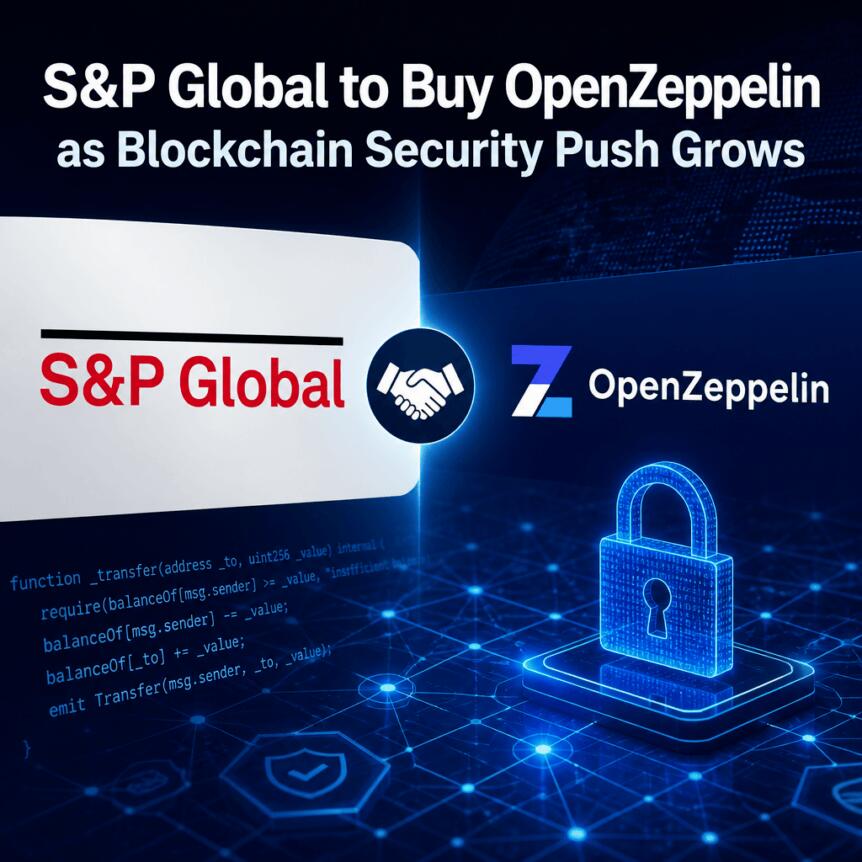
S&P Global has announced an agreement to acquire OpenZeppelin, a blockchain security firm known for its open-source smart contract tooling and security review services. The move is designed to broaden S&P Global’s ability to evaluate risk across the digital asset ecosystem, particularly where smart contracts and onchain infrastructure are central to financial activity.
The companies did not disclose financial terms. S&P Global said the transaction is still subject to customary closing conditions.
Key takeaways
- S&P Global’s planned acquisition of OpenZeppelin targets stronger smart contract and onchain technology risk assessment capabilities.
- The deal does not include publicly disclosed pricing; the agreement remains subject to closing conditions.
- OpenZeppelin’s software and contracts library will remain free and publicly maintained on GitHub.
- OpenZeppelin will operate as a separate business unit within S&P Global, with its CEO continuing in a leadership role.
- The acquisition follows S&P Global’s earlier investment activity in crypto market infrastructure, including a strategic investment in Kaiko.
Why the acquisition matters for digital asset risk
In a statement accompanying the announcement, S&P Global’s ratings president Yann Le Pallec said the company’s digital assets strategy focuses on bringing “trusted data, benchmarks and transparent risk assessment” as markets increasingly move onchain. According to the company, OpenZeppelin will deepen its ability to analyze smart contract and other onchain technology risks—an area that has become more important as tokenized products, stablecoin-based rails, and decentralized applications extend into regulated financial contexts.
Smart contract security is often treated as a technical specialty, but for mainstream finance players it can become part of broader credit and operational risk frameworks. By adding OpenZeppelin’s capabilities to its ratings and ecosystem development efforts, S&P Global is positioning itself to assess not only market-related factors, but also the underlying code-related risks that can affect asset safety and system reliability.
OpenZeppelin’s role and what will stay open-source
Founded in 2015, OpenZeppelin develops open-source smart contract software and performs security assessments for blockchain projects and financial institutions. The announcement states that OpenZeppelin’s smart contracts have supported more than $37 trillion in value transferred and that it has completed over 900 security engagements.
Importantly for developers and auditing teams, OpenZeppelin says its contracts library and other open-source applications will remain free and publicly maintained on GitHub. This helps address a common concern when security tooling moves under corporate ownership: whether developers will still be able to rely on transparent, community-auditable code.
Under the proposed structure, OpenZeppelin will operate as a separate S&P Global business unit. The company also stated that OpenZeppelin’s CEO, Demian Brener, will continue to lead and will report to Le Pallec.
How this fits S&P Global’s broader move into crypto infrastructure
S&P Global’s acquisition announcement comes shortly after the company took another step into crypto data infrastructure. Earlier this week, S&P Global led a strategic investment in Kaiko, the Paris-based crypto market data provider. The investment extended Kaiko’s Series B funding to $110 million as the firm expands data infrastructure for tokenized financial markets, according to the prior coverage referenced by Cointelegraph: S&P Global leads $110M Kaiko funding round as Wall Street eyes tokenized markets.
Taken together, the two moves suggest a consistent theme: building a stack around digital asset markets that includes both data and security/risk assessment. Kaiko focuses on market data and related infrastructure for crypto trading and tokenized environments, while OpenZeppelin’s value proposition centers on smart contract security and the evaluation of onchain technology risk.
That pairing may be particularly relevant as more financial products and services attempt to connect legacy risk frameworks with blockchain systems. Market data without security assurance can leave a gap, while security expertise without dependable market benchmarks and transparency can limit how effectively risk is communicated to investors and institutions.
What to watch before the deal closes
With no financial terms disclosed and the transaction still pending closing conditions, the near-term focus for market participants is likely to be procedural rather than operational. OpenZeppelin’s continued open-source maintenance on GitHub is already a meaningful signal for developers, but investors and institutions will also want to monitor how S&P Global integrates the security team into its ratings and ecosystem development processes after closing.
Readers should keep an eye on the final deal timeline and any updates on how OpenZeppelin’s security engagement workflow—especially for financial institutions and blockchain teams—will be maintained or expanded within S&P Global’s broader digital assets strategy.