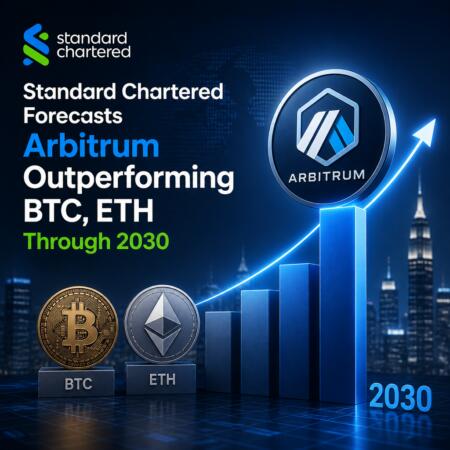
Standard Chartered’s Geoff Kendrick is making a pointed bet on Arbitrum’s long-term upside, arguing that the layer-2 network could become a standout beneficiary as traditional finance accelerates the shift toward onchain and tokenized assets.
In a note shared with Cointelegraph, Kendrick highlights Arbitrum’s revenue model as a key reason for optimism: the network receives 10% of net protocol revenue generated by companies building on it. He points to Robinhood Chain—developed by the online brokerage Robinhood—as an early, high-visibility example of that mechanism in action.
Key takeaways
- Standard Chartered expects Arbitrum’s revenue share (10% of net protocol revenue) to translate into stronger token economics.
- According to Kendrick, Robinhood Chain materially increased Arbitrum’s run-rate revenue after launching in July.
- Arbitrum revenue is projected to reach $5 million in September, the bank says—more than five times the pre-Robinhood level.
- Standard Chartered’s base case targets ARB potentially rising to as high as $10 by 2030, contingent on tokenization growth and competition.
- The bank flags slower-than-expected asset tokenization and competing layer-1/layer-2 ecosystems as the main risks.
Why Standard Chartered thinks Arbitrum’s token economics can expand
At the center of Standard Chartered’s outlook is the idea that Arbitrum is not only a destination for crypto-native users, but also an infrastructure layer for tokenization and onchain financial services. Kendrick’s argument ties network growth to economics that ultimately flow back to the system—and by extension, to the ARB token.
In the note, Kendrick emphasizes that Arbitrum receives 10% of net protocol revenue produced by companies building on the network. He also credits the arrival of Robinhood Chain with “materially” shifting Arbitrum’s economics. The comparison Kendrick makes is straightforward: at the current run rate, Arbitrum is expected to generate $5 million in revenue in September, which he says is more than five times its level prior to Robinhood Chain’s launch in July.
That framing matters for investors because it positions Arbitrum’s upside as more than speculative usage growth; it’s anchored to a revenue-share structure that could scale as new onchain products are deployed on its infrastructure.
Robinhood Chain as an early test case for the revenue model
Kendrick describes Robinhood Chain as the first major example of how traditional finance activity could influence Arbitrum’s economics. Earlier coverage from Cointelegraph noted Robinhood’s launch of an Ethereum layer-2 testnet aimed at tokenized assets.
Standard Chartered’s assessment suggests that the market may be underestimating the direct financial linkage between deployments on Arbitrum and the network’s protocol revenue intake. If the bank’s projections hold, that linkage could strengthen the case for ARB not just as a governance token, but as a proxy for the economics of Arbitrum’s expanding developer and enterprise footprint.
From revenue growth to ARB price targets—what’s bullish, what’s conditional
Building on the revenue outlook, Kendrick expects Arbitrum’s economics to support a steady rise in ARB over the coming years. Standard Chartered’s projection reaches as high as $10 by 2030. From current levels, Kendrick frames that outcome as roughly a 70-fold increase.
The bank also contrasts that trajectory with its projected returns for Bitcoin and Ether over the same period, suggesting that Arbitrum—under this scenario—could outperform major benchmark assets in risk-adjusted terms. Still, Kendrick’s note is explicit about uncertainties.
He flags two main risks to the ARB projection: a slower-than-expected pace of asset tokenization and increased competition from alternative blockchain networks. Those concerns are important because they go directly to the assumptions behind Arbitrum’s revenue expansion—namely, whether tokenization demand grows quickly enough and whether enterprises choose competing ecosystems for their layer-2 or tokenized-asset infrastructure.
Tokenized asset growth is the bigger bet
Standard Chartered’s thesis leans heavily on the broader market trend of tokenized real-world assets (RWAs). According to RWA.xyz data, the cumulative value of tokenized real-world assets is nearly $39 billion.
In its note, Kendrick reiterates the bank’s forecast that tokenized assets could reach $4 trillion by the end of 2028 as banks and asset managers bring more assets onchain. Under that pathway, Arbitrum is positioned as a potential beneficiary because it enables companies to build their own layer-2 networks while collecting a share of net protocol revenue generated by deployments.
Standard Chartered has previously connected tokenization expectations to other parts of the crypto ecosystem, citing the growth of tokenized RWAs as supportive of its bullish outlook for Chainlink and for the wider decentralized finance sector.
For readers, the next signals to watch are whether tokenization adoption accelerates faster than anticipated—and whether Arbitrum keeps attracting major deployments without losing share to rival ecosystems. Kendrick’s projections hinge on that pace, and any divergence could materially change the implied path from protocol revenue growth to ARB performance.