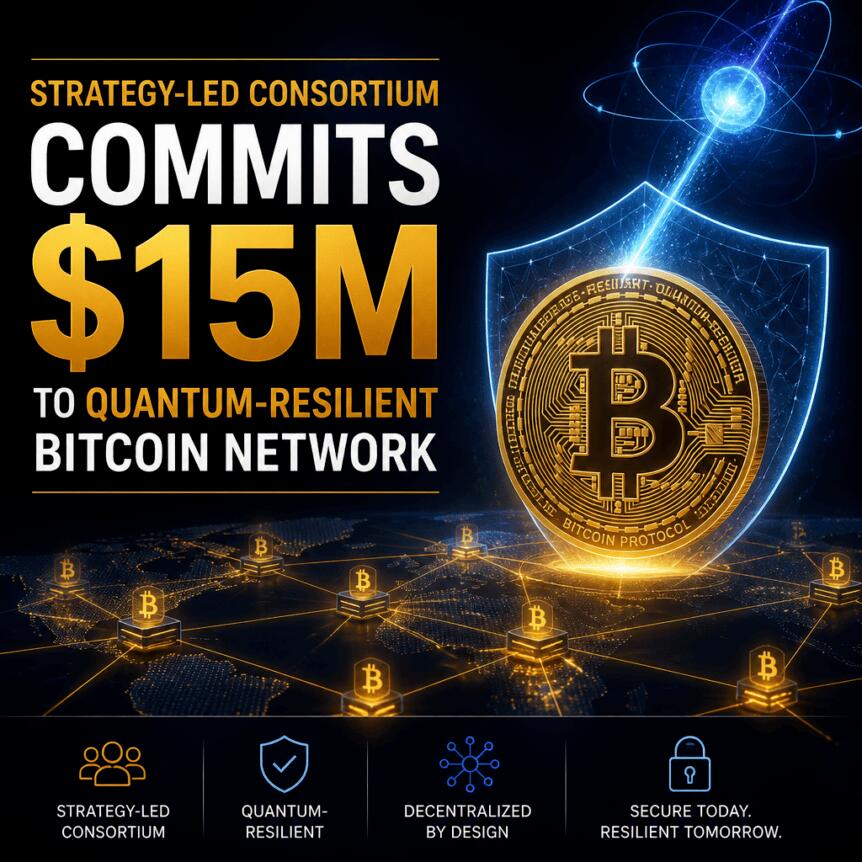
Strategy has unveiled the Bitcoin Security Consortium, a new coalition of financial institutions and Bitcoin-focused companies aimed at strengthening the network’s resilience against the potential impact of future quantum computing breakthroughs. In a Thursday announcement, Strategy said the group plans to commit an aggregate $15 million over the next three years toward developer efforts focused on “quantum security” work for Bitcoin.
The initiative adds formal institutional backing to a debate that has been running through the Bitcoin ecosystem for years: how and when (or whether) quantum computers could force a shift in how the network secures transactions. While experts disagree on timelines, the consortium’s creation signals that large players are preparing for long-horizon security challenges rather than waiting for consensus to harden.
Key takeaways
- Strategy says the consortium will fund $15 million over three years to support developer work on Bitcoin’s quantum security.
- Founding members include major asset managers and crypto firms such as BlackRock, Coinbase, Fidelity Digital Assets, and Blockstream.
- Day-to-day coordination will be handled by Mike Schmidt, a volunteer executive director of Brink, a non-profit focused on Bitcoin open-source developers.
- Galaxy pledged up to $5 million in separate grants earlier this week and formed a quantum-advisory council for research on migration solutions.
- Bitcoin’s quantum risk timeline remains contested, with industry estimates ranging from decades away to only a few years.
A consortium built around long-term quantum resilience
According to Strategy’s press release, the Bitcoin Security Consortium brings together financial institutions and Bitcoin companies with the shared goal of supporting work designed to protect the network against a potential quantum-security threat. Strategy’s stated focus is enabling developers to pursue approaches that would help Bitcoin adapt if quantum capabilities reach a threshold that undermines existing cryptographic assumptions.
The consortium’s plan is structured as a multi-year funding pool: $15 million in total commitments over the next three years. While the announcement does not detail specific deliverables or milestones, the emphasis on developer support indicates that the effort is intended to translate research and engineering into practical upgrades and implementation work over time.
Who’s involved, and how the work will be managed
The consortium names a broad set of founding participants. In addition to Strategy, the list includes Anchorage Digital, ARK Invest, BlackRock, Block, Blockstream, Coinbase, Fidelity Digital Assets, and Galaxy, among others.
Strategy also said the consortium’s daily operations will be coordinated by Mike Schmidt in a volunteer capacity. Schmidt is described as the executive director of Brink, a non-profit that supports Bitcoin open-source developers. The operational link to a developer-support organization matters because quantum security work is likely to require sustained engineering capacity—areas like cryptographic tooling, testing, and migration planning often take longer than headline news cycles.
Recent quantum-security funding momentum from Galaxy
In the same broader timeframe, Galaxy Digital separately announced support for quantum security-related development. Earlier coverage noted that Galaxy pledged up to $5 million in grants for developers working on Bitcoin’s quantum security and formed a council of quantum-advisory experts to study quantum-resistant migration options.
While the consortium and Galaxy’s grants are distinct efforts, together they reinforce a pattern: institutional capital is increasingly targeting the “preparation” phase—funding research and engineering before a crisis scenario forces rushed changes.
Disagreement on timelines, but shared urgency on preparedness
Bitcoin’s quantum risk debate is not purely academic. It influences how investors evaluate the durability of the network’s security model and how engineers prioritize long-term roadmap items.
Community concern is tempered by disagreements about when a meaningful quantum threat might arrive. Strategy’s announcement points to the ongoing debate rather than resolving it. In November 2025, Blockstream CEO Adam Back said Bitcoin faces no meaningful quantum threat for at least the next 20 to 40 years, according to earlier reporting from Cointelegraph in an article about the topic (“Bitcoin faces no meaningful quantum threat for at least the next 20 to 40 years,” Back said).
Other viewpoints compress that timeline dramatically. In April, investment manager Bernstein suggested Bitcoin has roughly three to five years to prepare for a post-quantum security upgrade, as discussed in Cointelegraph’s earlier coverage (Bernstein said Bitcoin has about three to five years to prepare).
This split matters because it shapes what “useful funding” looks like. In a decades-ahead scenario, the priority is gradual research and maintainable upgrades. In a short-window scenario, the emphasis shifts toward accelerating migration planning and ensuring that any transition path can be executed with high confidence.
Institutional backing signals confidence in core development capacity
Alongside the consortium announcement, Strategy’s partner ecosystem includes large traditional finance and crypto incumbents. BlackRock’s involvement, for example, is tied to its view that Bitcoin developers are doing critical work. As stated in the announcement, Robert Mitchnick, BlackRock’s global head of digital assets, said Bitcoin core developers do “incredibly important work” and that BlackRock is pleased to provide “significant additional funding” to support Bitcoin’s long-term security needs.
For investors and market participants, that message carries a specific implication: quantum security is being treated not as a speculative side project, but as a core infrastructure concern worthy of institutional budget lines. Even if the exact timing of quantum risk remains uncertain, multi-year funding structures are better aligned with how protocol security improvements actually get built—through testing, peer review, and coordinated development rather than emergency patching.
At the same time, it’s worth noting the consortium does not claim to settle the timeline question. Instead, it appears designed to fund the unknowns: research gaps, migration options, and implementation readiness that could become valuable under multiple scenarios.
Looking ahead, the key question is how the consortium and parallel grant efforts translate funding into concrete engineering outputs—such as migration research, candidate upgrade work, and developer tooling—while the broader community continues to debate quantum timelines. Observers should watch for updates that clarify priorities and measurable milestones over the consortium’s three-year window.