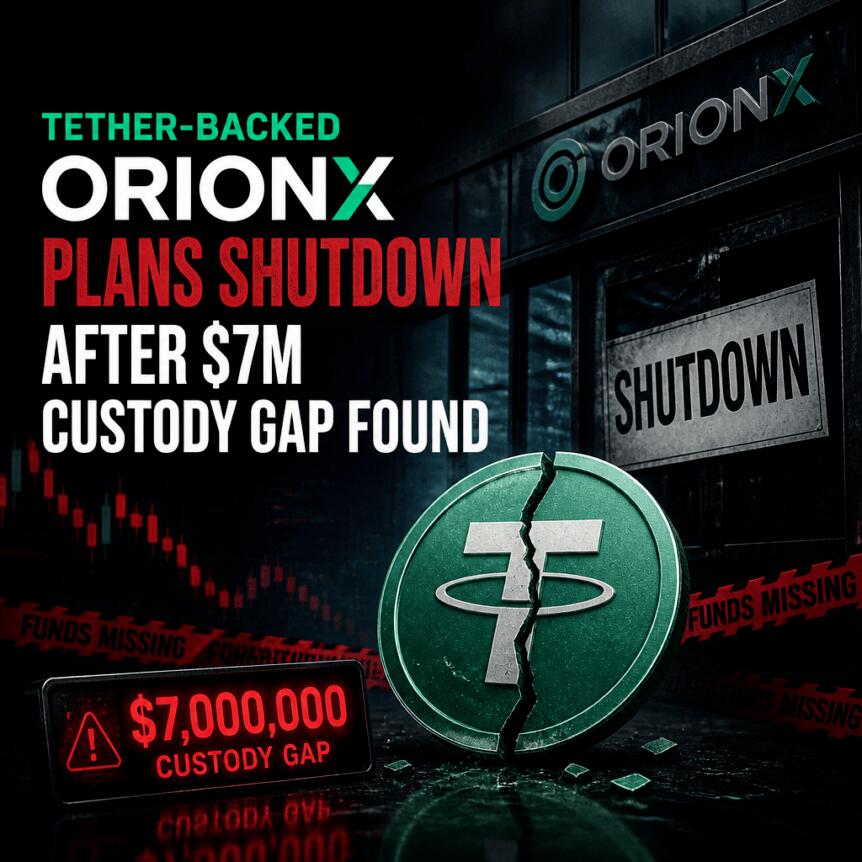
Orionx, a Chilean cryptocurrency exchange backed by Tether, is shutting down after discovering a custodial shortfall that Orionx says is tied to assets leaving wallets the exchange did not manage. The company said it has started a permanent closure process and is temporarily suspending withdrawals while it works to return funds to clients.
In a statement posted on X, Orionx said a forensic audit found that more than $7 million in custodial assets recorded in the exchange’s systems had moved to wallets not controlled by Orionx. “Our sole priority now is to return as much of our clients’ assets as possible,” the exchange said.
Key takeaways
- Orionx began permanent closure after a forensic review identified a custody mismatch involving over $7 million.
- Withdrawals are temporarily suspended as the exchange moves to return client assets.
- The company did not disclose when the transfers occurred, but a criminal complaint referenced activity between 2018 and 2021.
- Orionx accused former co-founders of alleged access to custody systems and denied wrongdoing by the accused parties.
- Tether led Orionx’s Series A in June 2025, underscoring how quickly the fallout can arrive even after major investment.
A custody mismatch triggers a shutdown
Orionx’s announcement did not provide specifics on the timing of the discrepancy or how the issue was first uncovered. However, the exchange said it initiated a permanent closure process following forensic findings that compared Orionx’s internal records with onchain data linked to its custody addresses.
The external audit, according to reporting cited in a criminal complaint, concluded that balances maintained in Orionx’s systems exceeded the assets actually held at the custody addresses for several cryptocurrencies, including Bitcoin (BTC), Ether (ETH), XRP, and Polygon (POL). Orionx said these funds had been moved to wallets it did not manage.
For customers, the practical impact is immediate: withdrawals are currently paused while Orionx attempts to reconcile records and return what it can. The lack of disclosed timing in the company’s public post also leaves outside observers with an incomplete picture of when customers may have been most exposed to the custody gap.
What Orionx says it found, and what remains unclear
According to Orionx and related reporting, the exchange’s review started in the context of compliance efforts tied to Chile’s Fintech Law. Orionx reportedly carried out an internal operational review in 2025 and brought in financial professionals, as described by La Tercera, citing the company’s criminal complaint.
La Tercera reported that on Aug. 27 Orionx’s chief operating officer, Thomas Mac Millan, identified what the complaint describes as a “significant mismatch” between what Orionx’s systems recorded and what was actually held in custody. After that internal review, Orionx commissioned a forensic audit that compared operational records against data verifiable onchain.
The criminal complaint, as reported, alleges that assets were transferred out of Orionx’s custody between 2018 and 2021, including to accounts on other crypto platforms. Despite that window being referenced in the complaint, Orionx’s public closure announcement did not confirm when the discrepancy occurred or whether all of the alleged transfers align with the full value of the shortfall ultimately identified.
Criminal complaint against former co-founders
Orionx said it filed a criminal complaint on Wednesday against former executives Roberto Zibert and Joaquín Díaz, both described as co-founders who allegedly had access to the custody systems. The company’s allegations center on transfers tied to wallets not controlled by Orionx.
La Tercera reported that the complaint alleges an account associated with Díaz received more than $1.5 million across 14 transfers. It also reported that another wallet allegedly received 187 Ether, more than 4.1 million USDt (USDT), and 200,000 USDC from Orionx.
Zibert and Díaz denied the accusations. According to La Cuarta, they said they never acted against customers’ interests and argued that the cause of the asset shortfall remains unclear. The denial adds a key uncertainty for clients and observers: even if custody mismatches are documented, disputes over responsibility and intent can complicate timelines for recovery and any eventual legal resolution.
Tether’s 2025 backing and the speed of disruption
Orionx was founded in Chile in 2017 and expanded from a retail crypto exchange into a broader platform offering crypto payment and financial services across Chile, Peru, Colombia, and Mexico.
In June 2025, Tether led Orionx’s Series A funding round, described in a Tether announcement that is now available only via an archived link. The exchange’s Series A was positioned by Tether as part of an effort to expand digital-asset adoption in Latin America.
As of publication, Cointelegraph reported that it contacted both Tether and Orionx for comment but had not received a response.
The episode highlights a broader reality for investors and users: even where a major stablecoin issuer participates in funding, due diligence on operational custody processes must remain a continuous effort rather than a one-time milestone. Orionx’s shutdown, coming only about a year after the Series A, also raises questions about how custody controls evolve after an investment round and what auditing mechanisms—internal or external—are in place during periods of growth.
For clients, the next steps will likely hinge on how Orionx conducts reconciliations and whether it can identify recoverable assets tied to custody mismatches. Readers should watch for updates on the scope of the recovered funds, the timing of the alleged transfers, and how the criminal case progresses—especially given the accused parties’ claim that the root cause of the shortfall is not established.