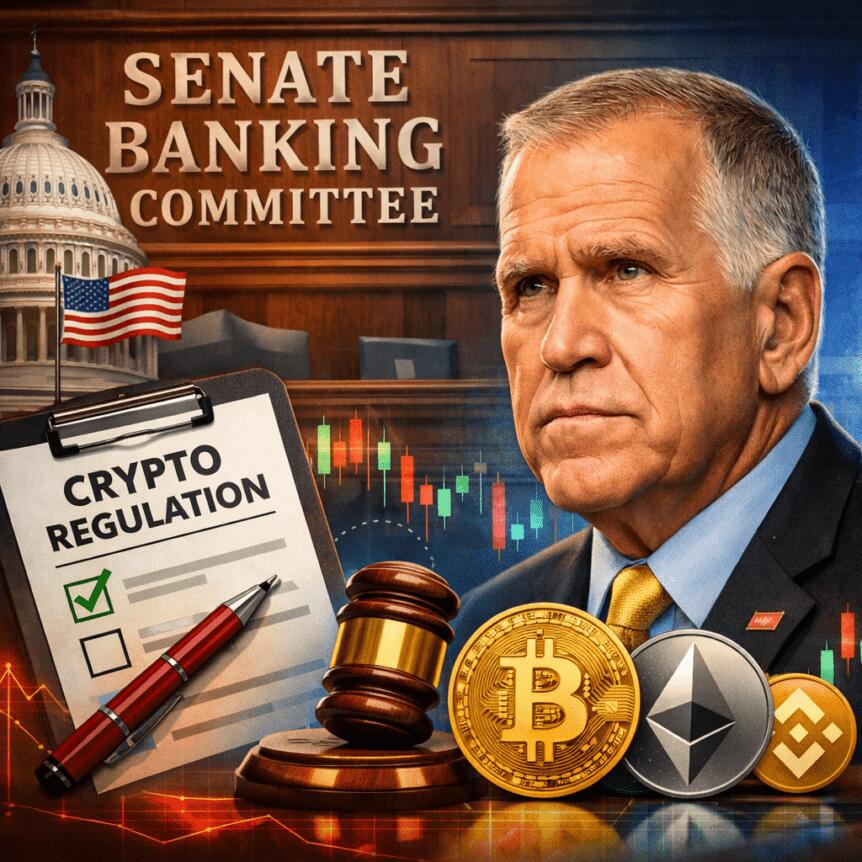
The stalled crypto market structure legislation in the United States is edging toward a mark-up, with Senator Thom Tillis signaling that he will push the Senate Banking Committee to schedule a formal session on the bill when lawmakers return to Washington. Tillis, a leading Republican on the panel, told reporters that the committee should move forward with a markup to prevent further protraction, arguing that the text has progressed sufficiently to merit a formal vote.
The legislation would define how the U.S.’ two flagship market regulators — the Securities and Exchange Commission and the Commodity Futures Trading Commission — oversee crypto markets. The House has already passed its version, the CLARITY Act, but the Senate version has faced delays as negotiators and stakeholders sought to refine provisions. The path forward gained complexity after the committee postponed a markup in January when Coinbase pulled its support over a stipulation banning crypto exchanges from paying yields on stablecoins.
Thom Tillis speaking with reporters this week on the legislative process.
The discussions unfold amid a broader policy dialogue on how to regulate digital assets in a manner consistent with traditional financial markets while addressing innovation, consumer protection, and anti‑money‑laundering objectives. The Senate bill’s fate hinges on several contentious provisions, including the treatment of stablecoins, the rights of software developers, and the ethics framework governing government officials’ engagement with crypto policies. Tillis has suggested that the committee should advance the bill unless meaningful changes are obstructing the process, while indicating willingness to incorporate additional good-faith concessions from stakeholders.
According to Cointelegraph, Tillis indicated that he intends to publicly release the legislative text at least four days before the markup to give crypto and banking participants a preview and meaningful time to prepare comments and compliance adjustments. He stressed that early visibility would help inform a constructive, transparent negotiation process as lawmakers weigh the balance between oversight, innovation, and enforcement.
Beyond the procedural questions, the bill contains a suite of provisions that have drawn intense lobbying from both sides of the aisle and from industry groups. One central flashpoint is a clause related to stablecoins and yield payments. Some industry participants argue that prohibiting third parties from paying yield on stablecoins closes a perceived loophole in the GENIUS Act, which already restricts stablecoin issuers from paying yield. Bank lobbyists have pressed to retain portions of this provision, framing it as a necessary safeguard against yield-based incentives that could complicate consumer protections and market integrity.
Key takeaways
- The Senate Banking Committee plans to schedule a markup on the stalled crypto market structure bill upon lawmakers’ return, signaling renewed momentum toward finalizing legislation that would clarify regulator oversight for crypto markets.
- The House-passed CLARITY Act contrasts with the Senate version; the latter remains under negotiation, with progress attributed to recent deliberations but lingering points of contention.
- A January markup delay followed Coinbase’s withdrawal of support over a stablecoin yield provision, highlighting how issuer-liability and yield practices influence legislative support and stakeholder engagement.
- Ethics language and protections for software developers are high-priority items; lawmakers have pressed to ensure that provisions governing officials’ use and promotion of crypto are robust before passage.
- Law enforcement considerations are under scrutiny, with reports that a provision protecting developers from prosecution for illicit activity on platforms requires further refinement, a point of debate among legislators and industry participants.
Legislative trajectory and timing
The core aim of the Senate bill is to delineate how the United States will regulate crypto markets by assigning authority and responsibilities to the country’s main financial-market regulators. While the House version, the CLARITY Act, has cleared the chamber, the Senate counterpart has struggled with a series of edits that reflect ongoing negotiations between lawmakers and industry stakeholders. The January postponement of the markup, prompted by Coinbase’s decision to withdraw its backing, underscored the sensitivity of some provisions to corporate risk assessments and compliance considerations.
Senator Tillis indicated that progress has been made and that the committee will consider moving forward with a markup when the Senate reconvenes in May. He signaled a preference for advancing the bill rather than allowing it to languish as a function of ongoing negotiation on a few disputed points. He also emphasized the importance of timely disclosure of the legislative text to enable stakeholders to review. The goal, as described by Tillis, is to ensure the process remains productive and capable of delivering a final, enforceable framework that can withstand regulatory scrutiny.
In parallel, the policy conversation includes ethics provisions related to how government officials engage with crypto policy and the need for heightened governance standards to prevent conflicts of interest or improper use of regulatory influence. Tillis aligned with a broader Democratic call for ethics language, arguing that the bill must include robust restrictions on official conduct before it can advance, else he would oppose it.
There is also attention on how the bill addresses law enforcement concerns around potential protections for developers. Reports have indicated that this area remains unsettled, with lawmakers seeking a balance between encouraging innovation in software development and preserving accountability for illicit activity conducted on crypto platforms. Senator Cynthia Lummis has been cited as making progress on this provision, but the ultimate language remains a subject of intense negotiation.
Looking ahead, Tillis’s stated plan to publish the text several days before markup aims to facilitate constructive scrutiny from crypto firms, exchanges, and financial institutions that would be subject to the final framework. The timing could be critical for compliance teams to align internal risk controls, AML/KYC processes, and licensing considerations with any policy shifts emerging from the markup process.
Politico reported that lawmakers will need to address law enforcement concerns surrounding the provision that would shield developers from prosecution for illegal activity carried out on their platforms. This reflects the broader tension between fostering technological innovation and ensuring accountable liability frameworks — a central question for regulators as they seek to reduce systemic risk while preserving the incentives for responsible innovation. Tillis has described himself as generally supportive of Lummis’s progress on this area, signaling a pragmatic approach to achieving consensus without compromising core governance objectives.
Contested provisions: stablecoins, ethics, and enforcement
At the heart of the contention is a tension between avoiding regulatory gaps that could permit opaque or risky activity and preserving a conducive environment for legitimate innovation in digital assets and related technologies. The GENIUS Act’s approach to stablecoin yields has become a focal point for both supporters and skeptics of the current drafting. Proponents of allowing yield connections argue that comprehensive clarity about payment models and custodial arrangements is essential for market integrity and consumer protection, while opponents contend that yield-bearing schemes present potential misalignment with traditional securities or banking laws. The resulting debate has direct implications for stablecoin issuers, exchanges, and financial partners engaged in cross-border settlements and liquidity provisioning.
On ethics, the bill’s proposed language would set boundaries around the use and promotion of crypto within official capacities, a topic that gained prominence as lawmakers sought to ensure that policy development remains insulated from improper influence. The insistence on explicit ethics provisions reflects a broader regulatory trend toward heightened governance standards in financial technology policy making, which could influence how agencies collaborate with private actors and how enforcement priorities are framed.
Enforcement considerations, particularly around protections for software developers, raise important questions about liability and accountability in a rapidly evolving ecosystem. While supporters argue for a form of safe harbor that accelerates innovation and clarifies developer responsibilities, critics warn that insufficient safeguards could impede enforcement against illicit activity or obscure gatekeeping signals in high-risk segments of the market. The evolving text seeks a balance that would satisfy consumer protection and anti‑fraud objectives without stifling legitimate development and deployment of crypto software.
Regulatory implications for institutions and markets
For exchanges, wallets, and other crypto market participants, a Senate-passed framework would provide much-needed regulatory clarity on jurisdiction and supervisory expectations. The prospect of formal oversight by both the SEC and CFTC could influence licensing regimes, registration requirements, and ongoing compliance burdens. Institutions that operate cross-border activities would also need to assess how the U.S. framework interacts with international standards and regional rules such as the European Union’s MiCA regime, highlighting the importance of harmonization in areas like disclosure, custody, and consumer protections.
From a compliance perspective, the anticipated text release four days before markup would be a critical milestone. Firms would use that window to assess the impact on AML/KYC workflows, reporting requirements, and governance procedures. The policy alignment with anti‑money‑laundering rules and financing of terrorism controls would influence how exchanges handle customer due diligence, suspicious activity monitoring, and cross-border transaction screening. In parallel, licensing and oversight expectations could affect banking relationships and access to payment rails, given ongoing regulatory scrutiny over crypto exposure in mainstream financial systems.
For policymakers, the bill signals a deliberate attempt to define a stable coordination between innovation incentives and market safeguards. The interlocking debates over stablecoin economics, developer protections, and ethics language illustrate how regulatory design choices can shape the pace of industry growth, the resilience of market infrastructure, and the ability of the United States to compete globally in crypto finance while maintaining robust risk controls. The degree to which the bill can reconcile these objectives will influence not only domestic market structure but also cross-border policy conversations and the trajectory of crypto-enabled financial services.
As the majority of these issues remain under negotiation, observers should monitor the committee’s calendar for a markup date, the timing of the public release of the legislative text, and the reactions from major industry groups and financial institutions. The outcome will likely set the tone for U.S. crypto regulation in the near term and could shape regulatory expectations for exchanges, stablecoin issuers, and developers operating within the ecosystem.
In sum, the Senate’s approach to the crypto market structure bill reflects a careful attempt to codify regulatory oversight while preserving the capacity for innovation. The coming weeks will reveal whether negotiators can bridge divergences on yield provisions, enforcement protections for developers, and ethics standards, paving the way for a vote that could redefine the regulatory landscape for digital assets in the United States.
Closing perspective: The next phase hinges on the markup schedule, the availability of a finalized text for review, and the capacity of lawmakers to reconcile core policy tensions. Stakeholders should stay attuned to committee proceedings and statements from key legislators, as the balance between enforcement, innovation, and consumer protection will continue to shape the trajectory of crypto regulation in the United States.