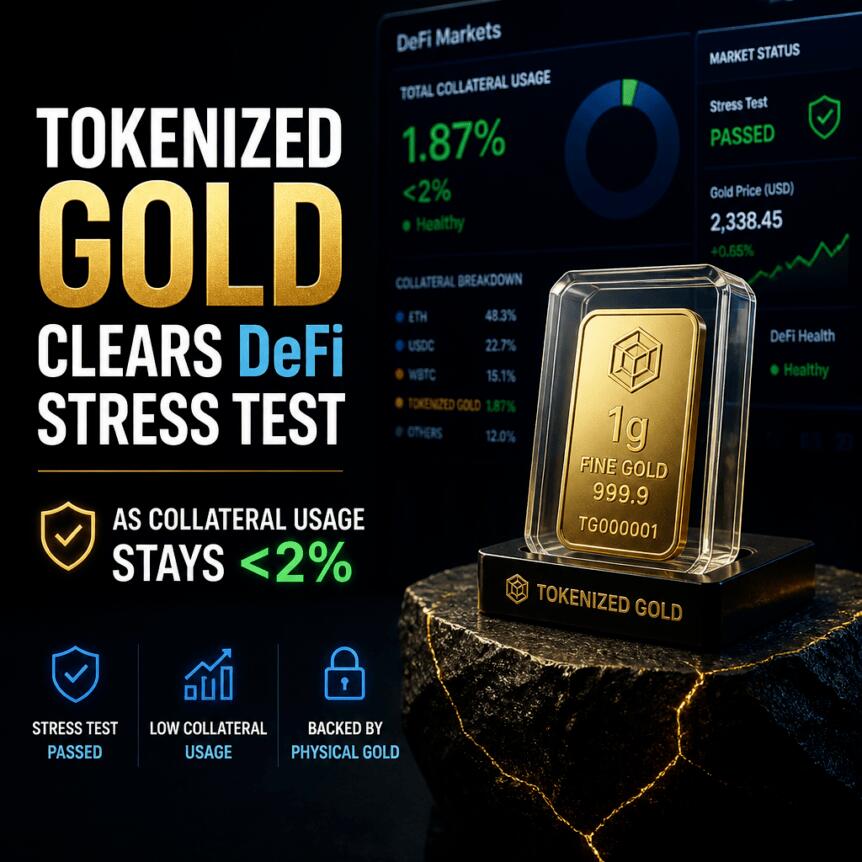
Tokenized gold is getting a burst of investor attention this year, tracking a surge in physical bullion demand as gold prices have repeatedly set fresh highs. But a new report from RedStone suggests that—despite improving market conditions—only a small portion of tokenized gold is actually being used in decentralized finance.
RedStone data points to a widening gap between market interest in tokenized bullion and its deployment in DeFi lending. In the first quarter, tokenized gold spot trading volume reached $90.7 billion as gold futures climbed above $5,600 per troy ounce. Yet just $63 million worth of tokenized gold—via Tether Gold (XAUT) and PAX Gold (PAXG)—is currently posted as collateral on Aave v3 and Morpho, according to RedStone. That collateral usage represents roughly 1.5% of the tokens’ combined $4.2 billion market capitalization.
Key takeaways
- Tokenized gold saw high activity in spot markets, with $90.7 billion in Q1 trading volume.
- Despite that liquidity, DeFi adoption remains thin: only about $63 million in XAUT and PAXG is used on Aave v3 and Morpho.
- RedStone highlights a real stress test: Aave processed its largest cluster of XAUT liquidations on March 23 without disruption during a sharp gold sell-off.
- Gold has been under pressure from expectations of higher US interest rates, which can reduce demand for non-yielding assets.
A resilient collateral asset, but with limited deployment
RedStone’s report frames tokenized gold as “battle-tested” in DeFi collateral, even while showing that the broader adoption story is still early. The core issue is not whether tokenized bullion can hold up during market volatility—it can—but whether enough capital is being placed into decentralized lending markets to make tokenized gold a meaningful on-chain primitive.
To ground that claim, RedStone points to Aave’s performance during a major sell-off. On March 23, Aave processed its largest cluster of XAUT liquidations without disruption as gold prices moved sharply lower. RedStone presents this as evidence that tokenized bullion can function reliably as DeFi collateral when markets turn fast.
That liquidation episode landed after gold dropped around 10% over the prior week—its worst weekly performance in more than four decades. Earlier coverage linked the sell-off to what JPMorgan precious metals strategist Greg Shearer called an “extremely brutal flush,” reflecting heightened risk-off behavior and fast repricing in commodity markets.
Why DeFi use is lagging: the market is there, collateral is not
RedStone’s numbers point to a mismatch between trading interest and productive DeFi usage. Tokenized gold spot volume suggests there is plenty of demand to buy, sell, and exchange tokenized bullion exposure. But the amount actually locked or committed to decentralized lending stays relatively small—about $63 million across Aave v3 and Morpho.
That matters because lending protocols are where tokenized real-world assets can translate from “tradable exposure” into “composable financial infrastructure.” If only a tiny fraction of the token supply is being used as collateral, DeFi’s ability to scale tokenized assets—especially during periods of high volatility—remains constrained by capital deployment rather than technical viability.
RedStone also situates the findings within a broader RWA expansion. Gold is one component of a market that includes private credit and tokenized US Treasurys paired with equity-related structures. In June, Token Terminal reported the sector had topped $43 billion in value, underlining that tokenization momentum is visible beyond gold alone.
Gold’s macro headwind could cut both ways
Even though the DeFi collateral test showed operational resilience, the report arrives during a period when gold itself has been under pressure. Since peaking in January, gold futures have fallen more than 26%. RedStone attributes the decline to expectations of higher US interest rates—an environment that tends to weigh on non-yielding assets like precious metals.
For tokenized gold, that matters for two reasons. First, falling prices can increase liquidation activity in lending protocols; the March 23 event shows that this process can occur without disruption. Second, if rates remain elevated, investor demand for bullion exposure may fluctuate, influencing both the spot trading volumes and the willingness of lenders/borrowers to engage with tokenized collateral strategies.
At the same time, RedStone’s reporting implies that DeFi adoption hasn’t accelerated in proportion to the broader “tokenized gold” trading narrative. If gold volatility persists, investors may demand more robust collateral mechanisms—but the current deployment levels suggest that the industry still has work to do to turn resilience into sustained utilization.
Centralized exchanges may be moving faster than on-chain lending
While RedStone’s focus is on DeFi collateral usage, the report’s broader framing highlights a contrast: centralized platforms are increasingly integrating tokenized assets as they try to bridge traditional finance and digital assets. According to a CoinGecko report referenced in the article, an emerging “crypto TradFi” market had grown to $6.6 billion as of June.
This difference in pace helps explain the adoption gap. Tokenized gold can be actively traded on centralized exchanges without necessarily being locked into on-chain lending. Until more liquidity and integrations flow directly into decentralized collateral ecosystems, tokenized real-world assets may remain more of a trading product than a primary DeFi building block.
As the tokenized RWA market expands—both on-chain and off-chain—readers should watch whether DeFi collateral usage of XAUT and PAXG rises meaningfully beyond current levels. The March 23 liquidation test suggests protocols can handle stress, but the next key question is whether capital continues to move from spot trading activity into sustained lending and other decentralized use cases.