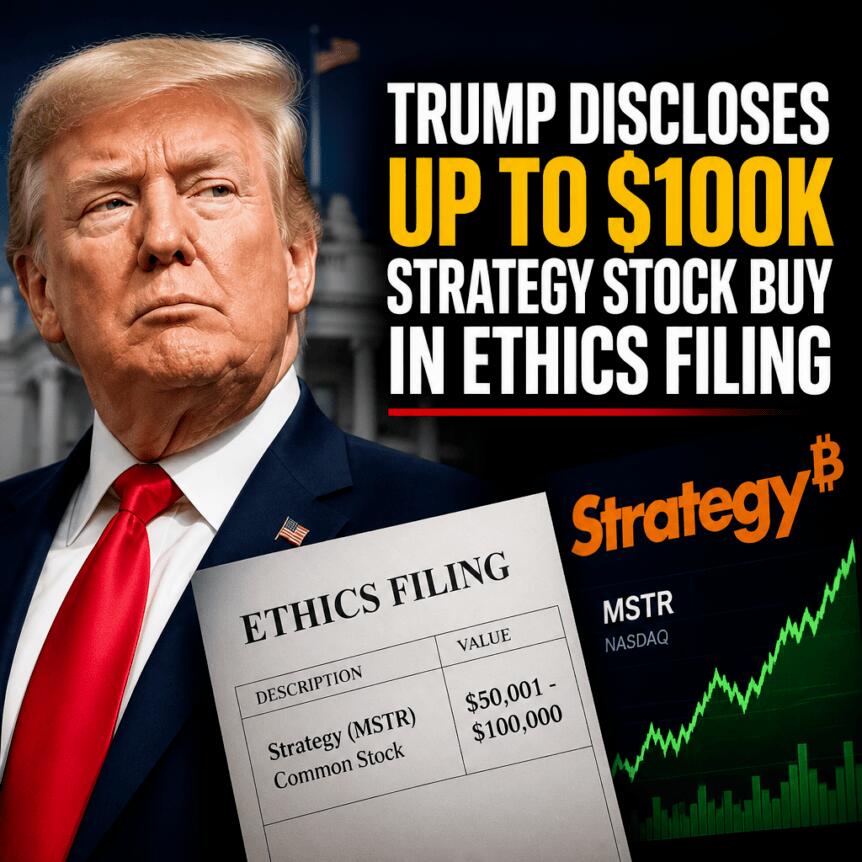
President Donald Trump disclosed that he bought between $50,001 and $100,000 worth of Strategy (Strategy, formerly MicroStrategy) shares in late July, according to a U.S. Office of Government Ethics filing released Tuesday. The disclosure also references earlier purchases of the bitcoin-linked software company, as well as other crypto-adjacent transactions.
In the same disclosure, Trump reported a smaller Strategy buy three days earlier and described additional activity tied to several other crypto-related firms, including stock trades involving Coinbase and sales of bitcoin miner holdings including MARA Holdings and CleanSpark. The Strategy purchase dated July 27 is the largest bitcoin-exposure transaction identified in the document.
Key takeaways
- Trump disclosed a $50,001–$100,000 Strategy share purchase on July 27, following a $1,001–$15,000 buy on July 24.
- Strategy remains one of the most widely followed public corporate bitcoin proxies, holding 846,000 BTC according to BitcoinTreasuries.net data referenced in the filing coverage.
- The filings report transaction values in ranges, not an ongoing share count, so remaining Strategy holdings cannot be directly determined.
- White House guidance to CNBC says Trump’s portfolio is managed independently by third-party financial institutions without input from Trump or his family.
- The disclosures land as U.S. regulators and lawmakers continue working through crypto policy issues amid stalled comprehensive market-structure legislation.
What the disclosure says about Strategy shares
According to the U.S. Office of Government Ethics filing linked in the report, Trump’s July trades included a purchase of Strategy shares valued between $50,001 and $100,000 on July 27, after buying between $1,001 and $15,000 worth on July 24. The document also indicates earlier Strategy activity, including another $50,001–$100,000 purchase disclosed previously on Feb. 12, as tracked by BitcoinTreasuries.net.
While the filings show multiple transactions over time, they do not provide a running total of shares held. Instead, reported activity is expressed in value brackets, meaning it is not possible to calculate how many Strategy shares—if any—remain in Trump’s portfolio based solely on the disclosures.
Strategy is described as the world’s largest publicly traded corporate bitcoin holder, with 846,000 BTC reported by BitcoinTreasuries.net. That fact matters for readers because Strategy’s stock is often treated by markets as a proxy for corporate bitcoin exposure—albeit with equity market dynamics layered on top of bitcoin price movement.
Broader portfolio trades and independent management
The Strategy purchase is presented in the context of a wider set of portfolio transactions reported for July. The filing indicates sales of between $5 million and $25 million each of Microsoft and Amazon stock on July 20, alongside several additional buys and sells in the $1 million to $5 million range.
On Tuesday, the White House told CNBC that Trump’s stock and bond portfolio is independently managed by third-party financial institutions and that Trump or his family do not provide input into those investment decisions. That characterization is important for interpreting the disclosure: it suggests investors should treat the reported trades as part of a broader managed portfolio process, rather than assuming a single direct investment thesis or immediate reaction to bitcoin market moves.
For traders, the key question is how to connect the disclosure to market pricing. The report notes that Strategy shares have rallied sharply in recent sessions—nearly 30% over the past five trading days and about 37% over the past month according to Yahoo Finance data—highlighting that the stock’s performance has been strong regardless of whether a specific public figure disclosed ownership.
Crypto policy backdrop: stalled legislation, active regulators
Trump’s Strategy disclosure arrives amid continued U.S. government activity around digital-asset regulation—even as comprehensive market structure legislation remains stuck in Congress. The report states that the Senate failed to advance the CLARITY Act on Sept. 15, but that regulators have proceeded using existing authorities.
Two days after the CLARITY Act cloture vote failed, the Securities and Exchange Commission (SEC) cleared limited onchain trading of tokenized U.S. stocks under a temporary exemption, according to coverage linked in the report. In parallel, the Commodity Futures Trading Commission (CFTC) eased registration requirements for certain software providers offering access to regulated derivatives markets, as described in the cited coverage.
Separately, the CFTC also sent a broader crypto market rulemaking initiative to the White House for review on Sept. 17. As characterized in the report, the initiative—titled “Regulation Crypto Asset Transactions and Regulation Crypto Asset Markets”—is still in preliminary stages and has not yet become a formal proposal.
For market participants, this regulatory sequencing matters. When omnibus legislation stalls, targeted exemptions and rulemaking under current legal frameworks can still change how tokenized assets, exchange functions, and market-access technology are regulated. Investors watching disclosure stories around publicly traded bitcoin proxies often should also track these regulatory moves, because they can shift demand for crypto-related products and the risk profile of platforms serving those markets.
Bitcoin policy efforts extend beyond markets
The report also ties the broader political context to bitcoin itself. It notes that the House Financial Services Committee voted 28–21 to advance legislation that would codify a “Strategic Bitcoin Reserve” into law and require bitcoin placed in the reserve to be held for at least 20 years, citing earlier coverage linked in the report.
In addition, the report says the U.S. government currently holds an estimated 324,527 BTC, referencing Arkham Intelligence data. While such estimates can vary by methodology, the figure underscores why bitcoin exposure is increasingly treated as a policy and balance-sheet topic—not only a market-trading theme.
Against that backdrop, disclosures involving corporate bitcoin holders like Strategy can quickly become part of the political narrative around digital assets, even when the disclosed transaction itself is comparatively small relative to broader holdings and portfolio trades.
As more filings surface, readers may want to watch two things next: whether Trump’s disclosed crypto-adjacent trades continue to shift over subsequent quarters, and whether the regulatory groundwork laid after the CLARITY Act setback translates into formal proposals that meaningfully affect tokenized markets and crypto derivatives access.