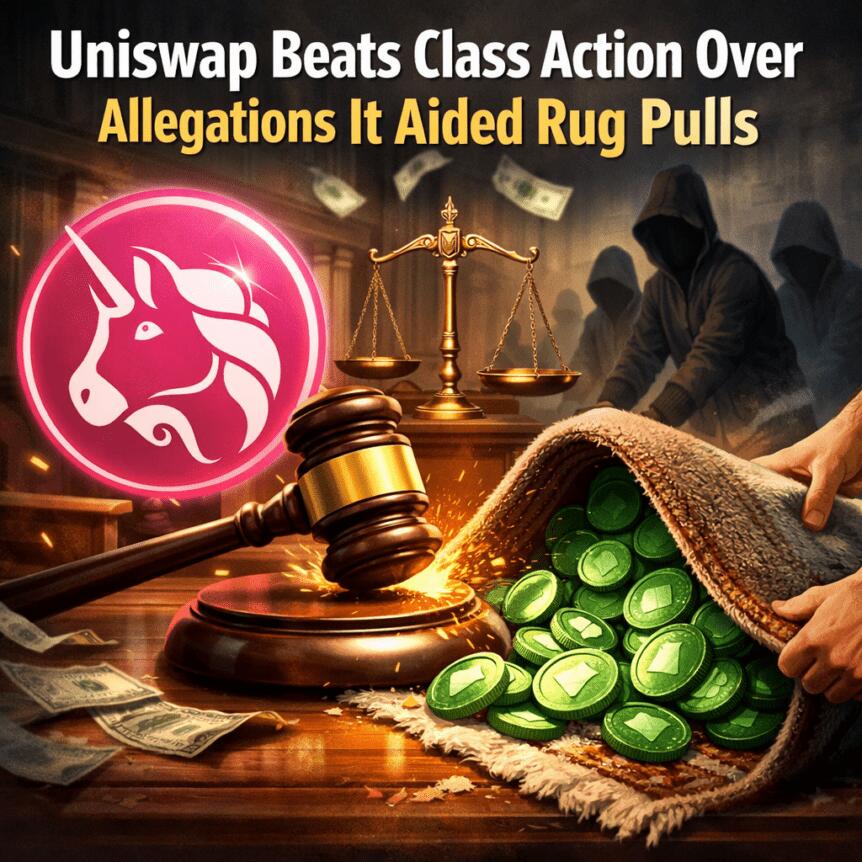
Uniswap Labs and its founder Hayden Adams secured a decisive legal victory in a four-year dispute that challenged the decentralized exchange’s role in allegedly enabling scam tokens. A Manhattan federal judge, Katherine Polk Failla, dismissed the class-action suit against Uniswap with prejudice, effectively ending the case and signaling that platform operators should not be held liable for the misdeeds of unaffiliated third-party token issuers. The plaintiffs had pursued what they described as state-level consumer-protection claims, arguing that Uniswap’s open marketplace facilitated rug pulls and pump-and-dump schemes. The ruling arrives after the plaintiffs amended their complaint to sharpen their theories around consumer protection and DeFi conduct.
The case first landed in federal court in April 2022. After an initial dismissal in August 2023, the appellate process did not overturn the lower court’s view, setting the stage for the latest decision. Adams reacted to the ruling on social media, deeming it a “good, sensible outcome” and portraying it as a potential legal precedent for the open-source, permissionless design that underpins many DeFi projects. The court’s written opinion underscores a central theme in the legal treatment of decentralized finance: platform operators that provide the infrastructure, without actively participating in fraudulent activity, may not be deemed to have aided fraud simply by hosting services used by others.
In her opinion, Judge Failla rejected the core theory advanced by the class representatives: that Uniswap’s platform knowledgeably facilitated fraud or substantially assisted those responsible for it. The judge stressed that the plaintiffs failed to allege that Uniswap “had knowledge of the fraud and substantially assisted in its commission.” Merely creating an environment where unlawful activity could occur does not equate to affirmative participation or control over the wrongdoing. The decision aligns with a line of reasoning that emphasizes the distinction between providing a service that is agnostic to misuse and actively enabling or enabling criminal behavior.
The court’s formal ruling came after the plaintiffs, led by Nessa Risley, continued to pursue a theory that framed Uniswap as a conduit for consumer harm, despite the platform’s status as an open, on-chain exchange protocol. The complaint tied alleged misdeeds to the broader ecosystem of projects launched on Uniswap, but Failla’s order makes clear that the presence of scammers in a marketplace does not automatically impose liability on the platform operator. As the judge wrote, “No matter how they try to dress up their allegations, Plaintiffs are basically alleging that Defendants substantially assisted fraud by providing ordinary services that anyone could use for lawful purposes, but that some used for unlawful purposes.”
The decision also touches a longstanding tension in crypto law: how to apportion responsibility in an ecosystem built on code that anyone can inspect and deploy. Adams, for his part, has framed the ruling as a protective precedent for developers who contribute to open-source smart contracts. In a platform-agnostic sense, the ruling delineates boundaries between hosting infrastructure and actively enabling illicit activities. It remains to be seen how other courts will interpret similar claims against different DeFi protocols or open-source projects, but Failla’s order provides a reference point for future cases that hinge on the line between standard platform services and substantive assistance to fraud.
While the litigation ended for Uniswap in the current forum, the episode sits within a broader debate about consumer protection in crypto markets and the accountability of developers and platforms. The plaintiffs had also named venture financiers Paradigm, Andreessen Horowitz, and Union Square Ventures as defendants in the original complaint, highlighting the ecosystem’s interconnected web of developers, capital providers, and marketplaces. The court’s analysis, however, centers on Uniswap’s role as a protocol provider and its duties, or lack thereof, to police every token listed on its decentralized exchange. The opinion avoids endorsing a blanket shield for all DeFi activity but reinforces the principle that liability is not triggered by mere platform exposure to potential misuse.
The backdrop to this ruling includes ongoing regulatory and legal scrutiny over crypto markets, especially around how consumer protections apply to decentralized technologies. A separate line of legal and regulatory developments continues to evolve as courts weigh questions of oversight, responsibility, and the allocation of risk among platform operators, project issuers, and investors. While the decision neither endorses a laissez-faire approach nor endorses unbridled liability for developers, it does clarify that the legal standard for “substantial assistance” is nuanced and demands concrete demonstrations of active participation rather than mere facilitation by offering a widely accessible tool.
As Adams noted in his post, the ruling represents a boundary-setting moment for the open-source community behind DeFi. The sentiment among developers and investors is that the decision preserves the ability to innovate without being automatically tethered to criminal activity that occurs off-chain and outside the direct control of protocol builders. Yet, the judge’s explicit insistence that plaintiffs must establish knowledge and substantial assistance if they claim fraud implies that future lawsuits may still test how courts interpret the duties of platform operators in relation to on-chain activity and off-chain outcomes. The line remains nuanced, and the possibility of further litigation in related cases or different jurisdictions persists.
Why it matters
For users and builders, the ruling offers a clearer framing of risk and responsibility within DeFi ecosystems. It emphasizes that the mere existence of a marketplace where bad actors can operate does not automatically pin liability on the platform. This distinction matters for innovation, as developers can continue to contribute open-source code and deploy smart contracts with confidence that liability will not be presumed merely because someone else exploited the system for wrongdoing. At the same time, the decision preserves a path for consumer-protection claims under specific contexts, should plaintiffs be able to demonstrate concrete knowledge or affirmative assistance by a platform.
From a market perspective, the dismissal reduces near-term litigation risk for open-source DeFi protocols and their funders, while underscoring the importance of sound security practices, transparent governance, and robust auditing of smart contracts. It signals that regulators and courts may demand careful consideration of the line between providing a generic service and actively enabling unlawful conduct. In practice, that means protocol teams may continue to rely on established best practices—audits, formal verification, transparent disclosures, and clear user protections—without fearing automatic liability for every token or project launched with their tooling.
Yet the case also demonstrates that the legal framework surrounding crypto remains unsettled in important ways. The judge’s critique of the plaintiffs’ theory—treating ordinary platform services as substantial assistance—serves as a reminder that litigation strategies will need to articulate more precise evidence of knowledge and intent to secure a favorable ruling. Investors and developers should monitor how courts define “substantial assistance” in future disputes, particularly as on-chain activity becomes more complex and as regulatory attention intensifies around DeFi governance, token issuance, and consumer protections.
What to watch next
- Whether the plaintiffs pursue any further appellate action or attempt new claims under different theories.
- Any regulatory guidance or policy shifts that address platform liability in open networks and consumer protection in DeFi markets.
- Rulings in parallel cases involving other DeFi protocols or token issuers that might refine the standard of care for platform operators.
- Market and developer responses in the wake of the decision, including governance discussions around risk management and compliance tooling for on-chain projects.
Sources & verification
- Order by U.S. District Judge Katherine Polk Failla in Risley v. Uniswap, docket: 63213270/126 (New York Southern District Court).
- Original April 2022 complaint and the May 2022 amendment focusing on consumer-protection theories.
- Historical dismissal in August 2023 and subsequent appellate posture as described in the cited coverage.
- Hayden Adams’ X post commenting on the ruling as a “good, sensible outcome.”
- Cointelegraph coverage of related litigation and regulatory context, including references to Bancor patent cases and other crypto-law developments linked in the article.
Key details and context
Uniswap Labs and its founder successfully navigated a complex civil action that tested the boundaries between open-source platforms and accountability for misuse. The decision reaffirms a fundamental principle: simply hosting a platform or providing broadly available tooling does not automatically amount to substantive participation in fraudulent activity. The court’s analysis focused on the plaintiffs’ ability to show that Uniswap knew of the fraud and actively assisted it, rather than merely offering a general-purpose service used by others for legitimate or illegitimate purposes. The judge’s language makes clear that the court does not imply immunity for platform builders in every circumstance, but it places a high bar on claims that seek to reframe ordinary platform services as preparatory steps for wrongdoing.
Why this topic matters for the crypto landscape
The outcome contributes to the ongoing calibration of risk for DeFi developers, investors, and users. By drawing a line between open infrastructure and direct facilitation of fraud, the ruling supports continued innovation while signaling that meaningful evidence of knowledge and intent remains essential to establish liability in similar disputes. As the ecosystem evolves, market participants will closely watch how courts across jurisdictions interpret liability standards for platform operators, the role of auditing and governance, and the balance between consumer protection and the permissionless ethos that underpins decentralized finance.