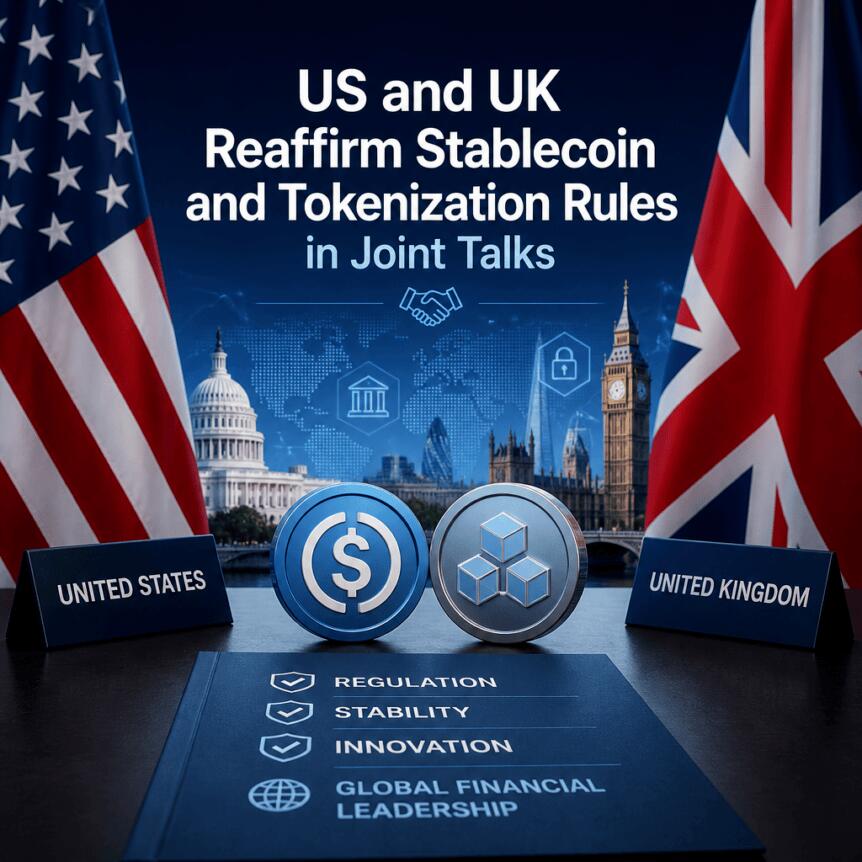
The United States and the United Kingdom used a recent bilateral meeting to signal continued alignment on digital-asset oversight, focusing in particular on stablecoin regulation, cross-border payments, and the structure of tokenized markets. The discussion took place during the 13th session of the UK–US Financial Regulatory Working Group (FRWG) in London on July 8.
In an Aug. 4 joint statement summarizing the meeting, US officials told their UK counterparts they are updating implementation details for the GENIUS Act, alongside ongoing work on how digital asset markets should be regulated. The statement also highlighted broader efforts on payment modernization and participation in the G20 Cross-border Payments Roadmap.
Key takeaways
- The July 8 FRWG meeting reinforced US–UK policy coordination around stablecoins, digital asset market structure, and tokenization.
- US officials provided an update on implementing the UK-referenced GENIUS Act and related stablecoin work, but no new policy measures were announced.
- Cross-border payments modernization remains a shared priority, with both governments pointing to international work under the G20 roadmap.
- UK stablecoin regulation is evolving as the Bank of England and other authorities reassess earlier approaches amid competitive momentum from the US.
FRWG meeting places GENIUS Act implementation and market structure front and center
The FRWG meeting covered several areas that regulators typically treat as interconnected: stablecoin rules, the way digital-asset markets operate in the US, tokenization, and the UK’s “Wholesale Financial Markets Digital Strategy.” Those topics matter because stablecoins are often the settlement layer for payments and tokenized instruments, while regulatory frameworks for market structure influence how exchanges, brokers, custodians, and trading venues adapt to digital assets.
According to the Aug. 4 joint statement released by the US Treasury, the US side shared updates with the UK about implementing the GENIUS Act—framed as the country’s landmark stablecoin legislation—along with work on digital asset market structure. The statement also indicates that participants discussed payment modernization initiatives and international coordination on cross-border payments through the G20 Cross-border Payments Roadmap.
While the meeting did not yield new regulatory actions, it did reinforce a familiar theme in transatlantic policy: the desire to keep pace with fast-moving market developments without undermining financial stability. Notably, the statement described a “responsible” approach to digital-asset innovation, while still emphasizing oversight and the need for international regulatory cooperation.
US–UK coordination extends beyond stablecoins to tokenization and payments
The FRWG meeting appears to fit into a broader effort by the two governments to coordinate on financial innovation. Earlier, on July 14, the Transatlantic Taskforce for Markets of the Future—an initiative aimed at strengthening cooperation on financial innovation and capital markets—published initial recommendations together with a joint statement on stablecoins.
That earlier announcement said the measures would help set the foundation for continued US–UK leadership in digital assets and capital markets. Taken alongside the July 8 FRWG discussion, it suggests regulators are treating stablecoin policy not as an isolated topic, but as part of a larger strategy that includes tokenized finance and how payments infrastructure evolves.
For investors and operators, the implication is straightforward: regulatory decisions in one country may influence how compliant products and services are designed for the other. Even when there are no immediate new rules, ongoing coordination can reduce uncertainty for cross-border issuers, market intermediaries, and firms building payment and tokenization applications intended to serve both jurisdictions.
UK stablecoin review accelerates as US regulation gains momentum
UK policymakers’ renewed attention to stablecoins arrives at a time when some observers believe the US is pulling ahead. The rationale is that the GENIUS Act has created clearer traction for regulated, dollar-backed stablecoin activity, providing a benchmark for other jurisdictions to respond to.
Within the UK, the Bank of England has reportedly softened its stance after earlier controversy over potential limits. Cointelegraph previously reported that the BoE was considering alternatives to temporary limits on stablecoin holdings and reviewing whether a proposal requiring at least 40% of reserve assets to be held as non-interest-bearing deposits at the central bank was too restrictive. Separate coverage also noted the BoE’s ongoing work to calibrate regulation in a way that supports stability without overly constraining legitimate market participation.
At the same time, the UK’s Financial Conduct Authority has signaled where it sees near-term real-world value. Earlier in the year, the FCA pointed to cross-border payments as one of the “clearest near-term use cases” for stablecoins, emphasizing that regulators increasingly recognize the technology’s potential—not just as a trading asset, but as a component of payments systems.
For market participants, these signals together indicate that the UK is attempting to thread a needle: maintain strong financial stability requirements while ensuring its framework does not lag in usability and competitiveness relative to the US approach.
What to watch next: implementation details and remaining UK constraints
With the FRWG meeting described as a coordination exercise rather than a source of new rules, the practical question for the market is what happens next in implementation—especially in the US under the GENIUS Act—and whether the UK continues adjusting aspects of its earlier stablecoin proposals. Readers should watch for further clarity from UK authorities on reserve requirements and for concrete milestones tied to stablecoin market-structure work, since those details will likely determine how quickly compliant dollar-backed stablecoin services can expand across borders.