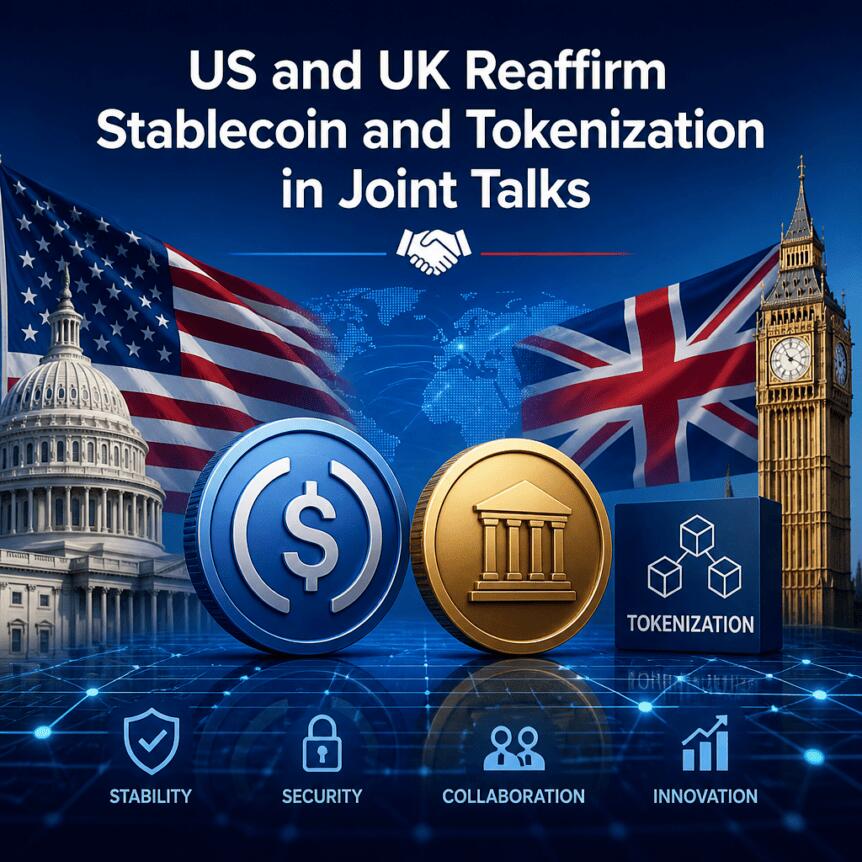
The United States and the United Kingdom used their latest bilateral regulator meeting to reaffirm coordination on digital-asset oversight, with particular focus on stablecoins, market structure, and payment modernization. The 13th session of the UK-US Financial Regulatory Working Group (FRWG) took place in London on July 8, continuing a pattern of policy alignment as the U.S. prepares to roll out the GENIUS Act.
In an Aug. 4 joint statement summarizing the discussions, U.S. officials said they provided their UK counterparts with an update on GENIUS Act implementation, alongside ongoing work related to the structure of digital asset markets. The statement also referenced broader efforts to improve cross-border payments under the G20 Cross-border Payments Roadmap, signaling that stablecoin regulation is being treated as part of a wider payments and financial stability agenda rather than in isolation.
Key takeaways
- The FRWG meeting highlighted continued U.S.-UK coordination on stablecoin rules, including progress on implementing the GENIUS Act.
- Officials also discussed how digital asset market structure is evolving in the United States, alongside UK initiatives tied to tokenization and capital markets.
- The joint statement framed stablecoin oversight within payment modernization and international cooperation on cross-border transfers.
- No new policy measures emerged from the July 8 talks, but the tone emphasized “responsible” innovation alongside financial stability and regulatory alignment.
What the US-UK regulators covered
According to the joint statement issued on Aug. 4, the FRWG meeting included updates on several areas relevant to crypto and tokenized finance. Alongside stablecoin regulation, participants discussed digital asset market structure in the United States—an issue that has attracted heightened attention globally as regulators attempt to define how tokens fit within existing financial frameworks.
The statement also pointed to UK priorities in the tokenization space, referencing the UK’s Wholesale Financial Markets Digital Strategy. While the statement did not announce new rules, the range of topics matters to market participants because it illustrates how regulators are connecting stablecoins and tokenization to mainstream financial infrastructure, including wholesale markets and cross-border payment flows.
Payment modernization was another recurring theme. By tying the meeting’s work to the G20 Cross-border Payments Roadmap, the regulators effectively acknowledged that stablecoins—when they meet defined compliance and reserve requirements—are increasingly viewed as potential tools for faster, lower-friction settlement across borders.
GENIUS Act implementation remains central
For U.S. watchers, the most concrete element in the joint statement is the mention that U.S. officials updated the UK on GENIUS Act implementation. The GENIUS Act is described in the statement as the United Kingdom’s “landmark stablecoin law” counterpart in terms of the stablecoin policy direction both countries are taking—reinforcing that the U.S. and UK see stablecoin legislation as a cornerstone for broader regulatory clarity.
The immediate practical takeaway is that firms operating across the Atlantic may increasingly expect policy outputs that are compatible or at least coordinated in spirit. Even without new measures announced at this meeting, continued communication between regulators can reduce uncertainty for issuers, exchanges, custody providers, and market participants planning product rollouts that depend on stablecoin rails.
UK stablecoin debate: shifting stance and reserve requirements
The U.S.-UK alignment comes as the UK’s stablecoin regulatory posture continues to evolve. Industry reporting referenced in the original coverage indicated that the Bank of England has softened its stance and is exploring alternative approaches to a temporary framework affecting stablecoin holdings.
Earlier coverage also cited the BoE’s review of whether a proposed requirement—holding at least 40% of reserve assets as non-interest-bearing deposits at the central bank—might be too restrictive. That matters because reserve composition requirements directly affect the economics of stablecoin issuance and risk management, and can shape whether dollar-backed stablecoins expand primarily through regulated channels in the UK or migrate to jurisdictions with more operational flexibility.
Separate commentary referenced in the source indicates that the UK Financial Conduct Authority has identified cross-border payments as one of the clearest near-term stablecoin use cases. Taken together, these points suggest the UK is trying to balance financial-stability constraints with a pragmatic recognition that stablecoins may have real utility in international settlement—an area the FRWG also emphasized through the cross-border payments roadmap.
Broader implications: regulation as a competitiveness lever
The meeting did not introduce fresh rules, but the overall direction remains noteworthy. The original reporting framed the UK’s renewed emphasis on stablecoins against concerns that the United States has gained momentum in building a regulated environment for dollar-backed stablecoins. In that context, U.S.-UK coordination can be read as more than technical harmonization: it is also part of a competition between jurisdictions over who sets the terms for compliant stablecoin growth.
That competitive element becomes clearer when viewed alongside earlier U.S.-UK cooperation. On July 14, the Transatlantic Taskforce for Markets of the Future—a joint U.S.-UK initiative aimed at strengthening collaboration on financial innovation and capital markets—published initial recommendations and a joint statement on stablecoins, according to the source. The FRWG meeting’s supportive tone toward “responsible” innovation and emphasis on international cooperation suggests these parallel efforts are feeding into a single long-term policy trajectory: aligning standards so that capital markets innovation, tokenization, and stablecoin use are able to scale without undermining financial stability.
For builders and investors, the most important uncertainty is not whether stablecoin regulation is coming—both countries are clearly moving—but how precisely reserve and operational requirements will be shaped in practice. The UK’s ongoing review process around holding structures and the BoE’s consideration of alternatives signal that implementation details may change before final frameworks fully lock in.
Going forward, market participants should watch for how U.S. GENIUS Act implementation translates into operational requirements for issuers and intermediaries, and whether UK regulators further adjust stablecoin rules in response to concerns about restrictiveness and cross-border payment needs—particularly as U.S.-UK officials continue to tie domestic legislation to international payment modernization objectives.