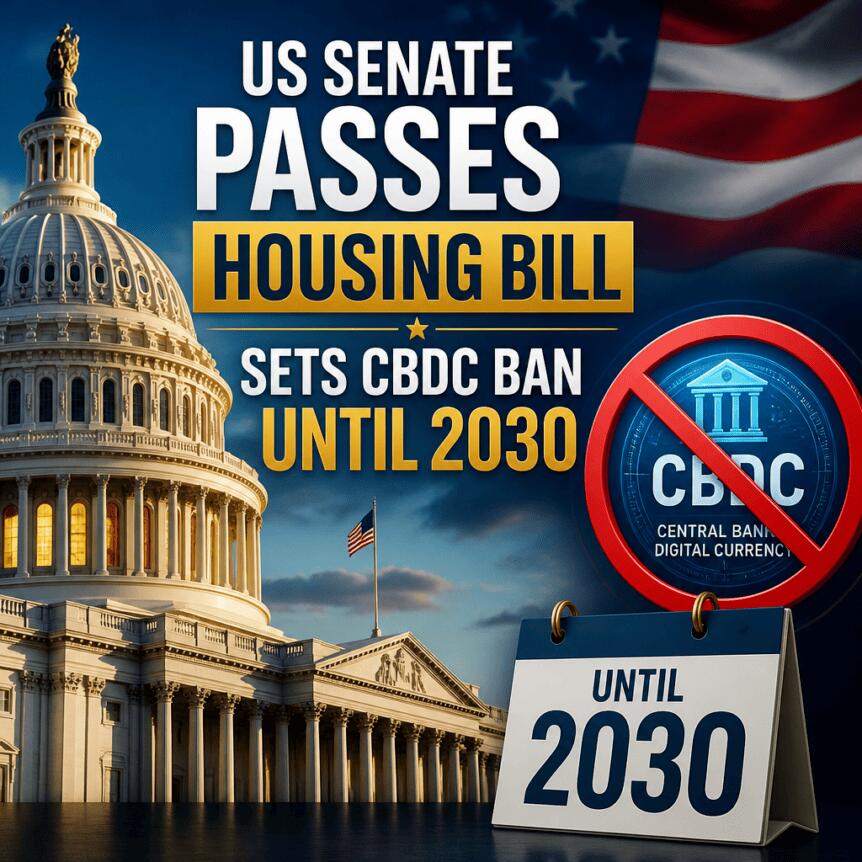
The U.S. Senate has approved the 21st Century Road to Housing Act in a vote that includes a prohibition on the Federal Reserve creating or working on a central bank digital currency (CBDC) until 2030. The measure, passed on Monday by a vote of 85–5, is now set to move to the House of Representatives, where it is expected to pass quickly before being sent to the president for signature.
For crypto policy stakeholders, the provision signals a significant shift in the near-term trajectory of U.S. CBDC planning and frames the issue within a broader legislative package aimed at increasing housing supply. More broadly, it underscores how U.S. lawmakers are using statutory language to constrain central bank discretion and to set a clear authorization threshold for any future CBDC initiative.
Key takeaways
- The Senate passed the 21st Century Road to Housing Act with a CBDC ban preventing the Federal Reserve from creating or working on a CBDC until 2030.
- The bill bars the Fed from issuing or creating a CBDC or a digital asset “substantially similar” to a CBDC without explicit congressional authorization.
- A carve-out in the clause addresses stablecoins, including “dollar-denominated” permissionless, private stablecoins.
- The provision appears designed as a political condition to help secure House and administration support for faster passage of the broader housing bill.
- Internationally, CBDC development remains active: China is expanding digital yuan cross-border participation, while many other jurisdictions are still piloting or researching CBDCs.
How the Senate CBDC restriction would work
The CBDC limitation is embedded in the 21st Century Road to Housing Act and was included in earlier Senate versions of the bill dating back to March. The operative language prohibits the Federal Reserve, directly or indirectly, from “issu[ing] or creat[ing] a central bank digital currency or any digital asset that is substantially similar to a central bank digital currency” until the ban expires in 2030.
In practical compliance terms, a statutory prohibition of this type is notable because it attempts to remove ambiguity about whether the central bank could pursue CBDC-related work under administrative or internal programs without new legislative approval. By defining not only a CBDC but also “substantially similar” digital assets, the clause seeks to constrain adjacent projects that could otherwise be characterized as pilots, experiments, or technology development.
Importantly, the legislation does not leave the post-2030 environment open-ended. Even after the ban lifts, the Fed would still be barred from acting on a CBDC absent explicit authorization from Congress, which effectively requires future lawmakers to revisit the issue.
Stablecoin carve-out and what it signals for regulated markets
The bill includes a carve-out for certain stablecoins, described as “dollar-denominated” currencies that are open, permissionless, and private. While the clause does not equate stablecoins with CBDCs, it creates a distinction that could matter for industry structuring and regulatory positioning, particularly for firms that operate at the intersection of crypto assets and payments.
For institutional compliance programs, the carve-out can reduce certain legal uncertainties about how a CBDC ban might apply to stablecoin ecosystems, especially where stablecoins are used for settlement or as on-chain representations of dollar value. At the same time, the clause’s phrasing leaves compliance teams with interpretive work ahead: whether specific products, custody models, or operational controls fit within “open, permissionless, and private” criteria may depend on implementation details and future legal or regulatory clarification.
As a policy matter, the stablecoin exception also indicates that lawmakers may view private-sector dollar tokenization as sufficiently distinct from a central bank-issued digital currency to warrant separate treatment—an approach that aligns with the broader U.S. regulatory tendency to address stablecoins through ongoing market-structure and enforcement frameworks rather than through an outright exclusion from federal policy.
Legislative strategy and cross-border context
According to Cointelegraph, the CBDC clause became “wrapped into the housing package as a political sweetener” to secure support from House Republicans and the administration for faster passage. That framing matters for monitoring because it suggests the CBDC policy outcome may be driven as much by legislative coalition-building as by a single-purpose CBDC bill—an important consideration for firms tracking how quickly the text may become law and how narrowly any future amendments might be contested.
In the near term, the Senate vote sets up a House floor decision. If the provision survives intact and is enacted, it would establish a clear statutory constraint on Fed activity through 2030, with additional authorization required thereafter. This timeline may influence how U.S. stakeholders plan product roadmaps and technology investments tied to payment infrastructure or central-bank-linked settlement rails.
The congressional action also arrives amid continued CBDC momentum internationally. Reuters reported on June 16 that China signed up 26 financial institutions to its digital yuan (e-CNY) cross-border payment platform. Separately, the Atlantic Council’s CBDC Tracker indicates that three countries have launched CBDCs, 41 are in pilot phases, 33 are in development, and 40 are still researching.
This global backdrop highlights a key strategic tension for U.S. institutions: while U.S. federal action may be constrained by legislation, other jurisdictions may expand CBDC capabilities and cross-border rails. For compliance and risk officers at banks, payment providers, and crypto exchanges, such divergence can increase the importance of governance around cross-border flows, counterparties, and interoperability assumptions.
What happens next for U.S. CBDC policy
The bill will now proceed to the House for a vote, with expectations that it will pass quickly given the deal struck by House leaders. If enacted, the CBDC ban would become a binding constraint on the Federal Reserve’s ability to pursue CBDC creation or work until 2030, while carving out a path for certain dollar-denominated stablecoins.
Over the longer horizon, the most consequential open question is how “substantially similar” and “open, permissionless, and private” will be interpreted in practice if companies, banks, or exchanges seek to understand the boundaries of the carve-out. Analysts and compliance teams should also watch for any subsequent congressional action that could explicitly authorize CBDC work after 2030—or further refine the statutory language through amendments or related financial services legislation.