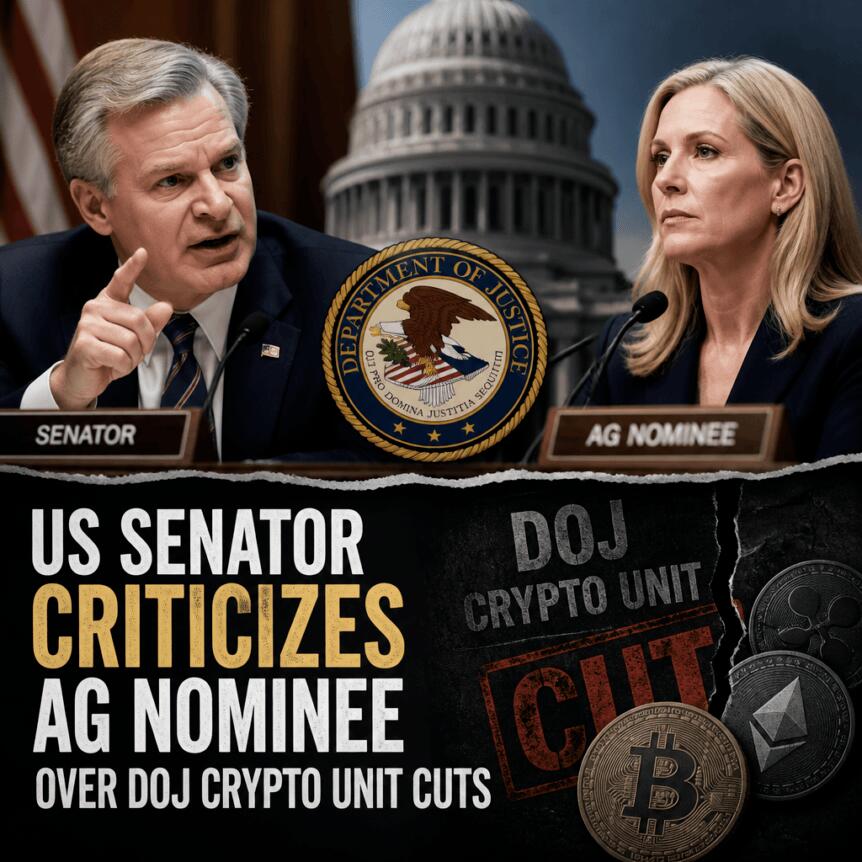
Acting U.S. Attorney General Todd Blanche faced sharp criticism during his Senate Judiciary Committee confirmation hearing on Wednesday, as lawmakers questioned whether the Justice Department’s approach to crypto enforcement is weakening and favoring President Donald Trump’s network.
Ranking member Sen. Dick Durbin said Blanche’s tenure has included actions that, in his view, dismantled the department’s capacity to pursue crypto-related crime, pointing in particular to a reported move that disbanded a DOJ crypto enforcement unit in April 2025. The hearing also featured questions about Binance CEO Changpeng “CZ” Zhao’s pardon and whether DOJ will revisit how such clemency decisions were reached.
Key takeaways
- Sen. Dick Durbin accused Blanche of dismantling DOJ crypto enforcement and closing out investigations tied to the industry.
- Durbin tied the alleged DOJ shift to potential conflicts of interest, including claims involving Trump and family business World Liberty Financial.
- Blanche said DOJ would not investigate or charge blockchain developers who are not third-party users and are not knowingly aiding illicit activity.
- Republican Sen. Thom Tillis pressed Blanche on whether CZ Zhao’s pardon raises concerns; Blanche said he would review the pardon process if confirmed.
- With Mitch McConnell hospitalized, Senate Republicans hold a narrow 52–47 margin to confirm Blanche if the nomination advances.
Durbin’s critique centers on enforcement capacity and investigations
Durbin’s comments focused on Blanche’s role in reshaping DOJ’s posture toward crypto enforcement. At the hearing, he criticized what he described as Blanche “dismantling” enforcement teams and shutting down ongoing criminal investigations involving the crypto sector.
Durbin’s argument referenced reporting that Blanche was behind the reported disbanding of DOJ’s crypto enforcement unit in April 2025, when he was deputy attorney general. The accusation aligns with earlier coverage noting that the unit was effectively dismantled through a memo distributed within DOJ. According to Fortune’s reporting on the development, the disbanding occurred as part of a broader internal restructuring.
Durbin also raised a conflict-of-interest allegation, saying that the actions he described would enable Trump to benefit financially from ties to the crypto industry. He pointed to Trump’s family’s business, World Liberty Financial, and argued that Blanche’s policies would protect that ecosystem from aggressive enforcement.
In addition, Durbin accused CZ Zhao of “broker[ing] a deal to channel $2 billion” into World Liberty, which he said resulted in a presidential pardon. The hearing comments connected the pardon to CZ Zhao’s earlier legal resolution: in 2023, Zhao agreed to plead guilty to one felony charge related to the Anti-Money Laundering (AML) regime at Binance.
“Every smarmy, suspect deal in this administration has cryptocurrency behind the curtain,” Durbin said during the hearing.
Confirmation odds remain tight as Republicans seek a simple majority
Outside the substance of crypto enforcement, the political math around confirmation could prove decisive. Republicans need only a simple majority of lawmakers present to confirm Blanche if his nomination clears the Senate Judiciary Committee and moves forward.
With Sen. Mitch McConnell still hospitalized after what his team described as a fall that led to pneumonia, Senate Republicans have a slim 52–47 margin to confirm Blanche, according to the reporting referenced in the source article.
Supporters and skeptics alike are watching whether the nomination will survive additional scrutiny beyond crypto issues. The hearing context described pushback not only on crypto policy, but also on other DOJ actions, including immigration-related enforcement and questions surrounding how the department may handle the release or processing of Jeffrey Epstein-related materials.
Blanche draws a line between developers and wrongdoing
While Durbin’s critique emphasized perceived restraint toward enforcement, Blanche’s own responses suggested a more targeted approach rather than a blanket retreat. The acting AG has previously signaled that DOJ’s crypto posture would shift toward differentiating between culpable actors and peripheral technical contributors.
The hearing record referenced a 2025 DOJ memo described as pushing “ending regulation by prosecution” in the crypto industry. Blanche was also described as having held at least $159,000 in digital-asset-related investments prior to divesting them to his children and grandchildren.
Blanche has said DOJ will focus on illicit conduct and will not pursue cases involving blockchain developers who are not responsible for criminal activity on platforms. In remarks cited from the Bitcoin 2026 conference, he said that if someone is developing software and is not a third-party user—and is not helping and knowing that third parties are using the development to commit crimes—then they “are not going to be investigated and not going to be charged.”
The distinction matters for builders and technical teams because it frames the threshold for criminal exposure around intent, knowledge, and the role in facilitating wrongdoing. For investors and users, it signals that enforcement priorities may concentrate more heavily on operational participants rather than on the mere act of writing or maintaining code.
At the same time, the department’s enforcement footprint is not portrayed as entirely dormant. The source notes that federal prosecutors are expected to retry Tornado Cash co-founder Roman Storm after a jury in 2025 failed to reach a verdict on two charges. That ongoing effort suggests DOJ’s approach may still include high-profile prosecutions tied to platforms alleged to be used for illegal activity.
Pardon questions and what Blanche says he will do next
Another flashpoint in the hearing was the presidential pardon granted to CZ Zhao. Republican Sen. Thom Tillis told Blanche he was “concerned that the Binance CEO got pardoned,” framing the clemency as part of broader concerns about accountability and fairness in how crypto-related cases are resolved.
Blanche responded that, if confirmed, he would review the pardon process. The comment did not specify whether that review would lead to any particular legal action, but it indicates a willingness to scrutinize decision-making rather than treat the pardon as settled beyond DOJ’s reach.
As the confirmation process continues, readers should watch not only for whether Blanche secures the votes he needs, but also for what DOJ’s internal guidance means in practice—especially whether prosecutors continue pursuing developer-focused cases, how ongoing trials like Roman Storm’s proceed, and whether Blanche’s promised review of the pardon process signals broader changes to enforcement strategy.