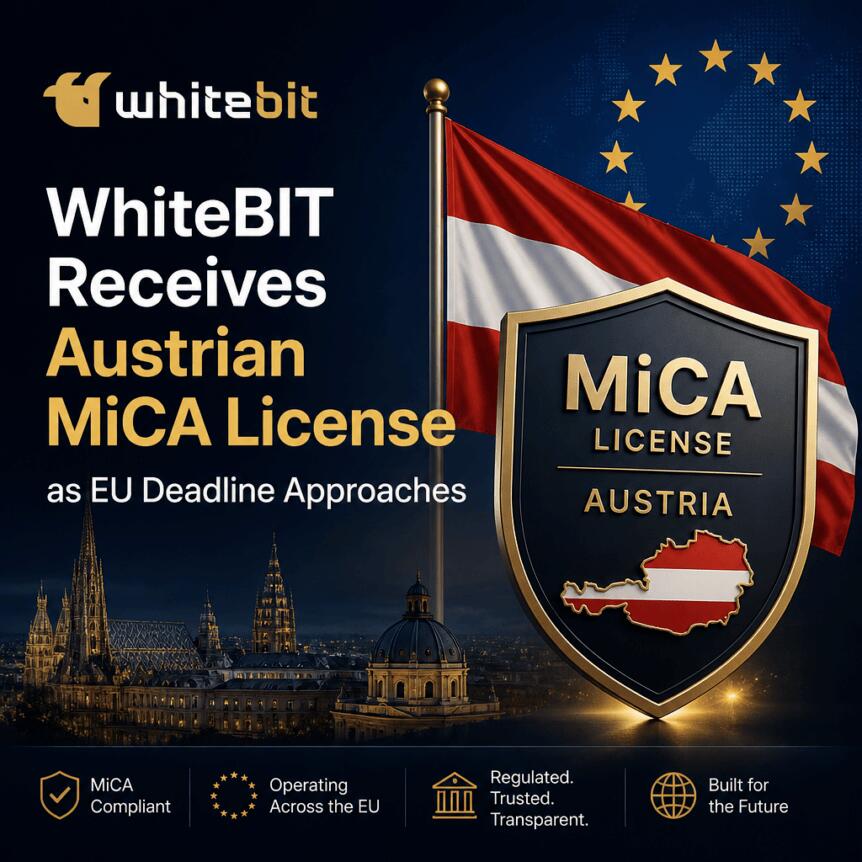
WhiteBIT has secured authorization under the EU’s Markets in Crypto-Assets Regulation (MiCA) from Austria’s Financial Market Authority, enabling the exchange to provide regulated crypto services across the European Economic Area using a single passported regime. The authorization positions WhiteBIT to operate within the harmonized EU framework as transitional national arrangements near their end.
MiCA’s cross-border “passporting” mechanism is designed to reduce the need for repeated licensing across member states. For institutions and market participants, the development is consequential: it affects how exchanges structure compliance programs, customer communications, and operational continuity in jurisdictions where legacy registrations may no longer be sufficient.
Key takeaways
- WhiteBIT received MiCA authorization from Austria’s Financial Market Authority, supporting regulated service delivery across the EEA.
- MiCA allows authorized firms in one member state to passport services across the EEA, reducing duplicative licensing.
- Austria has not extended grandfathering for virtual asset service providers beyond Dec. 31, 2025, accelerating migration to MiCA.
- EU deadlines are tightening: after July 1, legacy operators may need to hold MiCA authorization or cease EEA client services.
- Regulators and oversight bodies are emphasizing wind-down and client migration planning for firms that remain unauthorized.
Austria authorization and the MiCA passporting framework
WhiteBIT’s authorization under MiCA was granted by Austria’s Financial Market Authority. Under MiCA, a crypto-asset service provider licensed in one EU member state can provide services throughout the EEA without securing separate authorizations in each jurisdiction.
The exchange indicated that the authorization will support the rollout of a dedicated European platform at whitebit.eu. In practice, passporting can streamline geographic expansion while also increasing the importance of centralized compliance controls—such as transaction monitoring, risk management, and supervisory reporting—aligned to MiCA requirements.
WhiteBIT is part of W Group, which the company says serves more than 35 million customers globally. The exchange was founded in 2018.
Why Austria’s MiCA transition matters: grandfathering and regulatory timing
Austria’s approach underscores the timetable confronting many European crypto businesses. Austria did not extend “grandfathering” provisions for virtual asset service providers beyond Dec. 31, 2025, according to information referenced in comments provided to Cointelegraph by the Financial Market Authority. As a result, Austria has become one of the earlier EU jurisdictions to fully shift operating models to MiCA.
MiCA’s transition rules are pivotal for compliance departments because they determine which firms can lawfully continue serving customers and under what conditions. For exchanges and other regulated service providers, the end of grandfathering increases the operational consequences of delayed approvals—especially where customer onboarding, marketing claims, and service delivery are tied to licensing status.
According to the Financial Market Authority’s previously provided comments cited in the coverage, the regulator has licensed nine crypto-asset service providers under MiCA and characterized application volume as “significant.” This suggests a relatively active supervisory pipeline, but it also signals that authorization throughput may vary across regulators and categories of services.
Approaching July 1 deadline and enforcement posture
WhiteBIT’s approval arrives less than two weeks before the EU’s MiCA transition period expires on July 1. After that date, firms operating on legacy national registrations must either obtain MiCA authorization or stop serving clients within the EU/EEA.
The proximity of the deadline has intensified scrutiny on exchanges that have not yet secured authorization. Reuters has reported that Greece’s market regulator was preparing to reject Binance’s MiCA application. Separately, reporting referenced that France may represent a remaining route for certain exchanges seeking authorization before the deadline.
The compliance significance of these developments is not limited to licensing outcomes. Where authorizations are rejected or delayed, firms may face operational constraints affecting custody arrangements, marketing and advertising practices, and customer support processes. For institutional stakeholders, this increases the need to validate counterparties’ regulatory status and to assess the continuity of access to services during wind-down scenarios.
In its reporting shared with Cointelegraph, OKX Europe suggested the transition could affect a meaningful portion of European activity. The company pointed to data indicating that approximately 7.6 million of 18.5 million crypto app downloads in Europe between May 2025 and May 2026 were linked to exchanges not listed on public MiCA authorization registers. While download data is not a direct proxy for user balances or revenue, it can provide a directional sense of where operational risk may concentrate as firms transition away from legacy permissions.
ESMA guidance: wind-down and client migration plans
Beyond national regulators, EU-level oversight has been explicit about what unauthorized firms should do once transitional periods end. The European Securities and Markets Authority (ESMA) has stated that companies remaining unauthorized after July 1 should implement wind-down and client migration plans rather than continue operating while applications are under review.
This guidance is particularly relevant for compliance monitoring because it frames expected conduct after the regulatory line is crossed. Wind-down planning typically requires firms to consider customer asset handling, disclosure obligations, operational timelines, and coordination with service providers responsible for order handling, custody, and payment-related workflows.
For institutions assessing risk exposure to crypto service providers, ESMA’s posture supports a practical checklist: confirm whether the counterparty is on public MiCA authorization registers, understand the scope of authorized activities, and evaluate whether the firm has contingency plans that align with EU expectations for client migration rather than ongoing service delivery.
Closing perspective
WhiteBIT’s MiCA authorization illustrates how passporting under the EU framework is beginning to reshape the competitive and compliance landscape for European exchanges. As July 1 approaches, the key question for market participants is whether remaining applicants can obtain authorization or will shift toward ESMA-aligned wind-down and client migration. The next phase will likely hinge on supervisory capacity across member states and the clarity of operational requirements for firms transitioning under the end-of-transitional timeline.