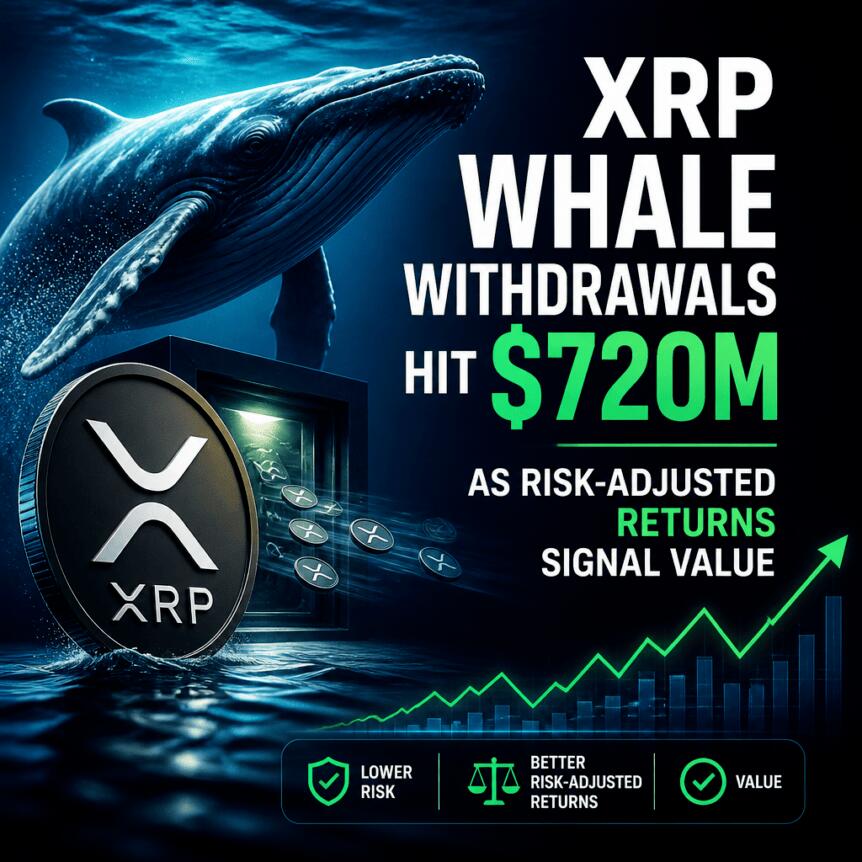
Crypto exchange data is pointing to a notable shift in how XRP is moving between wallets and trading venues. Since June 3, more than 720 million XRP has left exchanges across major platforms, while Upbit’s share of XRP wallet flows has risen to its highest level since May 2024.
The backdrop to the flow changes is a rebound in XRP price to around $1.30 on Monday, alongside continuing activity from large holders that is shaping withdrawal patterns. Still, key risk metrics remain mixed, suggesting investors should not assume the latest inflow-outflow trends automatically translate into an immediate sustained rally.
Key takeaways
- Between June 3 and June 14, large daily XRP outflows on multiple exchanges totaled roughly 722 million XRP, per CryptoQuant.
- Binance accounted for about 425 million XRP of those large outflows, underscoring continued whale influence in exchange flow data.
- Upbit’s dominance in XRP net wallet flows climbed to 31% on June 14, up from 13% a week earlier, according to CryptoQuant analyst Amr Taha.
- On Binance, the whale-versus-retail withdrawal spread is near 90%, indicating withdrawals of 100,000 XRP or more remain the majority driver.
- XRP’s Sharpe ratio is still negative (near -0.36, down from 0.18 in May), a condition that has historically coincided with stronger gains but can also align with “market pain.”
Exchange outflows rise, with whales leading the pattern
CryptoQuant data cited by analysts shows XRP’s multi-exchange daily outflow has been characterized by repeated withdrawals above 1 million XRP per transaction. Across the period from June 3 to June 14, major crypto platforms logged approximately 722 million XRP in large daily outflows—activity described as the most sustained whale-sized behavior since early February.
Within that total, Binance whales were responsible for about 425 million XRP in outflows. This is important for how to interpret exchange-flow indicators: while large withdrawals do not prove that holders are accumulating for the long term, they can reduce the immediate supply available for sale on exchange order books.
In other words, the data is more directly about positioning on trading venues than it is about confirmed intent. Traders often watch these metrics because persistent withdrawals can shift short-term liquidity conditions, even if price impact depends on broader demand.
Upbit captures a larger share of XRP wallet flows
A second exchange-flow metric points to where XRP holders are leaning when they move funds. According to crypto analyst Amr Taha, Upbit’s dominance in XRP net wallet flows rose to 31% on June 14—its highest level since May 2024—after increasing from 13% just a week earlier.
Taha also linked XRP’s roughly 5% rebound to about $1.30 on Monday with a “rotation” toward Upbit. In his view, deposit-wallet activity became increasingly concentrated on the South Korean exchange while several other major platforms lost relative share.
This kind of venue concentration matters because exchange-specific order books can respond differently to shifts in deposits and withdrawals. When a larger portion of flows begins concentrating on one trading venue, near-term volatility and depth can diverge across platforms, even if the overall market trend remains unchanged.
Binance whale-to-retail spread stays elevated
Beyond totals, CryptoQuant also highlighted a Binance-specific measure: the Binance Whale vs. Retail Spread. This metric compares the difference between whale-sized withdrawals—defined as 100,000 XRP or more—and retail-sized withdrawals below that threshold.
At the time of reporting, the spread sat near 90%, which implies large holders continue to account for most XRP outflows from Binance. Taha previously flagged that repeated declines toward the May 2024 range suggested a shift in Binance’s withdrawal profile away from the bullish period seen in 2024–2025.
Crucially, the analyst cautioned that the indicator should not be treated as a direct bullish or bearish trading signal. As he framed it, the spread tracks withdrawal behavior rather than measuring exchange selling activity outright. That distinction can help investors avoid over-interpreting exchange flows as instant momentum, particularly when other risk factors—such as volatility and return efficiency—are not clearly improving.
XRP’s Sharpe ratio remains negative despite the rebound
While exchange outflows and whale activity suggest positioning may be tightening on trading venues, XRP’s risk-efficiency snapshot remains under pressure. CryptoQuant data referenced in the article shows XRP’s Sharpe ratio continues to sit below zero, a range that has historically corresponded with bearish consolidation phases.
For context, the Sharpe ratio measures returns relative to volatility—essentially whether investors have been compensated for the risk they took. The report notes XRP recorded a Sharpe ratio of -1.097 in September 2022 when the token traded near $0.33. It then peaked at roughly 2.07 in January 2025 as XRP approached $3.14.
Currently, the reading is near -0.36, down from a positive 0.18 in May. CryptoQuant’s historical observation is that XRP has sometimes delivered some of its strongest gains when the Sharpe ratio was negative. During those stretches, average returns reportedly exceeded 50%, while performance tended to moderate once the ratio turned positive.
That said, another view adds nuance. In April, market analyst Teddy (via X) argued that deep negative Sharpe readings often reflect “market pain” rather than smooth, efficient trends. According to that framing, such periods can still create the conditions associated with long-term accumulation zones—but additional downside remains possible even if eventual upside historically follows.
What to watch next
If the June withdrawal surge persists and Upbit’s share of net wallet flows continues to rise, investors may see tighter exchange liquidity and shifting venue dynamics. However, with XRP’s Sharpe ratio still negative, traders should watch whether volatility compresses and whether risk-adjusted performance improves—signs that would better confirm whether the rebound can extend beyond a temporary relief move.