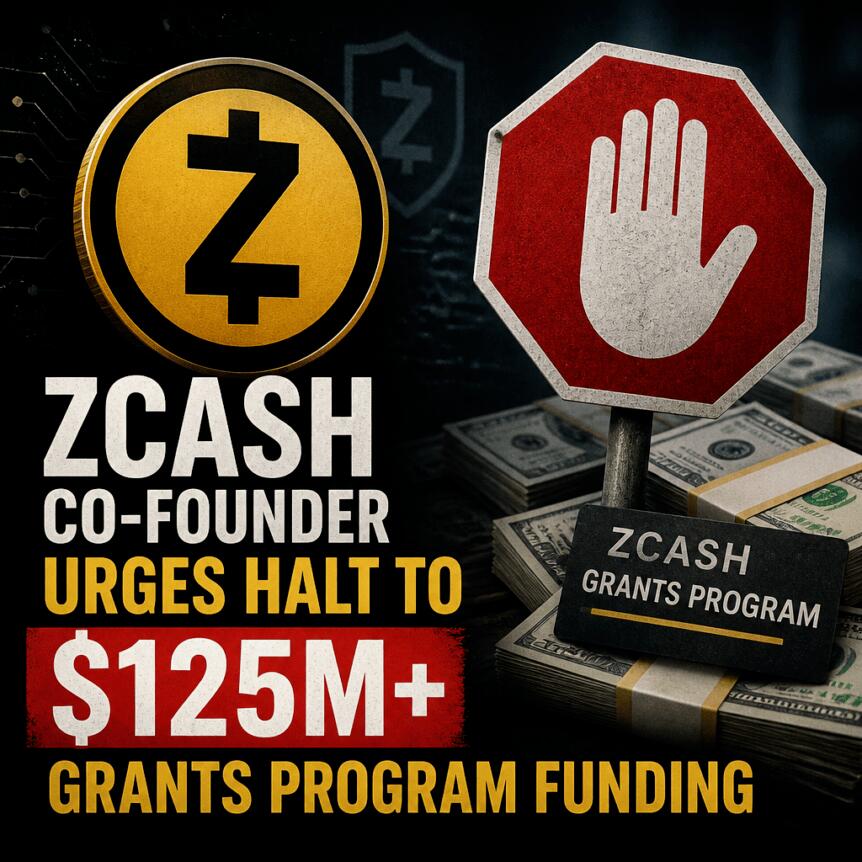
Zcash co-founder Sean Bowe has floated a plan to end the automatic funding stream from Zcash block rewards to the Zcash Community Grants (ZCG) program, arguing the treasury is already large enough to keep supporting initiatives without continued automatic payments.
In a post on X Tuesday, Bowe said ZCG has more than $125 million in funding and is expected to receive “millions more” before the mechanism is shut off. He shared a draft proposal on GitHub that would redirect ZCG’s 8% allocation of the Zcash (ZEC) block subsidy to a separate network sustainability reserve—while leaving ZCG’s current holdings untouched.
Key takeaways
- Sean Bowe proposes stopping ZCG’s automatic stream from block subsidies while keeping existing ZCG funds in place.
- The draft would redirect ZCG’s 8% block subsidy share to the Network Sustainability Mechanism through the end of the current funding period in 2028.
- Under the proposal, the sustainability mechanism is intended to remove ZEC from circulation and later reissue it via future block rewards.
- ZCG lists 91,453 ZEC and $8.8 million in cash, along with $2.4 million in outstanding grant commitments, per its dashboard.
- A separate earlier critique from Dragonfly’s Haseeb Qureshi targeted the Zcash developer fund, also warning it could become “politicized” as it grows.
Why Bowe wants to switch off the ZCG block-reward stream
Bowe’s proposal centers on a practical concern: the block-reward-linked funding mechanism may be oversized relative to what the program needs. On X, he argued that the ZCG program “was never designed to handle this amount of funding,” pointing to the size of the current treasury and the expectation of additional inflows before any change takes effect.
Rather than canceling grants or changing ZCG’s existing capital, the draft aims to change how future funding is generated. By redirecting ZCG’s portion of the block subsidy, the community grants program would not continue receiving automatic allocations from new blocks.
The mechanics: from ZCG’s 8% subsidy share to a sustainability reserve
According to Bowe’s draft GitHub proposal, ZCG would forgo its 8% share of the ZEC block subsidy. That allocation would instead be routed to the Network Sustainability Mechanism until the current funding period ends in 2028.
The key feature of the new routing is the mechanism’s intended effect on supply. As described in the proposal, the sustainability mechanism is designed to hold ZEC out of circulation and gradually reissue it through future block rewards.
For investors and users, this distinction matters: changing where newly minted ZEC goes can influence long-term token supply dynamics, while shifting grant funding away from automatic block-linked inflows could alter how predictably the grants ecosystem is funded over time.
How big is ZCG today?
ZCG’s public dashboard lists 91,453 ZEC and $8.8 million in cash as of Wednesday, with $2.4 million in outstanding grant commitments. Based on the reported ZEC holdings, the ZEC component was valued at about $111 million at press time.
That scale supports Bowe’s argument that ZCG’s treasury may already exceed what the program structure originally contemplated. It also raises the question of what happens to future grant strategy once automatic block-reward funding is removed—whether ZCG would rely solely on existing assets and unspent commitments, or whether governance would later revisit funding approaches.
Separate debates around Zcash funding and governance
Bowe’s plan is not the first time Zcash’s funding mechanisms have come under scrutiny. In September, Haseeb Qureshi—managing partner at Dragonfly—argued for ending the Zcash developer fund after its current funding period expires, saying it risks being “politicized” as it approaches $100 million in value. Earlier coverage from Cointelegraph highlighted Qureshi’s view that large, recurring pools can invite governance conflict as they grow.
While Bowe’s proposal targets the community grants stream rather than the developer fund, the underlying theme overlaps: both discussions reflect concerns that ongoing, relatively large funding flows tied to protocol incentives may create governance or legitimacy pressures as they scale.
At the same time, Zcash’s funding architecture is not uniform. Separate from ZCG, ZecStats reports that the network’s development lockbox holds 72,351 ZEC—worth roughly $89 million at the time of the article—underscoring that multiple pools exist with different purposes and payout designs.
For readers following Zcash’s evolution, the important tension is timing. If ZCG’s automatic stream is paused but other funding pools remain active for longer, questions will likely shift to how grant programming continuity is maintained and whether governance will prefer more transparent, milestone-based funding rather than fixed, protocol-linked percentages.
What to watch next
Bowe’s GitHub draft is the starting point, but whether it moves forward will depend on community and governance processes. The next signals to monitor are any formal Zcash improvement proposal steps tied to the switch-off mechanics, plus how ZCG plans for funding runway after future subsidy allocations to ZCG are redirected toward the sustainability mechanism through 2028.