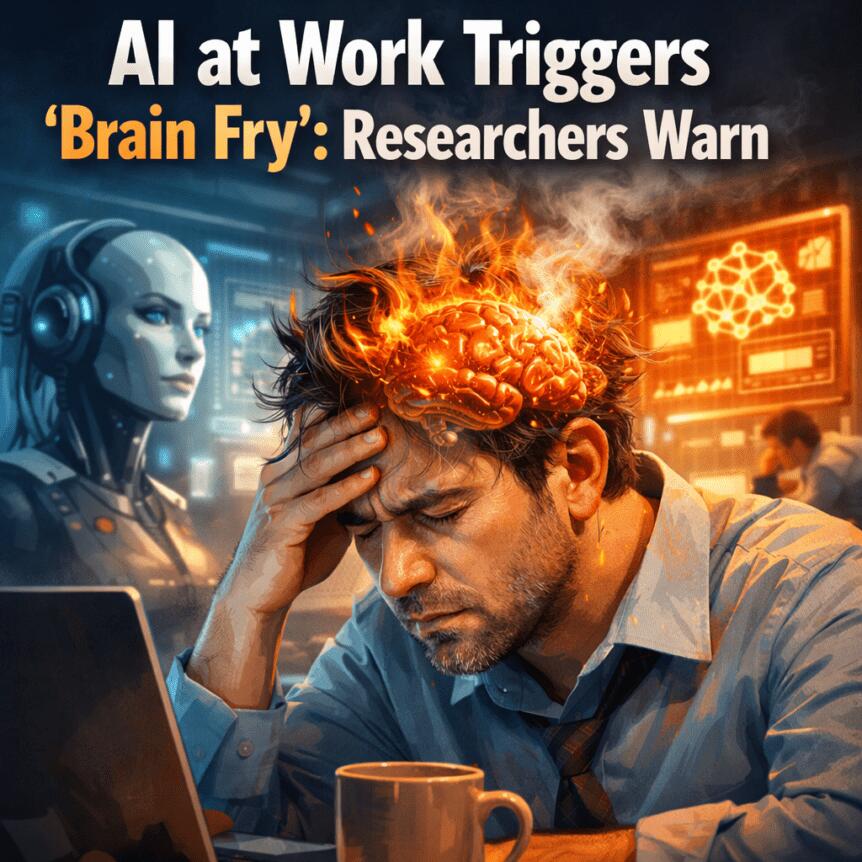
Enterprise AI promises to streamline workloads, but new research suggests a counterintuitive side effect: fatigue that can erode productivity and raise the risk of errors. A Harvard Business Review analysis, drawing on a study led by Boston Consulting Group and researchers at the University of California, surveyed nearly 1,500 full-time U.S. workers and found that a notable share experience what researchers coined “AI brain fry” — mental fatigue arising from constant interaction with, oversight of, and switching between multiple AI tools. The findings come as corporations across technology and finance push AI deeper into daily operations, from coding to customer support, intensifying the debate over whether productivity gains truly materialize in practice.
The report chronicles workers who described a mental hangover, foggy thinking, headaches, and difficulty concentrating after periods of heavy AI use. In some roles, marketing and human resources reported the highest incidence of these symptoms, underscoring how cognitive load can accumulate when employees juggle prompts, dashboards, and automated workflows. While the promise of AI is to take over repetitive tasks and accelerate decision-making, respondents painted a more nuanced picture: the very act of managing AI systems can become a central, energy-draining task in its own right.
Tech and crypto firms have embraced AI as a key performance lever, measuring AI use as a gauge of output and efficiency. The market’s enthusiasm has been reinforced by high-profile industry moves toward integrating AI to write code, analyze data, and automate routine operations. In parallel, some firms have publicly discussed accelerating AI-led coding initiatives. For example, Coinbase (EXCHANGE: COIN) CEO Brian Armstrong has publicly described pursuing aggressive AI adoption, including efforts to have AI contribute significantly to software development. Such statements highlight a broader industry trend: if AI can generate substantial portions of a platform’s code, the expectations for productivity gains rise, even as organizations grapple with the cognitive demands of multi-tool environments.
As the study authors note, the reality of enterprise AI is complex: enterprises deploy multi-agent systems that require employees to toggle between several tools, prompts, and data sources. That juggling, they argue, can become the defining characteristic of working with AI, rather than a liberating simplification of tasks. The Harvard Business Review piece stresses that without careful governance, AI’s assistive potential can be offset by cognitive overload, leading to mistakes, slower thinking, and declining job satisfaction. The tension is not unique to traditional workplaces; it reverberates through crypto and fintech teams tasked with maintaining rapid development cycles while preserving security and reliability.
AI carries “significant costs,” but can improve burnout
The study’s core finding is that AI-induced mental strain is not a trivial issue; it translates into tangible costs for organizations. Respondents who reported AI brain fry were about 33% more likely to experience decision fatigue than their peers who did not report such fatigue. This elevated decision fatigue can compound errors and slow strategic choices—an outcome with potential financial implications for large enterprises. In fact, researchers estimate that the combination of fatigue and misaligned AI workflows could cost big companies millions annually when scaled across departments and geographies. Moreover, those experiencing brain fry were roughly 40% more likely to express an active intent to quit, signaling higher turnover risk in teams involved in AI-enabled workflows. The data also show that self-reported major errors—defined as mistakes with potentially serious consequences—were nearly 40% higher among those experiencing brain fry.
Yet the research also surfaces a countervailing insight: AI can meaningfully reduce burnout when it is used to automate repetitive, protocol-driven tasks. Respondents who leveraged AI to take on routine work reported burnout levels about 15% lower than peers who did not use AI in that manner. The contrast underscores a central policy implication for leaders: AI should be deployed with clearly defined purposes and measurable outcomes rather than as a blanket productivity booster. When organizations tie AI initiatives to concrete goals—such as reducing time spent on mundane tasks or accelerating critical decision windows—employees can reap real relief from monotony without becoming overwhelmed by tool proliferation.
Industry observers have pointed to a broader set of considerations. As organizations explore multi-agent systems and automated coding pipelines, governance becomes critical to ensure that AI augments human work rather than simply adding to cognitive overhead. Some commentators have argued that incentives around AI usage—such as rewarding mere usage volume—can create waste, erode quality, and intensify mental strain. Instead, leaders should articulate AI’s purpose within the organization, outline how workloads will shift, and emphasize outcomes that can be measured and audited. The practical takeaway is clear: AI initiatives must be paired with transparent expectations and robust change-management practices to avoid simply trading one form of fatigue for another.
For readers seeking a broader perspective on AI deployment dynamics in tech and crypto, related coverage has examined how agents and automation tools are evolving beyond traditional boundaries. A widely cited piece discusses AI agents and their role in crypto workflows, offering context on how automation intersects with decentralized finance and blockchain projects. The evolving discourse around AI in specialized sectors continues to emphasize the need for thoughtful integration and governance, rather than overnight security of a magical productivity boost.
In parallel, industry narratives around AI in software development highlight the bold claims and real-world tensions facing engineering teams. For instance, reporting on Coinbase has illustrated how firms are balancing ambitious AI-coded expectations with practical concerns about reliability, security, and talent retention in a rapidly changing landscape.
What it means for crypto developers and investors
As AI becomes an integral part of software development and operations, crypto platforms face a dual frontier: the potential to accelerate code generation, risk analysis, and customer operations while also contending with cognitive fatigue caused by orchestrating an AI-driven workflow. The study’s findings imply that crypto builders should not assume a straight line from AI implementation to productivity gains. Instead, they should design AI programs with clear scoping, robust oversight, and a focus on reducing repetitive workloads where possible. The evidence points toward a cautious optimist stance: AI can alleviate burnout when applied strategically, but without careful governance and workload redefinition, it risks amplifying errors and fatigue across teams.
For investors and governance teams, the takeaway is to monitor AI outcomes with transparency and to scrutinize metrics beyond raw usage. Firms may want to establish dashboards that track cognitive load indicators, error rates, decision latency, and staff turnover alongside traditional productivity metrics. In a market where automation is increasingly priced into development timelines and security testing, the ability to quantify AI’s impact on human performance will be a differentiator between successful deployments and misaligned programs.
Moreover, the Coinbase case study underscores how public statements and corporate expectations around AI can influence strategic direction. As more crypto firms explore AI-enabled coding and risk tooling, the market will watch not only for performance gains but also for how these initiatives affect engineering culture, retention, and the reliability of codebases. The balance between innovation and human-centered design remains at the core of sustainable AI adoption in high-stakes environments.
Why it matters
First, the research reframes AI adoption as a human-centric issue. While automation offers efficiency, it also introduces a cognitive load that can undermine performance if workers must constantly juggle multiple interfaces and prompts. In sectors where precision matters—such as crypto development and risk analysis—understanding and mitigating AI brain fry could be a prerequisite for scaling AI programs responsibly.
Second, the findings provide a practical roadmap for leaders: set a clear purpose for AI implementations, communicate how workloads will change, and prioritize measurable outcomes over sheer usage. By focusing on quality-of-use rather than quantity of interactions, organizations can curb fatigue while still achieving meaningful productivity gains.
Third, the study reinforces the concept that burnout is not simply a function of workload but of workflow design. AI that targets repetitive tasks can have a tangible, positive effect on well-being, but only if teams are not overwhelmed by a zoo of tools and dashboards. The path forward for crypto platforms and broader tech ecosystems lies in balancing automation with governance, ensuring that AI serves as a partner rather than a source of cognitive overload.
Finally, the broader industry implications extend to policy and employment practices. As AI tooling becomes more embedded in software development, firms should re-evaluate performance metrics, incentives, and training to ensure that adoption supports long-term retention and high-quality outputs. The lessons from this research apply across domains, including crypto engineering, where reliability and security hinge on the clarity of AI-guided processes and the well-being of the teams that implement them.
What to watch next
- Follow-up studies expanding the sample size or exploring industry-specific burnout patterns, with a focus on crypto and fintech teams.
- Company governance updates that define AI’s purpose, workloads, and measurable outcomes, avoiding incentives based solely on usage volume.
- Broader adoption of AI-automation tooling with integrated fatigue monitoring and human-centric design principles.
- Public disclosures from tech and crypto firms on AI-generated code contributions and their impact on reliability and security.
Sources & verification
- Harvard Business Review: When using AI leads to brain fry — findings from the BCG/UC study covering roughly 1,500 U.S. workers and the 14% brain-fry rate.
- Boston Consulting Group and University of California researchers cited in the Harvard Business Review article.
- Links documenting Coinbase AI initiatives and leadership statements about AI-generated code and workforce decisions:
- Coinbase-preferred AI coding tool hijacked by new virus: https://cointelegraph.com/news/coinbase-preferred-ai-coding-tool-hijacked-new-virus
- Coinbase says AI writes nearly half of its code: https://cointelegraph.com/news/coinbase-says-ai-writes-nearly-half-of-its-code
- AI agents and crypto workflows overview: https://cointelegraph.com/explained/what-are-ai-agents-and-how-do-they-work-in-crypto
- Additional context from related tech coverage:
- Anthropic reopens Pentagon talks as tech groups push Trump to drop risk tag: https://cointelegraph.com/news/anthropic-reopens-pentagon-talks-trump-supply-chain-risk
- IronClaw coverage on AI tools in crypto contexts: https://magazine.cointelegraph.com/ironclaw-secure-private-sounds-cooler-openclaw-ai-eye/
What to watch next
Tickers mentioned: $COIN