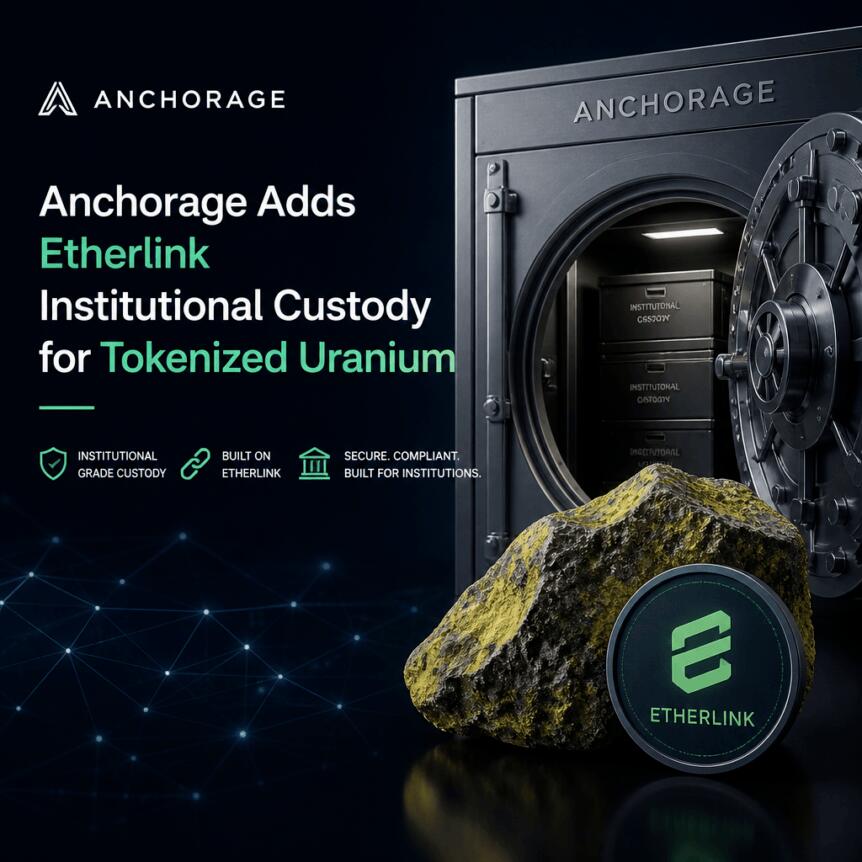
Anchorage Digital Bank, the first federally chartered crypto bank in the United States, has expanded its custody offering to include Etherlink-issued assets on the Tezos ecosystem. The update adds custody support for Etherlink’s native tokenized uranium exposure through xU3O8, alongside additional Etherlink tokens such as wrapped Tezos (WXTZ), liquid staking token stXTZ, and major stablecoins.
In an announcement shared with Cointelegraph, Anchorage said its institutional clients can now hold these assets in segregated custody accounts at the federally chartered bank, enabling regulated custody for tokens that settle via an Etherlink network that runs on the Ethereum Virtual Machine (EVM) while relying on Tezos for settlement.
Key takeaways
- Anchorage Digital Bank added custody support for Etherlink assets, including xU3O8, a token backed by physical uranium exposure.
- The custody integration is designed for institutional clients using segregated accounts at the federally chartered bank.
- Supported assets include WXTZ, stXTZ, wrapped Ether (WETH), and stablecoins USDT, USDC, and USDSM.
- Anchorage claims tokenization can reduce transfer and settlement time from weeks to minutes compared with traditional uranium intermediaries.
- xU3O8 custody support is not new—Hex Trust previously integrated Etherlink for xU3O8 custody in August 2025.
Anchorage moves Etherlink custody into segregated bank accounts
The integration targets the institutional custody workflow Anchorage is built around: custody in segregated accounts at a federally chartered institution. According to Anchorage’s announcement, this means clients can hold assets issued on Etherlink—an EVM-compatible layer-2 network—within a regulated custody framework.
Etherlink’s positioning matters for investors because it allows assets to be issued and transacted on an Ethereum-compatible environment while settlement occurs on Tezos. For institutions, that combination can make it easier to support tokenized products that may otherwise require multiple operational layers across different networks.
Anchorage did not frame the move as a broader expansion beyond Etherlink tokens, but the specific selection of assets suggests a focus on both liquidity utilities and “core” market infrastructure tokens: wrapped assets (WXTZ and WETH), liquid staking (stXTZ), and stablecoins (USDT, USDC, and USDSM) alongside xU3O8.
What xU3O8 is, and why tokenized uranium is attracting custody attention
xU3O8 is designed to represent ownership exposure to physical uranium without requiring investors to directly handle or store the underlying commodity. Anchorage’s announcement describes a traditional uranium investment process as involving “specialist intermediaries,” longer settlement periods, and higher minimum investment sizes.
The custody bank argues that tokenization changes the mechanics: it enables transfers and settlement “in minutes rather than weeks,” pointing to faster movement of exposure compared with earlier commodity trading and delivery workflows.
CoinMarketCap data cited in the original announcement places xU3O8’s market capitalization just above $9 million at current price levels. That relatively small market size underscores that uranium exposure via tokens remains a niche product—one that may be more dependent on institutional access and operational support than on mass retail adoption.
The full list of newly supported Etherlink assets
Alongside xU3O8, Anchorage’s Etherlink custody expansion includes the following assets, as reported in the announcement shared with Cointelegraph:
- Wrapped XTZ (WXTZ)
- Liquid staking token stXTZ
- Wrapped Ether (WETH)
- Stablecoins: USDT, USDC, and USDSM
For institutional custody users, the mix is notable. Wrapped and liquid staking tokens can be used for portfolio rebalancing and yield-oriented strategies, while stablecoins are often needed for collateral, treasury management, and operational liquidity. Adding them to the same custody rail as xU3O8 suggests Anchorage is aligning the uranium exposure workflow with the practical day-to-day requirements of professional asset managers and funds.
Custody competition on Etherlink: Hex Trust added xU3O8 earlier
Anchorage’s decision to support xU3O8 is part of a broader trend: other institutional custodians have already moved in the same direction on Etherlink. Earlier, digital asset custodian Hex Trust integrated Etherlink in August 2025 to offer custody for xU3O8 and other Etherlink-issued assets, as noted in earlier coverage by Cointelegraph: Hex Trust integrated Etherlink to offer custody for tokenized uranium.
That earlier integration helps explain why investors watching tokenized real-world assets (RWAs) may see this as incremental but meaningful: multiple custodians are building operational capabilities around the same product rails and the same tokenized commodity exposure. Anchorage’s entry, however, is distinguished by its positioning as a federally chartered crypto bank, which may matter to institutions comparing custody providers’ regulatory status and account structures.
Still, questions remain for market participants. xU3O8’s comparatively small market capitalization suggests limited liquidity relative to mainstream token categories, and the long-term demand for commodity-linked tokens will likely depend on how easily institutions can expand from custody access into consistent trading and portfolio allocation.
As more custodians integrate Etherlink-based assets, traders and institutional allocators should watch whether liquidity for tokens like xU3O8 deepens and whether additional uranium- and commodity-linked products follow onto the same custody infrastructure—especially within regulated, segregated custody accounts.