Bank of England Governor Andrew Bailey warned that international regulators will need to “wrestle” with the United States over global rules for stablecoins, which are largely denominated in and backed by U.S. dollars. The comment reflects growing calls for harmonized standards as central banks and financial authorities contemplate stablecoins as potential payment rails beyond the traditional banking system.
“If we want stablecoins to be part of the architecture of payments globally, they’re only going to work if we have international standards,” Bailey said, signaling that alignment with U.S. policy will be a central hurdle in any global framework. “Frankly, that, I think, is going to be a coming wrestle with the [U.S.] administration,” he added. These remarks were reported by Reuters at a conference address, underscoring the cross-border regulatory tensions surrounding stablecoins.
In the United States, the policy landscape features an emphasis on attracting crypto activity while imposing oversight. The GENIUS Act—promoted as a vehicle to bring the crypto industry to the U.S.—is cited as a framework to regulate stablecoin issuers. Regulators outside the U.S. are pursuing stricter controls on stablecoins relative to traditional banking, given concerns that these tokens could introduce systemic risk if not properly regulated. The sector remains dynamic as lawmakers and regulators weigh how to balance innovation with financial stability and consumer protection. The market for stablecoins has grown rapidly, with the largest projects pegged to the U.S. dollar and backed by USD-denominated assets. CoinGecko estimates the stablecoin sector at more than $317 billion in value, reflecting a broad mix of USD-pegged tokens and liquidity arrangements anchored in U.S. Treasuries and dollars.
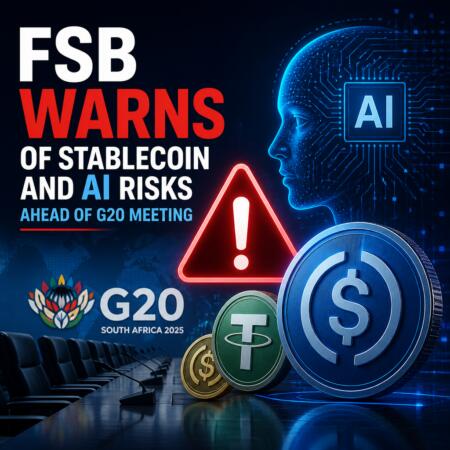
Bailey, who chairs the Financial Stability Board, indicated that stablecoins could pose a threat to financial stability if left without robust international oversight. He stressed concerns about convertibility in stressed conditions, noting that some stablecoins might not be easily redeemable for cash without the involvement of crypto exchanges. The implication is that cross-border use—especially in cross-border payments—could shift capital flows toward jurisdictions with stringent convertibility rules, such as the United Kingdom, which has signaled it intends to implement strong laws governing stablecoin conversion. Bailey warned of potential knock-on effects from a run on a stablecoin, arguing that liquidity crises could push flows toward jurisdictions perceived as having tougher safeguards.
Key takeaways
- Global standards for stablecoins are increasingly viewed as a prerequisite for widespread use in international payments, with potential friction anticipated between the U.K./EU approaches and U.S. policy positions.
- The U.S. stance on stablecoins—informing a framework for issuers under the GENIUS Act—will shape the pace and nature of international regulatory alignment, especially as the Senate weighs a crypto-market structure bill.
- Market size signals broad adoption: stablecoins are currently valued in the hundreds of billions of dollars, with most assets backed by U.S. dollars and U.S. Treasuries, raising implications for central banks, clearing rails, and banking integration.
- Convertibility risk remains a core concern: if stablecoins cannot be readily redeemed for cash in stressed market conditions, regulatory authorities worry about stability and consumer protections, particularly in cross-border contexts.
- Regulatory dynamics will influence institutions’ licensing, oversight obligations, and cross-border operations, including how exchanges, banks, and investors interact with USD-pegged tokens across jurisdictions.
Global standards vs. national frameworks: regulatory tensions and practical implications
International standard-setting bodies and national regulators are contending over how to treat stablecoins as an infrastructural element of global payments. Bailey’s comments, as reported by Reuters, emphasize a view that credible, interoperable standards are essential for stablecoins to mature as legitimate payment rails rather than speculative or siloed financial products. The Financial Stability Board’s mandate to coordinate macroprudential oversight places additional pressure on harmonized rules that can withstand cross-border capital flows and potential liquidity stress scenarios.
Beyond theory, practical considerations loom for regulators and firms. If stablecoins become widely used for cross-border settlement, divergent convertibility standards could lead to a concentration of flows in jurisdictions with favorable or robust frameworks, potentially exposing less-prepared markets to rapid shifts in liquidity or regulatory direction. The United Kingdom’s stated aim of imposing stringent convertibility rules further underscores the policy divergence that international regulators must reconcile to avoid systemic fragmentation.
U.S. policy developments and the legislative horizon
The U.S. policy narrative around stablecoins centers on balancing innovation with safeguards. The GENIUS Act has been cited as a policy pathway to clarify the regulatory status of stablecoin issuers, aiming to attract the crypto sector while providing a framework that reduces ambiguity for market participants. As part of broader congressional oversight, the Senate Banking Committee has scheduled a markup of related legislation, signaling ongoing scrutiny of how stablecoins should be integrated within the existing financial regulatory system.
Disagreement persists on specific provisions, including whether third-party platforms should be restricted from offering yield-bearing services on stablecoins. A recent version of the related bill would ban stablecoin rewards on idle balances, while permitting other forms of customer rewards. The legislative process remains fluid, with lawmakers weighing the balance between consumer protections and the attractiveness of the U.S. regulatory environment for digital-asset firms. This dynamic is likely to influence how other jurisdictions calibrate their own frameworks, particularly in areas of licensing, AML/KYC compliance, and supervisory oversight of stablecoin issuers and their networks.
Market structure, risk, and institutional considerations
From a risk-management perspective, the stablecoin space highlights several critical considerations for financial institutions and policymakers. The market’s USD-centric backing structure—largely funded by U.S. dollars and U.S. Treasuries—creates interdependencies with banking and custody infrastructure. In stressed conditions, convertibility and liquidity become central concerns for risk officers, compliance teams, and regulators seeking to prevent liquidity spirals or runs that could spill over into the broader financial system.
For banks and crypto-asset service providers, the evolving regulatory landscape will determine licensing requirements, permissible activities, and the nature of cross-border settlement arrangements. As authorities sharpen their focus on stablecoins as potential systemic assets, firms must align their risk governance, liquidity management, and customer-on-boarding procedures with anticipated regulatory expectations—particularly around AML/KYC standards and protections against consumer harm. The regulatory emphasis also reinforces the need for transparent reserve disclosures, auditability of backing assets, and robust contingency planning for fast-moving market conditions.
In parallel, policymakers are weighing broader policy implications—how stablecoins intersect with monetary sovereignty, cross-border banking relationships, and the resilience of payment infrastructures. While the United States positions itself as a hub for crypto innovation, other economies are pursuing stricter controls on conversion, custody, and exchange activity, potentially shaping a fragmented but interconnected global playfield. The resulting policy mosaic will require ongoing monitoring by financial institutions, auditors, and compliance teams to ensure alignment with evolving standards and supervisory expectations.
Overall, the trajectory suggests that international collaboration will be essential to meaningful, durable regulation of stablecoins. The coming years are likely to feature continued tension between national interests and the push for harmonization that can support trusted, interoperable payment ecosystems while safeguarding financial stability.
Closing perspective: As regulatory dialogues advance, institutions should anticipate a steadily tighter, more coordinated framework for stablecoins that emphasizes safety, transparency, and cross-border compatibility, with real implications for licensing, reporting, and cross-jurisdiction operations.