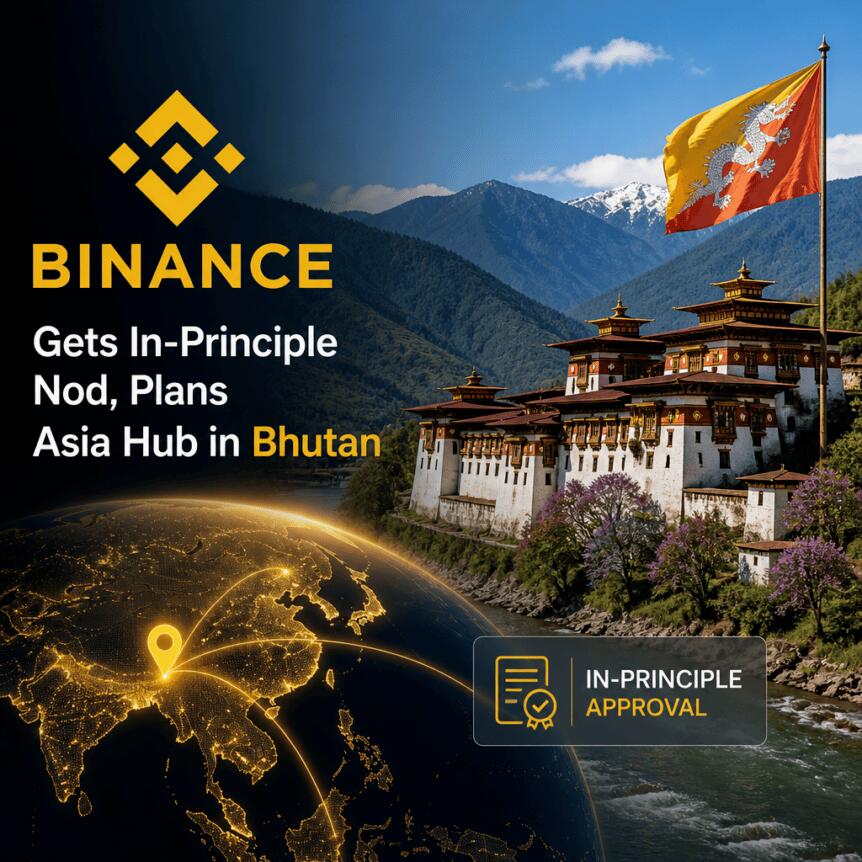
Binance has secured in-principle approval from Bhutan’s Gelephu Central Bank (GCB) to set up regulated digital-asset operations in Gelephu Mindfulness City (GMC). The decision, disclosed in a Saturday PR news release, follows the exchange earlier this year between Binance and Bhutan’s regional vision to build a new financial-services hub in the Himalayan country.
Under the partnership agreement, Binance plans for GMC to become an Asia hub serving Binance users, while continuing development of the local digital-asset ecosystem. The announcement also links the broader push to Binance’s wider engagement in Bhutan, including the company’s crypto-powered tourism payment system launched in 2025.
Key takeaways
- Binance received in-principle approval from Gelephu Central Bank to pursue regulated digital-asset operations in GMC.
- The approval is not a full license; Binance must meet GCB conditions and complete remaining regulatory steps.
- GMC is positioning itself as a new South Asian financial center, using streamlined processes to attract crypto and fintech firms.
- Bhutan’s approach emphasizes authorized presence over “passporting” licenses, according to prior reporting and GMC officials.
What the in-principle approval changes for Binance
While the headline is regulatory permission to move forward, the PR release characterizes the status as an initial step, not the end of the licensing journey. Binance must still satisfy conditions specified by the GCB and complete the remaining requirements before it can operate under a full regulatory framework in Gelephu Mindfulness City.
The difference matters for anyone watching execution: an in-principle green light can enable companies to plan staffing, tooling, and compliance roadmaps—but it does not remove the risk that regulators may require additional documentation, operational adjustments, or phased approvals before a final license is granted.
The release states that Binance will now work directly with Bhutan’s central bank to complete the requirements for full authorization.
GMC’s strategy: jobs, capability-building, and a regulated base
GMC board director Jigdrel Singay framed the approval as more than an operator landing in Bhutan. In remarks included in the PR news release, Singay said the goal is not just to attract global firms to create an entity locally, but to ensure they establish real operations—with meaningful jobs, talent development, and capability transfer that persists in the country over the long term.
That emphasis aligns with the city’s pitch of becoming a regional center for regulated digital-asset activity. In practice, this kind of framing typically signals a focus on local onboarding, governance maturity, and long-term infrastructure—areas that regulators and communities tend to value when emerging jurisdictions seek credibility in financial markets.
From licensing speed to regulatory scrutiny
Cointelegraph previously reported, in May, that GMC offered an accelerated licensing pathway for crypto and fintech firms already regulated in major hubs such as Singapore, Hong Kong, and Abu Dhabi. That earlier reporting also connected the city’s push to wider competition among emerging jurisdictions trying to attract crypto-related business through streamlined regulation, banking access, and tax incentives.
At the same time, the broader global environment has grown more cautious. The PR release and Cointelegraph’s earlier coverage point to regulator concern over regulatory arbitrage, including a warning from the European Securities and Markets Authority (ESMA) in the context of crypto-asset regulation under MiCA.
GMC’s approach, according to Singay’s comments in May as reported by Cointelegraph, is intended not to act as a “passport” for offshore licensing. Instead, firms still need authorization under GMC’s own rules. That distinction is particularly relevant for investors and operators evaluating whether expedited pathways increase certainty—or whether they mainly reduce friction while keeping the ultimate licensing bar unchanged.
Why this matters for Bhutan’s crypto ecosystem
Binance’s new step in Gelephu comes as part of an expanding Bhutan-linked digital-asset narrative. The release ties the regulatory progress to the company’s 2025 launch of a national crypto-powered tourism payment system, and it says Binance intends to keep building out the local digital-asset ecosystem.
For market participants, the key question is what “regulated operations” will translate into once full requirements are completed—such as which activities will be supported, what compliance and custody expectations will apply, and how the city’s banking and licensing framework will work in real conditions. Because the in-principle approval does not represent a full license, those details are likely to emerge only as Binance clears the next regulatory checkpoints with the GCB.
Readers should also watch how quickly the process moves from initial permission to final authorization, especially given that multiple jurisdictions are competing to attract firms while regulators globally tighten oversight. The outcome will show whether GMC’s accelerated approach can deliver both speed and sustained regulatory confidence.
Next, the focus will be on the GCB’s remaining requirements and the timeline for Binance to transition from in-principle approval to full licensing in Gelephu Mindfulness City—an inflection point that could set the tone for how easily other regulated crypto firms may expand into the Himalayan hub.