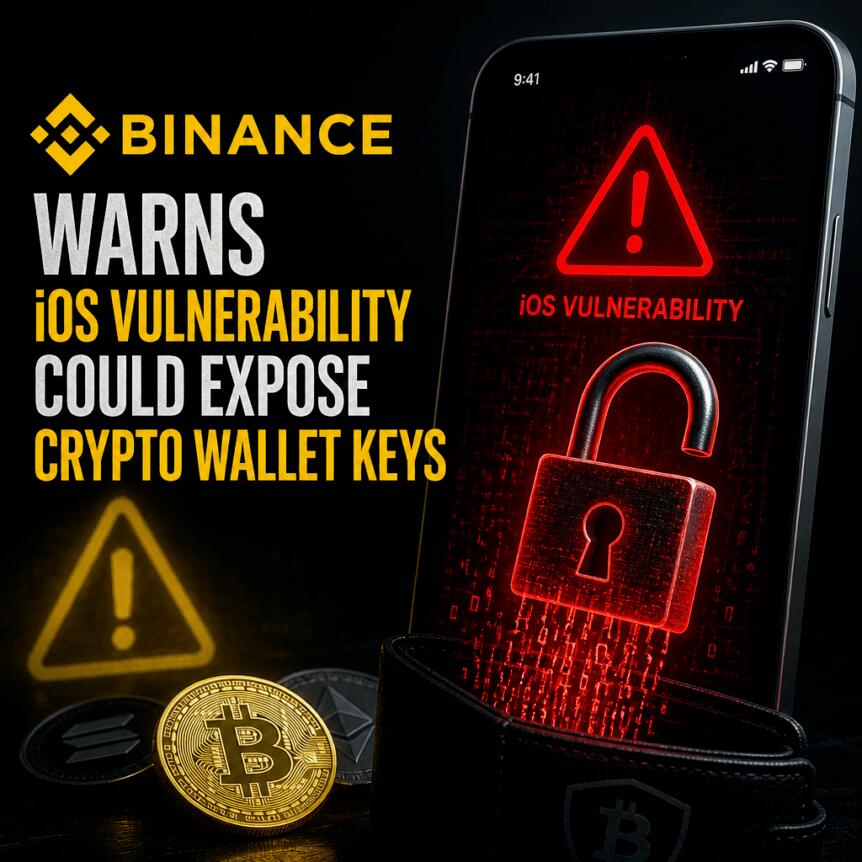
Binance has issued a security warning to iPhone users after flagging an iOS vulnerability that it says could allow malicious applications to access sensitive local data stored by other apps. The exchange’s concern centers on what a compromised system could expose—wallet recovery phrases (seed phrases), private keys, and login credentials—if users install a harmful app on an affected device.
In a post shared on Tuesday, Binance highlighted specific iPhone software versions it believes are impacted, warning that the issue is “an iOS-level issue, not unique to Binance.” As a result, the safest response is not only to secure Binance access, but to treat the underlying iOS risk as a broader threat to the wider ecosystem.
Key takeaways
- Binance says affected iOS versions could enable malicious apps to read local files from other apps, potentially exposing seed phrases, private keys, and login credentials.
- The exchange identifies iOS 26.7.1, 27.0.1, and 27.2 among the versions it believes could be vulnerable.
- Binance stresses the problem is iOS-level, meaning the risk extends beyond Binance accounts and applications.
- Apple released iOS 27.2.1 and 26.7.3 on Monday, but Binance did not confirm whether those updates fully resolve the flaw.
- Binance recommends deleting apps installed from untrusted sources, updating iOS and apps, and—if compromise is suspected—moving funds to new wallets created on clean devices.
What Binance says is happening on affected iPhones
Binance’s warning points to an iOS weakness that, in its view, could let a malicious app access local files belonging to other apps. That matters because crypto wallets and authentication flows often store sensitive material—such as seed phrases and account credentials—somewhere on-device, at least temporarily or via app-specific storage.
Binance’s framing is deliberately broad: it cautions that the exposure risk is not limited to any single exchange product. Instead, the exchange warns that a compromise at the operating system level could put “seed phrases, private keys and login credentials” “at risk across the entire ecosystem.”
Affected iOS versions and why the iOS scope matters
In its post, Binance lists iOS 26.7.1, 27.0.1, and 27.2 as versions of concern. The exchange also emphasizes that this is “an iOS-level issue,” not something tied to Binance specifically. That distinction is important for users deciding how to respond: even if they never interact with a risky app through a crypto platform, compromised applications could still target other apps on the device.
For investors and traders, the practical takeaway is that operational security on mobile devices becomes part of key management. If recovery phrases or authentication details are accessible to an attacker, funds can be threatened even if the exchange itself remains secure.
Apple updates released—uncertainty remains
Binance notes that Apple released iOS 27.2.1 and 26.7.3 on Monday. However, the exchange’s warning also leaves a key unanswered question for users: it is not clear whether either update fully patches the vulnerability described.
This uncertainty matters because iOS “.1” updates are not always straightforward for end users to interpret in terms of security coverage. Until the underlying issue is definitively confirmed to be fixed, users should avoid assuming that updating alone fully eliminates the risk—especially if they already installed an app from an untrusted source.
Binance’s recommended mitigation steps
Binance’s guidance focuses on limiting exposure and, in the worst case, reducing the value of any data the attacker may have already accessed.
First, the exchange urges users to delete any apps installed from untrusted sources. In a scenario where a malicious app can read local files from other apps, removing the likely entry point is a direct way to reduce ongoing risk.
Second, Binance advises updating both iOS and all applications to the latest official versions. Even if the patch status is not confirmed, keeping devices current is still a baseline defensive measure for security vulnerabilities.
Finally, Binance recommends a higher-friction step for users who suspect a breach: transfer funds to new wallets created on clean devices. The implication is clear—if seed phrases or private keys may have been exposed, the safest path is to move away from any wallet that could be compromised. While this step can be disruptive, it addresses the central threat model Binance described: that sensitive key material might be recoverable by an attacker.
For most users, the immediate decision point is whether they installed software from outside trusted app distribution channels and whether suspicious activity is present. Binance’s advice effectively treats untrusted-source apps as a primary risk indicator.
Separately, Binance’s warning comes amid ongoing attention on crypto security and exchange incident response across the industry. Earlier coverage from Cointelegraph noted how hackers moved a substantial portion of stolen Solana and routed funds via THORChain, underscoring that attackers continue to refine tactics once they gain access to wallets and keys.
As for what to watch next, iPhone owners should monitor whether Apple or security researchers confirm that iOS 27.2.1 and 26.7.3 fully address the issue described by Binance—and users who installed apps from untrusted sources should consider whether they need to rotate wallet credentials and move funds to newly generated wallets on verified clean devices.