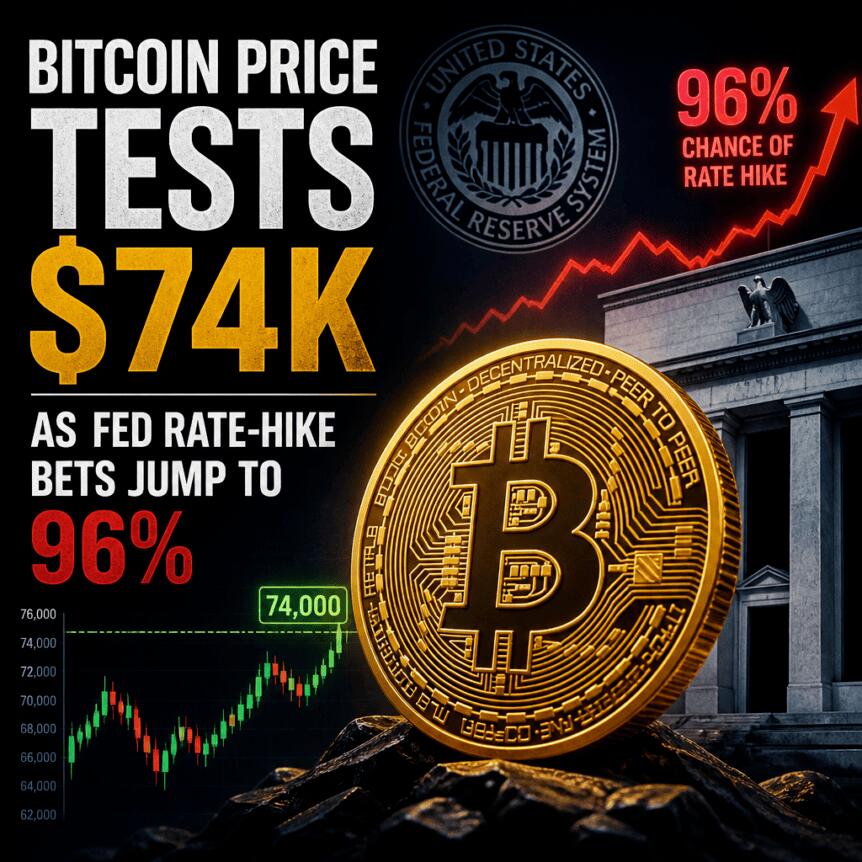
Bitcoin edged lower as US markets digested hawkish signals from the Federal Reserve ahead of a closely watched US inflation release. BTC traded around $74,080 on Bitstamp, down about 1.3% on the day, while Nasdaq 100 futures were also weaker into the Wall Street open.
The catalyst was a speech by Federal Reserve governor Christopher Waller, who said he would support a 25-basis-point rate hike at the Dec. 9 FOMC meeting even if Tuesday’s inflation data turns out better than expected. That stance helped push expectations for December tightening sharply higher shortly after his remarks.
Key takeaways
- Bitcoin fell toward $74,080 on Tuesday as US stock futures eased, reflecting renewed sensitivity to interest-rate expectations.
- October CPI was due at 8:30am Eastern; the consensus called for a 0.3% month-on-month increase, down from September’s 0.6% gain.
- Fed governor Christopher Waller said he would still “support” a 0.25% hike at the Dec. 9 meeting regardless of Tuesday’s CPI outcome.
- Market-implied odds for a December 25-basis-point move jumped to 96.3% after Waller’s comments, according to CME Group’s FedWatch Tool.
- US government shutdown-related data constraints were expected to limit what the CPI release includes for this cycle.
Inflation data meets a Fed official who won’t be “swayed”
According to TradingView data cited in the report, BTC/USD on Bitstamp reached $74,080, down 1.3% over the day. At the same time, US stock futures drifted lower, with Nasdaq 100 futures down about 0.4% at the time of writing.
Across the Atlantic, Waller’s remarks were the immediate driver for risk assets. Speaking at the Bank of England Watchers Conference in London, he said he would back a 0.25% interest-rate increase at the FOMC meeting scheduled for Dec. 9. Crucially, he added that his decision would not depend on Tuesday’s CPI reading.
Tuesday’s US Consumer Price Index (CPI) print was scheduled for release at 8:30am Eastern. The expectation was for the month-on-month increase in October to cool to 0.3%, compared with September’s 0.6% rise, with fuel costs identified as a key factor behind the prior uptick (the earlier price pressure from energy is referenced in related coverage).
“While I am hoping for an improvement over September, even if this occurs, I would still support a 25 basis point increase in the FOMC’s policy rate at our December meeting,” Waller said, adding that “if inflation comes in substantially higher” than his forecast, the Fed could take “more robust action,” according to his speech at the event.
Waller’s comments landed before markets could confirm how much cooling—if any—would show up in the latest inflation snapshot. That timing matters for crypto specifically because Bitcoin and other risk assets often react quickly to shifts in expectations for real yields and liquidity conditions.
CME FedWatch reprices December hike odds to near certainty
Following the speech, markets moved quickly to reprice the likelihood of a December rate hike. Per data from CME Group’s FedWatch Tool, the probability of a 25-basis-point move in December rose from 76.3% to 96.3% shortly after Waller’s remarks.
For traders, that repricing is significant: when the market shifts rapidly toward higher rates being “priced in,” it can tighten financial conditions even if the next data point (like CPI) prints cooler. In other words, the CPI release may influence how far expectations move beyond 25 bps, but it may matter less for whether the Dec. move happens at all—given Waller’s framing.
Fuel prices, shelter costs, and what the next CPI release will actually show
The CPI report that investors were waiting for is especially sensitive to fuel-price volatility. The report also notes that Waller flagged recent strength in the Personal Consumption Expenditures (PCE) index—described as the Fed’s preferred inflation gauge—stating it was the measure targeted by the FOMC.
Waller referenced the “bad” character of September’s inflation data. In that context, he pointed to PCE rising 0.5% month-on-month and 3.7% year-on-year, according to the speech excerpt summarized in the report.
Separate from the Fed official’s remarks, an economist at Natixis CIB Americas—Christopher Hodge—suggested the expected slowdown in core CPI for October could be driven by declines and stabilization in key components. As quoted by CNBC in the report, Hodge linked the slowdown to a “reversion” in shelter prices, including owners’ equivalent rents and lodging away from home, alongside stabilization in diesel prices, which would ease pressure in energy-intensive goods.
There was also a procedural wrinkle for the Tuesday CPI release. The report states that the Bureau of Labor Statistics confirmed the release would include only month-on-month statistics due to the 2025 US government shutdown reducing data availability. It adds that October 2025 CPI data for a prior reference period was not issued for the same reason, underscoring how macro data timing and completeness may affect market interpretation.
For investors, this means the CPI headline can still move rates expectations, but the shape of the data may be harder to compare directly with prior releases. When datasets are constrained, traders often focus more heavily on what’s included and less on comparisons that require missing breakdowns.
Watch whether Tuesday’s CPI reading changes expectations for anything beyond the Dec. 9 policy decision—especially given Waller’s insistence that CPI won’t alter his support for 25 basis points. Even with a cooler print, markets may remain reactive as they reassess how future inflation prints and the broader PCE trend could affect the Fed’s path into 2027.