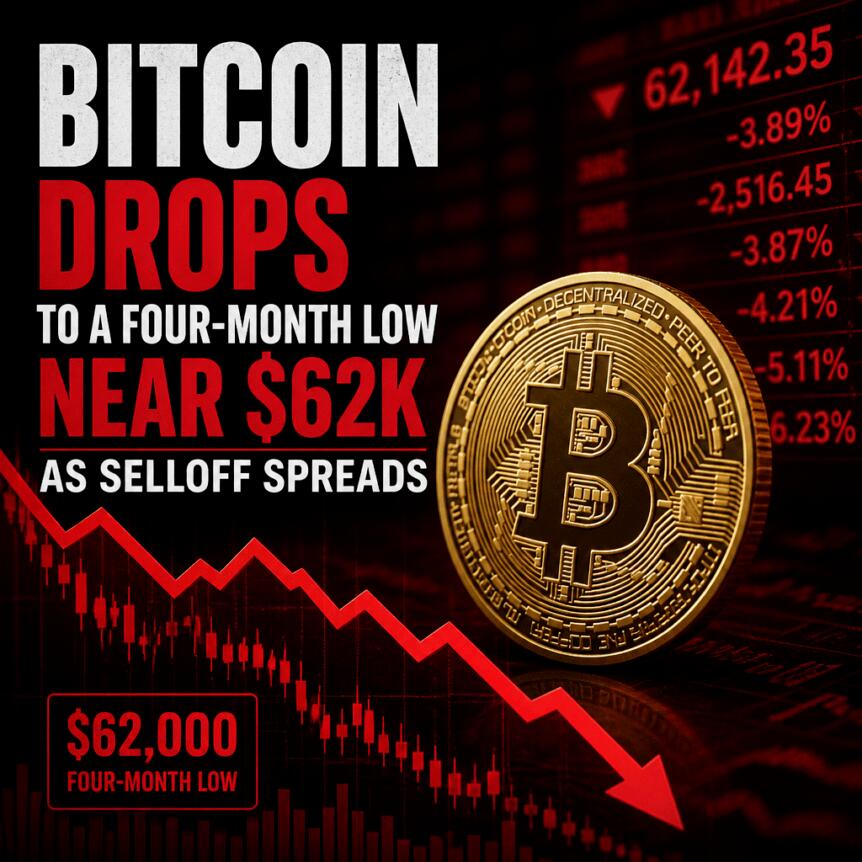
Bitcoin slid to a four-month low near $62,000 on Sunday as the broader cryptocurrency market extended its selloff, dragging several large-cap tokens lower as well. While BTC later recovered part of the drop and moved back above $65,000, losses remained heavy for the week.
According to CoinGecko, Bitcoin fell to a 24-hour low of $62,080.91 on Sunday—its weakest level since July. Despite the rebound, BTC was down nearly 15% over the past seven days. The pressure was not limited to Bitcoin: CoinGecko data showed Ether (ETH) down 19.5% for the week and Solana (SOL) down 20.7%.
Key takeaways
- Bitcoin reached $62,080.91 on Sunday, the lowest level since July, before partially rebounding above $65,000.
- CoinGecko shows broad weakness across majors, with ETH down 19.5% and SOL down 20.7% over the past week.
- The total crypto market value fell about 4% in 24 hours to $2.26 trillion, per CoinGecko.
- Market mood deteriorated further: the Crypto Fear & Greed Index dropped to 10 (“extreme fear”) from 13 Saturday and 20 Friday, according to Alternative.me.
- US spot Bitcoin ETF flows have added to the strain, with reported net outflows of $2.35 billion over two consecutive weeks.
Bitcoin’s four-month low and the rebound that wasn’t enough
Bitcoin’s move to the $62,000 area marked a fresh downside milestone for the market, with CoinGecko identifying the drop as BTC’s weakest point since July. The subsequent bounce above $65,000 suggests sellers may have paused at lower levels, but the broader trend still looks bearish given the depth of the weekly drawdown.
The key takeaway for traders and portfolio managers is that the recovery has not yet translated into a return to the levels that typically stabilize sentiment. With BTC still down close to 15% on the week at the time of reporting, Sunday’s dip appears to have reinforced a risk-off tone rather than reversing it.
Altcoins join the decline as liquidity and sentiment weaken
Sunday’s risk-off action extended across other major networks. CoinGecko data placed ETH at a week-to-date loss of 19.5% and SOL at 20.7%, highlighting that the selloff was broad rather than isolated to a single asset or narrative.
At the market level, CoinGecko reported the total value of cryptocurrencies falling roughly 4% over 24 hours to $2.26 trillion. When broad-based losses like this occur alongside weaker sentiment readings, they often point to liquidity tightening—where even assets with strong fundamentals struggle as capital rotates out of risk.
Fear gauges sink further into “extreme fear”
Sentiment indicators also moved deeper into the red. Alternative.me’s Crypto Fear & Greed Index fell to 10 on Sunday, down from 13 on Saturday and 20 on Friday, remaining in “extreme fear.”
This matters because sentiment gauges tend to reflect how aggressively investors are willing to buy dips. When the index stays pinned at very low levels, it can signal that sidelined participants are still waiting for clearer confirmation—either from price stabilization, improved ETF flow data, or shifts in macro and liquidity conditions.
The decline followed earlier market stress, including a reported slide below $70,000 on Friday, as coverage noted weakening investor sentiment and concerns about institutional outflows and tighter liquidity.
Spot Bitcoin ETF outflows add pressure
A major part of the bearish backdrop has been the flow data from US spot Bitcoin ETFs. Cointelegraph reported that the funds posted $2.35 billion in net outflows over two consecutive weeks, after previously showing sustained pressure.
According to that reporting, the week ended Nov. 13 saw the ETFs lose $1.07 billion, following outflows of $1.28 billion the previous week. In the same narrative, BlackRock’s iShares Bitcoin Trust reportedly extended its outflow streak to 11 trading sessions on Friday.
In practical terms, persistent outflows can reduce immediate bid support from the most common institutional access point for BTC. While ETF flows do not determine price in isolation, a sustained pattern of withdrawals can make it harder for the market to absorb sell pressure—especially during periods when broader sentiment is already deteriorating.
What to watch next
With BTC at a multi-month low and sentiment stuck in “extreme fear,” the next signals investors may look for are whether ETF outflows continue or begin to stabilize, and whether the market can hold above the rebound zone after Sunday’s bounce. If weakness broadens again, the $62,000 area could become a focal point for further downside; if it holds, it may be the starting point for a more durable consolidation.