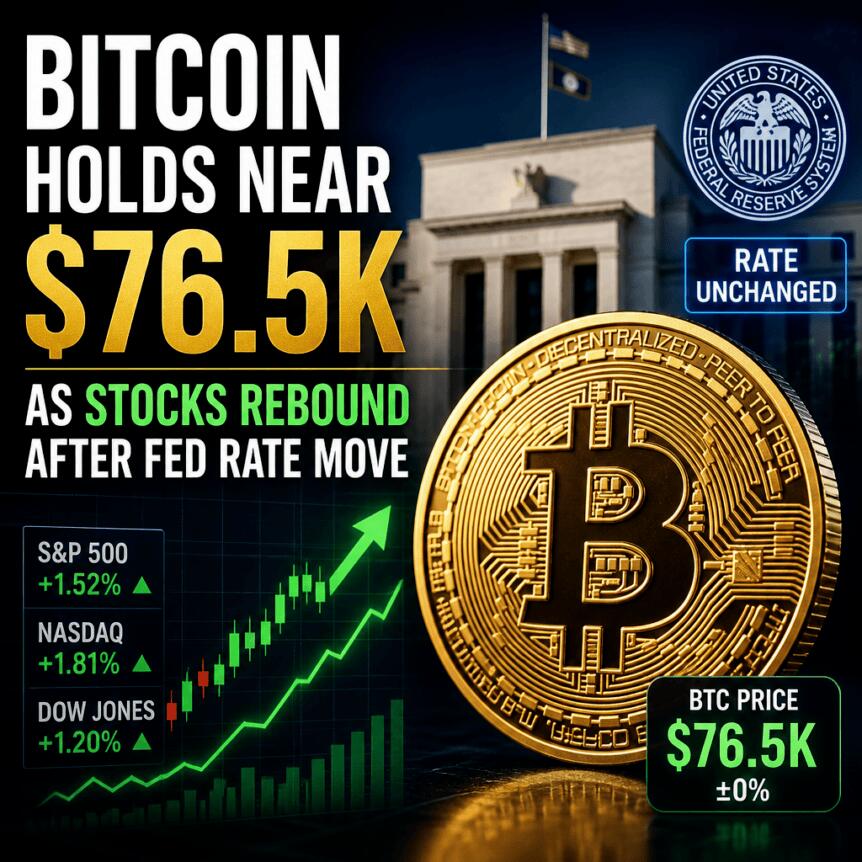
Bitcoin hovered near $76,500 in the hours after Wall Street opened, as a rebound in U.S. equities helped ease pressure on risk assets following the latest Federal Reserve decision. The move came after BTC slipped below $76,000 during the initial reaction to the Fed’s 25-basis-point increase in benchmark rates.
For traders, the key dynamic was less about a new burst of buying and more about stabilization: volatility appeared to cool over the prior 24 hours, liquidity around current levels thickened, and on-chain sentiment signals remained supportive—though not at peak “bullish conditions.”
Key takeaways
- BTC held close to $76,500 after consolidating following a dip below $76,000 tied to a 0.25% Fed rate hike.
- U.S. stocks rebounded, with the Nasdaq Composite up 1.5% and the S&P 500 gaining 0.9%, helping sentiment across high-beta markets.
- TradingView data pointed to cooling BTC volatility and only modest price moves, consistent with range trading.
- CryptoQuant’s Bull Score Index fell to around 60/100—still labeled “bullish,” but below levels associated with stronger momentum.
Range trading returns as equities find a bid
BTC’s near-term behavior looked more controlled than directional. According to TradingView, volatility eased over the last day, while price action largely stayed within the bounds needed to interact with nearby liquidity rather than driving a breakout or breakdown.
CoinGlass data also suggested a typical “two-sided” market: bid and ask liquidity thickened around spot levels, a pattern frequently associated with consolidation. In practical terms, this often means fewer aggressive liquidations and less forced repositioning—conditions that can keep traders from chasing until a catalyst reappears.
That catalyst, in this case, was partly external. U.S. equities turned higher after a policy-driven wobble, with major indexes finishing the day up on the session. The S&P 500 gained 0.9% and the Nasdaq Composite rose 1.5%, giving risk markets a fresh footing.
The Fed decision landed the day before: on Wednesday, it voted to increase benchmark interest rates by 25 basis points to 3.75%–4.0%, its first hike since July 2023. The move ended a long stretch in which the Fed had either cut rates or held them steady across prior meetings.
Earlier coverage from Cointelegraph highlighted the broader cross-market tone, noting that central-bank rates have been rising globally. In that context, the Fed’s shift fits a wider pattern: the European Central Bank delivered a 0.25% hike last week, and the Bank of Japan was expected to follow on Friday.
The Kobeissi Letter argued that assets could still perform well even if rate hikes tighten liquidity conditions, pointing to the Nasdaq’s gains as an example.
On-chain analytics: bullish trend remains, momentum fades
Bitcoin’s recent trajectory has been uneven. The article noted that after a Tuesday selloff—when BTC/USD hit new month-to-date lows—Bitcoin bounced, trading about 0.5% higher at the time of writing.
But the question for investors is whether that rebound is just pausing or actually restarting. CryptoQuant, in its latest weekly research shared with Cointelegraph, framed current conditions as supportive on the longer arc while less favorable for near-term momentum.
CryptoQuant’s head of research, Julio Moreno, said the trend is still bullish, yet macro factors and fading demand are weighing on continuation. He pointed to one of CryptoQuant’s proprietary measures: the Bull Score Index, which gauges whether market conditions fit CryptoQuant’s definition of “bullish” phases.
Moreno noted that the Bull Score Index had fallen from 80 to 60. While 60 sits at the threshold CryptoQuant uses to describe “bullish conditions,” it is also a clear step down from the higher-score environment that typically aligns with stronger momentum. In CryptoQuant’s view, this is why Bitcoin may look like it’s holding the floor without immediately resuming a sustained advance.
In the same report, CryptoQuant summarized the takeaway as “cooling, not turning.” The firm maintained that a Bull Score of 60 keeps the trend bullish, but it highlighted several offsetting pressures: fading U.S. demand, rising inflows into altcoins, and a week of macro risk that includes the delay of the CLARITY Act and the expectation of a Fed hike.
The practical implication is that investors may need to prepare for consolidation rather than assume the prior rebound automatically extends. CryptoQuant also identified levels to watch: $70,000 and the $62,000–$65,000 band as potential support zones.
What traders should watch next in a tightening-liquidity regime
The market is now digesting a key shift: the Fed has moved back into the hiking cycle after a pause period that spanned roughly three years of easing or rate holds. That matters because higher rates can change how capital flows across asset classes—often first through liquidity expectations and then through risk appetite.
Still, the immediate tape showed that equities can quickly swing back, and when that happens Bitcoin tends to respond as part of the broader risk complex. The combination of reduced volatility on the TradingView feed and thickening liquidity near spot suggests there is no urgent technical breakdown at the moment.
For participants, the next layer is monitoring whether the on-chain trend can stabilize despite macro headwinds. CryptoQuant’s Bull Score hovering around its “bullish conditions” cutoff is a reminder that the market’s internal momentum is no longer as strong as during earlier phases.
Looking ahead, the most important signals will likely be whether BTC can reclaim upside momentum without a fresh wave of macro pressure, and whether support zones identified by CryptoQuant hold if consolidation deepens. If liquidity conditions tighten again or equity volatility returns, Bitcoin’s range could widen rather than resolve cleanly.
Readers should watch how the Bull Score Index develops from this threshold area and whether $70,000 and the $62,000–$65,000 support band stay intact as the market continues to weigh central-bank policy expectations.