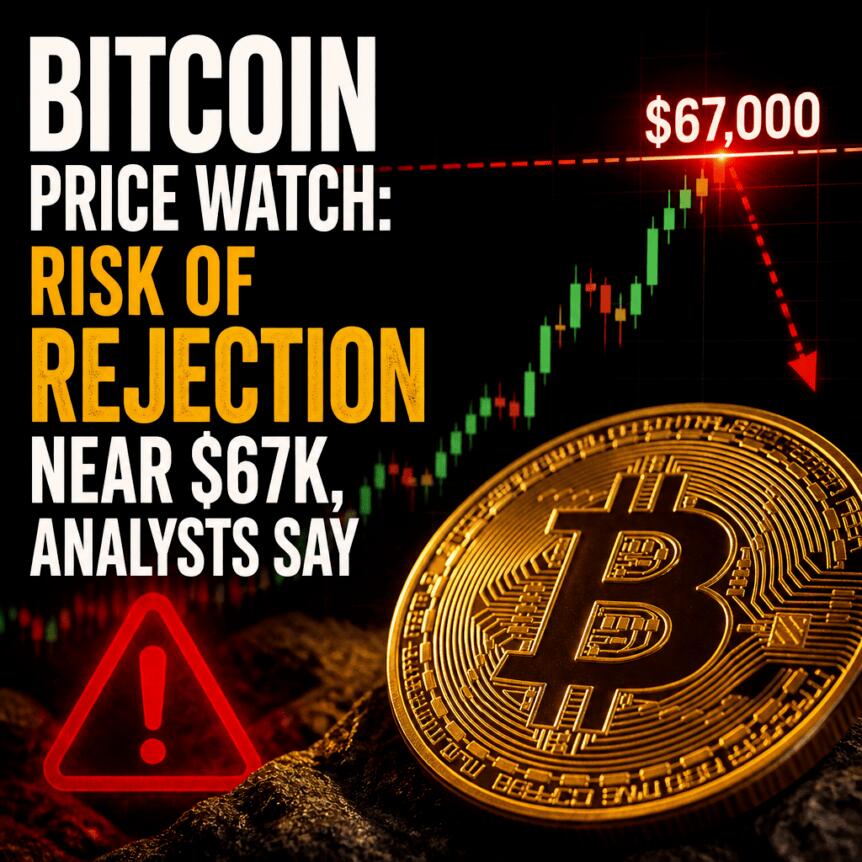
Bitcoin hovered just below the $67,000 mark at the Wall Street open on Monday, buoyed by a risk-on mood linked to improving US-Iran signals. Equity benchmarks pushed higher on the same day, reinforcing the broader “macro tailwind” backdrop traders have been watching closely.
Even so, market participants were divided on whether this latest bounce is the start of a sustained uptrend or simply a short-lived relief rally. Multiple commentary threads pointed to thin order-book conditions and positioning around key levels—factors that can amplify both upside moves and sudden reversals.
Key takeaways
- BTC’s rally accelerated near the US open as the S&P 500 and Nasdaq Composite gained as much as 2.4%, reflecting a wider risk-asset lift tied to US-Iran developments.
- Traders highlighted the importance of liquidity pockets around $67,000, suggesting price may react sharply if order-book depth remains light.
- CoinGlass data indicated BTC sweeping short liquidations during the US open window, consistent with momentum-driven price moves.
- Glassnode pointed to “supportive” options market conditions near a dense cluster around $65,000 and said accumulation trend scores have turned higher since BTC’s drop to $60,000.
- Despite constructive signals, some traders cautioned it may be “too early” to declare a bottom, warning that additional chop and untapped liquidity below could still matter.
Macro-driven bid lifts BTC toward $67,000
According to TradingView, BTC/USD gained about 1.5% from the weekly close leading into Monday’s Wall Street session. The move tracked broader market strength: details of an Iran ceasefire agreement, scheduled to be signed later in the week, were described as a driver of upside in US equities, with the S&P 500 and Nasdaq Composite each adding up to 2.4%.
Separately, US President Donald Trump said via Truth Social that shipping traffic through the Strait of Hormuz oil route was already increasing. In his post, he wrote: “Ships are starting to move, many loaded up with Oil, out of the Strait of Hormuz.” The implication for markets is straightforward—improved expectations around energy supply risks typically reduce uncertainty and can support risk appetite across asset classes.
Traders debate whether the relief rally can hold
Within crypto trading circles, attention quickly shifted from the macro trigger to the local price structure near $67,000. One trader, identified as Killa on X, said the week “is shaping up to be very interesting,” pointing to a potential rejection scenario above $67,000 as BTC tests the level.
At the same time, JDK Analysis cautioned that declaring a durable bottom might be premature. In a post shared on the same day, JDK argued that there are signs of a break in major resistance and “acceptance back into previous value,” which could “open the door for a larger move to the upside.” But the account emphasized that strong bottoms typically take time and warned to expect more choppy trading and to remain mindful of a “major pocket of untapped liquidity below.”
“That said, strong bottoms take time. I still expect more chop, and there is still a major pocket of untapped liquidity below that shouldn’t be ignored.”
Liquidity, liquidation sweeps, and options positioning
Several observers linked BTC’s momentum to market microstructure. Commentator Exitpump said it has been “easy” to push the price higher due to thin order-book liquidity both above and below current levels. When liquidity is sparse, even moderate demand can move price quickly—while also making it more sensitive to shifts in positioning.
CoinGlass data, as referenced in the report, showed BTC/USD sweeping short liquidations around the US open. Liquidation cascades can temporarily accelerate rallies by forcing leveraged short positions to unwind, but they also tend to run their course once the forced sellers are cleared—leaving the market to either build organic demand or stall.
On the derivatives side, Glassnode flagged conditions in options markets as “supportive.” In a post on X, Glassnode described BTC pushing back into a dense cluster of options positioning near $65,000 and argued that as price enters these zones, dealer hedging flows can become more supportive. Glassnode framed this as a stabilizing mechanism after a period of elevated volatility.
Glassnode also suggested that demand is returning after BTC’s move down to the $60,000 area. In a separate X post, the firm said Accumulation Trend Scores have turned higher across multiple wallet cohorts, indicating that supply may be getting absorbed as investors step in following the decline.
What to watch next as positioning matures
With BTC hovering near $67,000, the near-term question is whether the market can translate liquidation-driven momentum into sustained buying without needing fresh macro catalysts. Traders will likely watch whether order-book thinness continues to amplify moves, and whether the $65,000 options cluster mentioned by Glassnode can help stabilize price—or instead becomes a reference point for profit-taking.