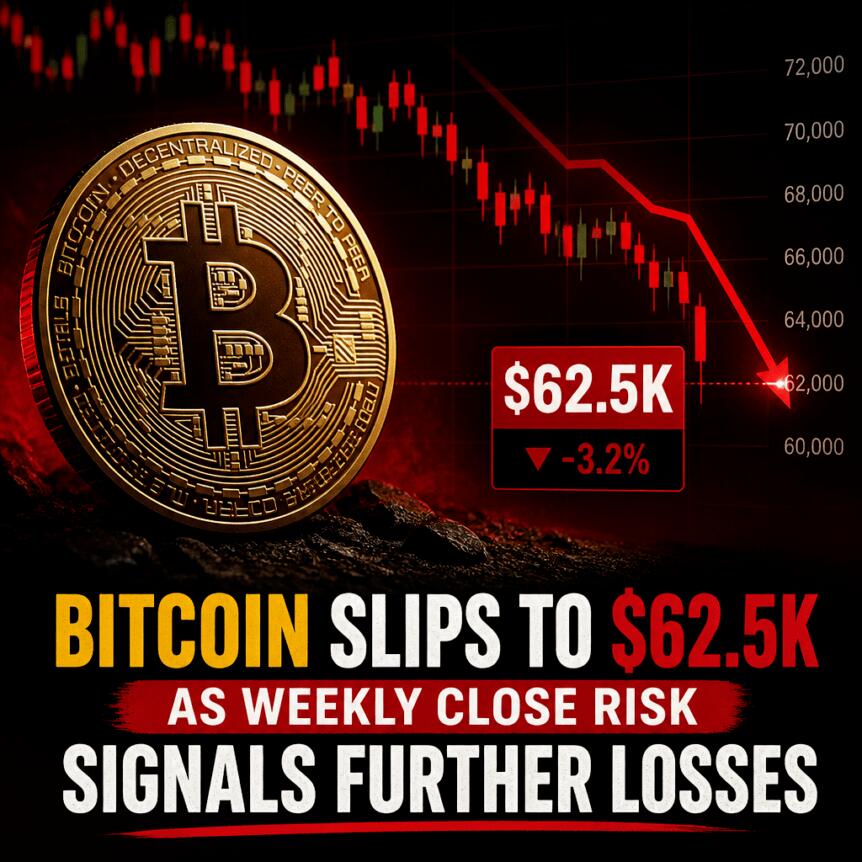
Bitcoin moved lower into Friday’s Wall Street open, with traders increasingly focused on whether the market is setting up for a renewed downside break. While broader risk assets managed to hold momentum after encouraging US inflation developments, BTC failed to participate, slipping toward month-to-date lows around the low-$62,000s.
Market attention has now shifted to the next major US macro release: the Aug. 26 Personal Consumption Expenditures (PCE) index, which is the Federal Reserve’s preferred inflation gauge. QCP Capital said the crypto sector’s muted response to softer inflation so far makes the upcoming PCE print especially important for what comes next.
Key takeaways
- BTC is trading below $63,000 and is nearing new August lows, despite US equities hitting record highs.
- Rekt Capital highlighted $63,220 as a weekly-close threshold, warning that staying below it could encourage a deeper breakdown.
- TradingView data showed BTC down about 1.3% on the day to roughly $62,570, near month-to-date lows.
- QCP Capital pointed to the upcoming Aug. 26 PCE release as the next critical test for whether macro tailwinds can translate into sustained crypto demand.
BTC underperforms as stocks press to new highs
According to TradingView, BTC/USD was down about 1.3% on the day to $62,570, trading close to its lowest levels month-to-date. This comes as US stocks continued to climb, with the S&P 500 and the Nasdaq Composite both posting gains by the time of writing on Thursday’s close—an environment that has typically supported risk-on assets.
The divergence matters because it suggests Bitcoin is not simply tracking the improving equity tape. Earlier coverage noted that inflation relief in the US had reduced expectations for further interest-rate pressure, but Bitcoin still lacked the follow-through traders often look for when macro conditions improve.
$63,220 on weekly close as a decision point
One of the clearest near-term signposts is $63,220. Trader and analyst Rekt Capital warned that the Sunday weekly close needs to be above that level to avoid setting up what he described as “a breakdown.” In a post on X, Rekt Capital also stressed that $63,000 is no longer behaving like reliable support after weakening throughout August.
Rekt Capital further tied the current structure to prior market behavior, noting that a 50-month exponential moving average (EMA) near $65,827 appears to be acting as resistance. He framed this as reminiscent of the 2022 bear-market pattern, emphasizing that BTC has recently struggled to reclaim key levels that would normally help stabilize price action.
For traders, the practical implication is straightforward: the market is approaching a level where confirmation could shift from “range behavior” to “trend continuation lower” if price fails to regain momentum on the weekly timeframe.
Derivatives positioning and liquidation risk remain in focus
The caution around a potential breakdown has also been linked to positioning in derivatives markets. Earlier coverage from Cointelegraph reported increasing odds of a liquidation event as BTC approached an area of liquidity around $61,000, alongside rising open interest (OI) in futures and other derivatives venues.
That setup can amplify volatility when price breaks downward, particularly when leverage is concentrated on one side of the market. In a recent edition of its newsletter, onchain analytics platform Glassnode summarized the broader imbalance: “Traders have added substantial risk, most of it long, into a market that shows no matching demand,” according to The Week Onchain.
In this context, the market’s inability to rally alongside stocks becomes even more notable—if demand doesn’t show up when price is supported by the macro narrative, leveraged long positioning can become vulnerable quickly when technical levels fail.
PCE on Aug. 26 becomes the next macro catalyst
Beyond technical levels, QCP Capital argued that the crypto market’s response to improved inflation conditions has been inconsistent. In its latest analysis, QCP said the phenomenon is “increasingly important,” distinguishing between “resilience” and “momentum.” The firm noted that BTC absorbed several negative headlines without a sustained breakdown last week, but that softer inflation data have only produced a muted response so far.
QCP’s key point for investors is that the market may be waiting for a more decisive macro signal rather than reacting to incremental improvements. The firm said macro traders are now focused on the Aug. 26 PCE index release—widely recognized as the Federal Reserve’s preferred inflation gauge.
According to data referenced by QCP, the PCE “last print” in July marked its first monthly decline since 2020, based on figures from the Bureau of Economic Analysis. That makes the upcoming reading notable: if the data reinforces a cooling inflation trend, traders may look for whether crypto can finally convert the narrative into sustained buying demand rather than staying range-bound or weakening.
At the same time, the key uncertainty is timing and translation. So far, the pattern described by QCP suggests that macro relief hasn’t yet been strong enough to move crypto into a clear uptrend. With BTC sitting below key technical thresholds, the PCE release could influence whether leveraged traders choose to reduce risk or add exposure—potentially affecting volatility regardless of the direction of inflation prints.
Heading into the Aug. 26 PCE report, traders will likely watch both the weekly technical level near $63,220 and whether derivatives positioning continues to build risk on the long side. If BTC remains unable to reclaim that threshold, the market may be setting up for sharper downside moves; if it does recover, investors will want to see whether the macro narrative finally produces sustained momentum rather than a brief relief rally.