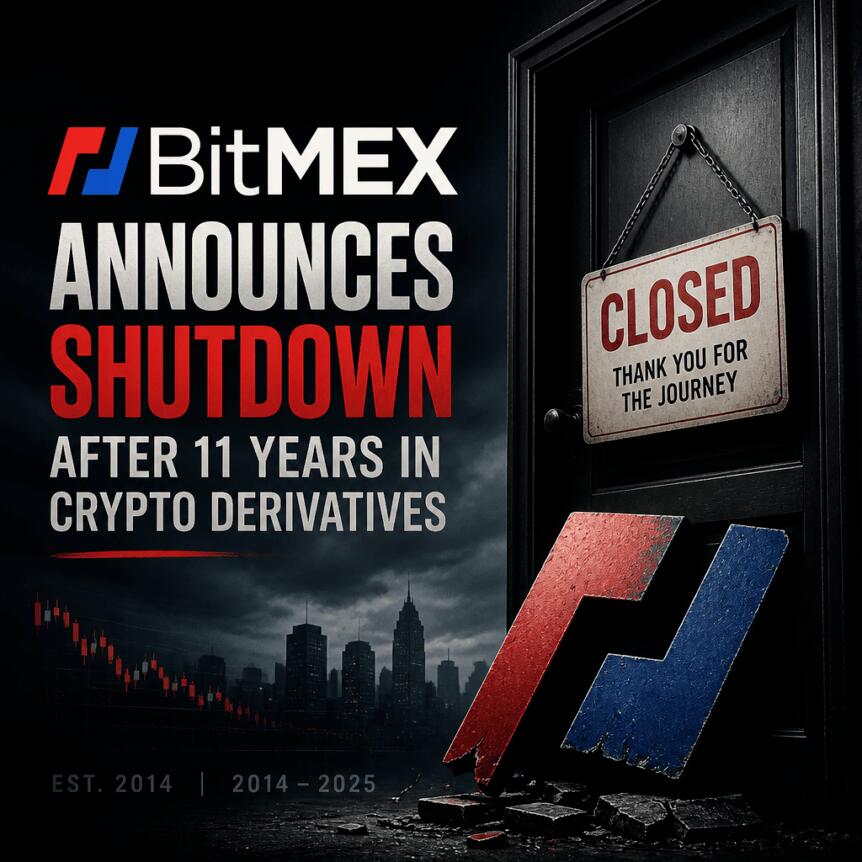
BitMEX, a landmark crypto derivatives exchange that helped popularize perpetual swaps, is shutting down its trading services. The company says it will stop exchange operations on Sept. 23, 2026, at 04:00 UTC, urging users to close positions and withdraw funds before the deadline.
BitMEX’s owner and operator, HDR Global Trading Limited, decided to close the exchange following a strategic review. In an announcement shared with users, BitMEX said it wants to reassure customers that their assets remain “fully safe and under your control during this transition period,” while declining to provide additional details on the reasons behind the decision.
Key takeaways
- BitMEX will cease trading services on Sept. 23, 2026 at 04:00 UTC, after stopping new account registrations immediately.
- Risk limits introduced on Aug. 26, 2026 will prevent opening new positions while allowing users to reduce existing exposure.
- BitMEX says it will close remaining open positions at shutdown time to wind down markets in an orderly way.
- Users who don’t withdraw by the end will still be able to access wallet balances and historical transaction records after trading stops.
- The closure comes amid recent executive departures, with Peter Wilkinson stepping in as CEO.
Shutdown timeline: from account freeze to forced closes
BitMEX said it stopped accepting new account registrations immediately, but will continue operating normally until the scheduled closure date. The exchange then plans to tighten trading conditions ahead of time: on Aug. 26, 2026 it will implement risk limits designed to stop users from opening additional positions while still permitting them to close or reduce existing positions.
At the moment trading shuts down, BitMEX says it will force-close any remaining open positions. The exchange framed this as part of an “orderly wind-down” process intended to bring derivatives markets to a close cleanly rather than leaving positions active without a functioning trading venue.
BitMEX also advised users to withdraw their funds before Sept. 23, 2026. The exchange noted that while wallet balances and historical transaction records will remain accessible after trading services end, users should not assume they will be able to continue interacting with the exchange as they have in the past.
Withdrawal warnings and proof-of-reserves process
In its user communication, BitMEX warned about potential phishing attempts and fake withdrawal offers, emphasizing that it does not offer an expedited withdrawal service. BitMEX also indicated it may apply additional withdrawal reviews and network restrictions during the transition period if withdrawal activity spikes.
The exchange further stated that its proof-of-reserves and liabilities process shows user assets exceed liabilities. While BitMEX did not add new performance metrics or third-party verification details in the available text, the company’s decision to reference this process suggests it wants users to understand the basis of its solvency assurances as it transitions out of operations.
What led to the closure: strategic review and leadership change
BitMEX’s shutdown follows a leadership transition and a decision by HDR Global Trading Limited to close the business after a strategic review. The exchange did not disclose further factors behind the decision, and it did not provide additional comments beyond the user-facing assurances.
According to BitMEX, CEO Stephan Lutz, chief financial officer Ina Steiner, and chief growth officer Raphael Polansky departed last month. Peter Wilkinson—previously BitMEX’s general counsel and chief operating officer—has taken over as CEO.
The timeline matters for market participants because leadership departures often coincide with shifts in risk posture, product strategy, or operational priorities. In this case, however, BitMEX did not connect the leadership changes directly to the closure rationale, leaving users to interpret the strategic review in the context of a broader industry transition.
BitMEX’s role in derivatives—and why the shutdown lands now
BitMEX launched in 2014 and became widely known for introducing the 100x leverage perpetual swap—an instrument that enables traders to speculate on crypto prices without a fixed expiry date. Over time, BitMEX said the product became one of the most traded in the crypto industry and was adopted by thousands of users and other exchanges.
The exchange’s exit reflects a market reality that has been shifting for some time: decentralized derivatives platforms are capturing increasing attention and liquidity relative to traditional centralized venues. The available report notes that, according to CoinGecko’s Q2 2026 Crypto Industry Report, CEX perpetual futures volume fell 10% to $12.7 trillion during the quarter, while decentralized platforms continued gaining ground.
Within that decentralized growth narrative, Hyperliquid is highlighted as a leading decentralized perpetual exchange. CoinGecko’s report ranks Hyperliquid second by open interest behind Binance. This kind of data point underscores why BitMEX’s closure may resonate beyond its user base: it’s the winding down of a pioneering CEX derivatives venue at a time when traders increasingly have competitive decentralized alternatives.
How users should think about the end of trading
For BitMEX customers, the most practical takeaway is timing: the exchange will block new position creation starting Aug. 26 and will close remaining positions at the shutdown moment, while also urging users to withdraw ahead of Sept. 23. In the final stretch, users should also be alert to withdrawal-related social engineering, especially given BitMEX’s explicit warning about fake withdrawal offers and phishing.
Looking ahead, the key uncertainty for market participants is not whether balances and records will remain available—BitMEX says they will—but how the wind-down will be experienced by individual traders with open exposure, and whether broader liquidity continues flowing to other venues as BitMEX exits. With decentralized perpetuals still expanding their footprint, users should watch how open interest and order flow redistribute in the weeks following the account-freeze and risk-limit milestones.