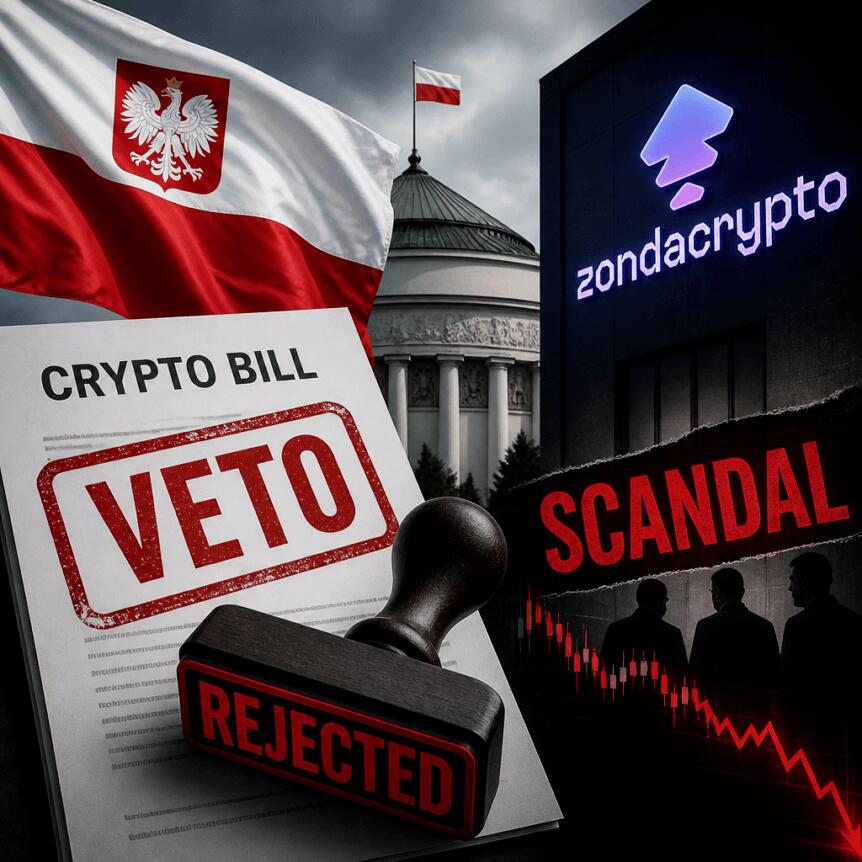
Poland’s lawmakers have again fallen short of the supermajority required to overturn President Karol Nawrocki’s veto of a bill intended to tighten crypto oversight. On Friday, the Sejm voted 241-198 to override the veto, but with three abstentions the measure missed the 266 votes needed by 25—marking yet another failed push to set a national framework for applying the EU’s Markets in Crypto-Assets Regulation (MiCA).
The renewed vote comes as Poland grapples with fallout from the Zondacrypto scandal. The case has widened amid bankruptcy proceedings against Zondacrypto’s Estonian operator and references by Prime Minister Donald Tusk to testimony alleging improper attempts to influence political figures.
Key takeaways
- The Sejm’s override attempt failed 25 votes short of the 266 needed for passage, leaving Nawrocki’s veto in place.
- The bill would have assigned crypto market supervision to Poland’s Financial Supervision Authority (KNF) as MiCA applies across the EU.
- KNF has said Poland still lacks a designated authority responsible for supervising cryptoassets, despite MiCA already taking effect in the EU.
- Meanwhile, prosecutors are investigating alleged fraud and money laundering tied to Zondacrypto, with losses previously estimated at no less than 350 million PLN.
- Zondacrypto’s operator, BB Trade Estonia, was declared bankrupt by an Estonian court, according to the public notice released in August.
A veto override misses the threshold again
Friday’s parliamentary vote was the latest attempt to advance Poland’s crypto regulatory plan after Nawrocki vetoed related legislation three times, arguing the rules would overregulate the industry. The president has said he supports regulating crypto but believes the bill’s approach goes too far, including concerns about compliance costs and the authorities’ ability to block websites.
In the Sejm’s vote, lawmakers backed the override 241-198, with three abstentions. The constitutional requirement of a three-fifths majority was therefore not met, preventing the bill from moving forward despite parliamentary support.
For market participants, the repeated vetoes underline a central uncertainty: while MiCA is the EU-wide backbone, domestic legislation is still needed to determine who will supervise crypto activity and enforce the rules in practice. Without that clarity, firms may face continued regulatory ambiguity around licensing, oversight procedures, and enforcement coordination.
Poland still has no designated crypto supervisor under MiCA
At the heart of the dispute is how MiCA should be implemented in Poland. The vetoed legislation aimed to establish Poland’s national framework for applying MiCA, including placing oversight of the crypto market under the Polish Financial Supervision Authority (KNF).
KNF said Friday that Poland still lacks a designated authority responsible for supervising the cryptoasset market, despite MiCA already applying across the European Union. The statement is significant because MiCA’s effectiveness for businesses depends not only on EU-level rules but also on national enforcement structures and supervisory responsibilities.
Nawrocki’s position contrasts with the urgency emphasized by regulators and government stakeholders. While the president does not oppose crypto oversight outright, his vetoes repeatedly cite concerns that the proposed Polish framework would impose excessive burdens or grant powers he views as too broad.
Investors and crypto firms watching Poland should pay attention to how this supervisory gap is handled in the absence of an operational national regime. The longer Poland remains without a designated supervisor, the more likely it becomes that compliance and enforcement decisions could be delayed or fragmented compared with other EU member states that have already implemented their supervisory arrangements.
Zondacrypto investigation expands as operator heads to bankruptcy
Friday’s parliamentary vote took place against the backdrop of a deepening criminal investigation linked to the failed crypto exchange Zondacrypto. Prime Minister Donald Tusk disclosed excerpts from what he described as testimony from a key witness, alleging payments and attempts to influence politicians connected to Poland’s previous government.
Tusk said the witness alleged a 2 million Polish zloty ($550,000) payment arrangement involving a foundation linked to former Justice Minister Zbigniew Ziobro. In separate testimony cited by Tusk, the witness alleged an unnamed person promised to secure a presidential pardon if the witness were convicted.
Polish prosecutors are investigating suspected fraud and money laundering connected to Zondacrypto. Earlier in the process, prosecutors merged the Zondacrypto case with a probe into the 2022 disappearance of Sylwester Suszek, founder of BitBay, which was later renamed Zondacrypto.
Prosecutors in April estimated that losses linked to Zondacrypto were no less than 350 million PLN ($95 million). Such figures are likely to keep pressure on policymakers to strengthen oversight and enforcement mechanisms—particularly around exchanges and custody-related risks.
In parallel with the criminal investigations, the exchange’s operator, BB Trade Estonia, has been pushed toward formal insolvency. An Estonian court declared the company bankrupt in August, with the first creditors’ meeting scheduled for Sept. 17, according to a public notice.
For users and creditors, bankruptcy can shift priorities from tracing wrongdoing toward asset recovery and claims verification. For regulators and legislators, the Zondacrypto episode adds urgency to establishing clear oversight structures—especially if supervisory authorities are expected to monitor compliance risks that failed entities allegedly exploited.
Why the regulatory fight matters beyond one country
Poland’s standoff is not just a domestic political contest. It highlights a broader tension in the EU’s post-MiCA transition: even when the rulebook is defined at the European level, member states still control the speed and structure of enforcement through domestic legislation and supervisory mandates.
With KNF previously stating that a designated authority for supervising cryptoassets is still missing, the impact is practical. Firms aiming to comply with MiCA may find it difficult to map responsibilities when the supervisor’s role is uncertain, while regulators may face challenges coordinating enforcement without a clear institutional lead.
The Zondacrypto case also raises the political salience of crypto oversight. As criminal investigations expand and insolvency proceedings develop, policymakers may come under increased pressure to align regulatory authority, investigative capacity, and compliance requirements—particularly for platforms operating at the center of investor funds and custody arrangements.
What readers should watch next is whether lawmakers attempt another override vote or if the government and regulators pursue an alternative path to assign supervisory responsibility. The key uncertainty remains who will ultimately supervise cryptoassets in Poland as MiCA obligations move from EU law into day-to-day enforcement.