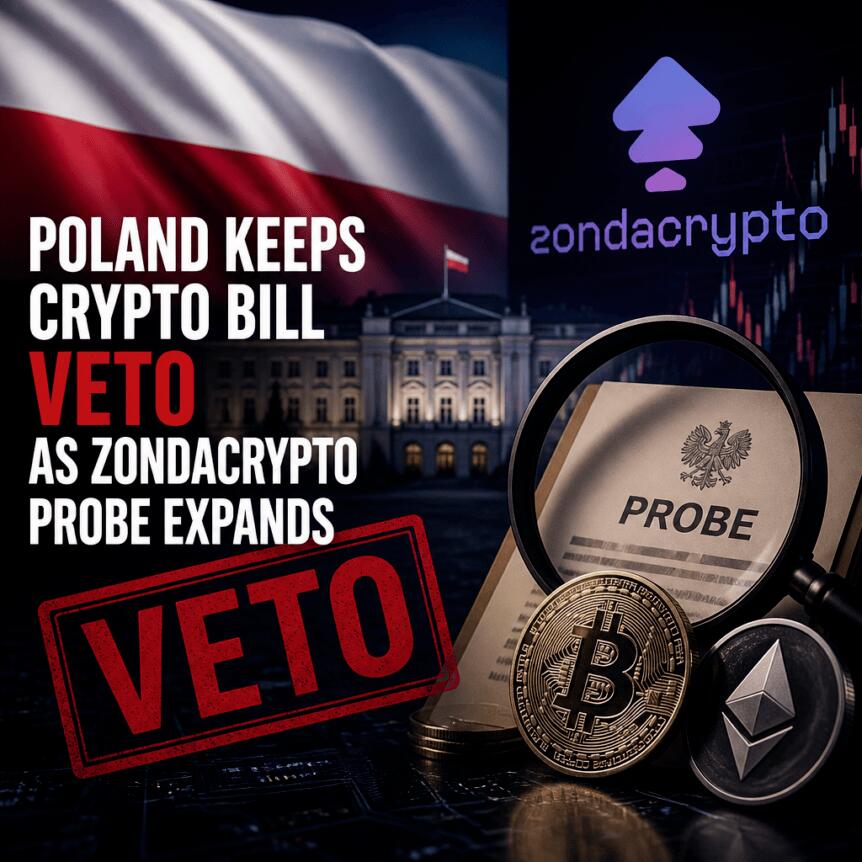
Poland’s lawmakers have once again fallen short of the supermajority needed to overturn President Karol Nawrocki’s veto of a bill intended to tighten oversight of the country’s crypto market. On Friday, the Sejm voted 241–198 in favor of overriding the veto, with three abstentions, leaving the proposal 25 votes short of the 266 required for passage.
The vote was the latest attempt to move the legislation forward after Nawrocki vetoed similar crypto rules three separate times, arguing the draft would impose excessive constraints on the industry. The renewed push comes as Prime Minister Donald Tusk highlights an expanding criminal investigation tied to the defunct exchange Zondacrypto—an issue that has added urgency for regulators and lawmakers to formalize a clearer supervisory framework.
Key takeaways
- The Sejm’s 241–198 vote confirms support for overriding the president, but it still missed the three-fifths threshold by 25 votes.
- Poland still does not have a designated national supervisor for cryptoassets under the proposed framework, despite the EU’s MiCA regime already applying across member states.
- Nawrocki’s vetoes rest on concerns about regulatory overreach, including compliance costs and powers that could be used to block websites.
- Tusk’s renewed statements tie the oversight debate to the continuing Zondacrypto scandal, including alleged political influence and financial arrangements.
A failed veto override keeps Poland’s crypto oversight in limbo
The bill at the center of Friday’s vote is designed to establish Poland’s national approach for applying the EU’s Markets in Crypto-Assets Regulation (MiCA). The proposal would place supervision of the cryptoasset market under the Polish Financial Supervision Authority (KNF), giving domestic regulators a clear mandate to enforce relevant rules.
Even though MiCA is already in force across the EU, Poland’s legislative process has not yet delivered the required national structure. KNF said on Friday that the country still lacks an authority responsible for supervising the cryptoasset market, a gap that matters for market participants because enforcement and supervision responsibilities must be assigned domestically rather than handled only at the EU level.
KNF warns of a missing supervisor as MiCA already applies
KNF’s statement underscores a practical problem: MiCA sets the framework, but supervision in each jurisdiction depends on the domestic rules and institutions that implement and enforce it. Without a properly designated national regulator, compliance questions can become harder for businesses, and regulatory clarity for users can remain incomplete.
That regulatory vacuum is exactly what the vetoed legislation attempted to fix—by anchoring crypto supervision within KNF. By failing to reach the vote threshold required to overturn Nawrocki, Poland remains without that assigned authority, leaving the market awaiting a clearer chain of responsibility.
Why Nawrocki continues to veto: costs and enforcement powers
Nawrocki has repeatedly argued that the draft goes too far. In earlier coverage of the president’s second and third vetoes, the president’s concerns were described as including regulatory costs for the industry and provisions that could grant authorities powers to block websites.
Supporters of the override, meanwhile, appear to treat the bill as necessary not only for compliance with MiCA but also for protecting consumers and improving oversight—especially in the wake of high-profile failures in the crypto sector.
Zondacrypto pressures the debate as prosecutors expand investigations
The political conflict over crypto regulation is playing out alongside the Zondacrypto fallout. Tusk has urged tighter oversight by citing what he described as testimony from a key witness connected to the investigation, including claims about payments and attempted influence reaching into Poland’s previous government.
In excerpts Tusk disclosed ahead of Friday’s vote, he alleged that the witness described a 2 million Polish zloty (about $550,000) payment arrangement involving a foundation linked to former Justice Minister Zbigniew Ziobro. Tusk also cited other testimony in which an unnamed person allegedly promised a presidential pardon in exchange for the witness’s conviction outcome.
Meanwhile, prosecutors are investigating suspected fraud and money laundering related to Zondacrypto. In July, they merged the case with an inquiry tied to the 2022 disappearance of Sylwester Suszek, the founder of BitBay—later renamed Zondacrypto—according to a Polish government disclosure referenced in the reporting.
Loss estimates cited by prosecutors place damages linked to Zondacrypto at no less than 350 million Polish zlotys (about $95 million), reflecting the scale of the case that regulators say should heighten the need for effective oversight.
Bankruptcy proceedings begin, but political scrutiny continues
Zondacrypto’s operator, BB Trade Estonia, was declared bankrupt by an Estonian court in August, with the first creditors’ meeting scheduled for Sept. 17. The bankruptcy adds another layer to the oversight debate: as insolvency processes unfold, creditors and affected users typically look for clearer accountability and stronger regulatory barriers to reduce the risk of similar failures.
Yet the veto override failure suggests that even in the face of an escalating investigation and a visible market fallout, political agreement in Poland remains difficult—particularly when the president argues that the proposed rules would be overly burdensome or grant enforcement powers he considers too sweeping.
Next, Poland’s lawmakers will likely have to decide whether to revisit the same bill with changes that address the veto concerns while still meeting the core need identified by KNF: assigning a domestic authority to supervise cryptoassets under MiCA. Readers should watch whether future Sejm attempts can reach the three-fifths threshold—and how the Zondacrypto investigation developments shape the urgency of the legislation.