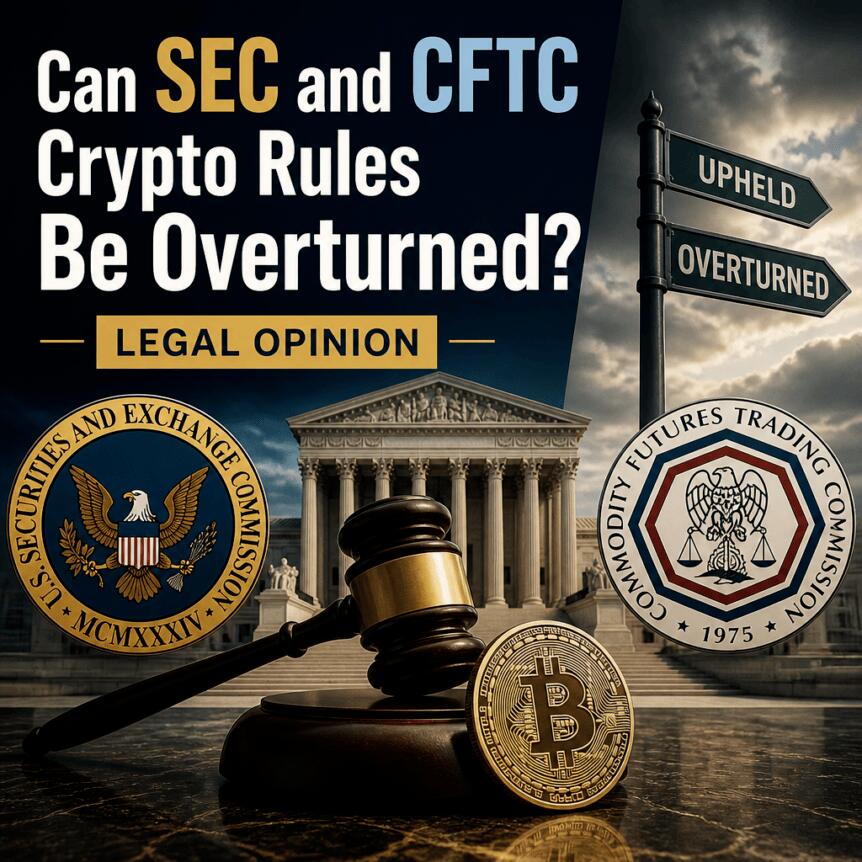
After the US Senate failed to advance the CLARITY Act, the SEC and CFTC moved quickly to fill parts of the regulatory vacuum for crypto markets. In the two days that followed, the SEC announced a five-year exemption tied to “stock tokens,” while the CFTC outlined a separate direction aimed at reducing certain compliance burdens for crypto software firms.
Beyond the immediate rulemaking flurry, the bigger question for market participants is how stable these new frameworks will be. Industry observers have pointed to recent legal shifts that could make agency rules easier to challenge in court—and to the possibility that future administrations could reshape regulatory approaches.
Key takeaways
- The SEC has moved toward token market regulation with a five-year exemption for issuing and trading stock tokens following the failed CLARITY vote.
- The SEC has also offered interpretive clarity on several topics, including token buybacks and the status of liquid staking tokens.
- The CFTC has proposed changes that would create a “crypto asset market” registration category and would allow registered exchanges to offer leveraged trading.
- Legal experts warn that regulatory rules may be vulnerable to rescission and court challenges, especially after major Supreme Court doctrine changes in 2024.
- Guidance such as SEC FAQs may help with compliance planning, but it is not the same as binding legislation or formal rulemaking.
Regulators rush to draft frameworks after CLARITY fails
With CLARITY unable to secure passage, the SEC and CFTC moved to establish their own rules and guidance for parts of the crypto ecosystem. Two days after the Senate vote failed, the SEC introduced a five-year exemption that would allow the issuance and trading of stock tokens.
Tokenization efforts were already progressing alongside these developments. According to reporting referenced in the source article, OXK partnered with ICE to bring trading to 63 NYSE-listed stocks. In parallel, Securitize launched on-chain trading for 12 US stocks and its “Securitize Stocks” offerings were highlighted as including major names such as Apple, Nvidia, and Microsoft, with the launch described in a PR Newswire release: Securitize launches global onchain trading of US stocks with security entitlements.
The SEC also issued guidance intended to clarify that buying back a token does not automatically make it a security, and that liquid staking tokens are not securities. Separately, the agency proposed new rules related to the custody of crypto assets.
The CFTC’s track: software registration relief and a new market category
While the SEC’s focus has included token issuance mechanics and custody rules, the CFTC’s approach has aimed at adjusting registration expectations across the derivatives and market structure side of crypto regulation.
According to the source article, the CFTC moved to exempt certain crypto software providers from registration requirements. It also proposed a new registration category for what it called a “crypto asset market,” and signaled an intent to permit registered exchanges to provide leveraged trading.
For market operators, these changes matter because registration categories determine which licenses a platform needs, what products it can offer, and how regulators assess compliance. They can also influence how quickly firms decide to expand into new jurisdictions or new product lines—particularly in areas such as leverage, where the risk profile is higher and consumer protections are typically more stringent.
Why durability—and not just direction—has become the central risk
Even with regulators moving forward, there is uncertainty about how long any new SEC or CFTC framework will last. Some in the industry have raised concerns that regulatory rules could be “built on shifting sands,” especially if future court decisions limit the agencies’ latitude or if administrations revisit regulatory priorities.
The source article attributes additional caution to TD Cowen, noting that agency rules are viewed as easier to rescind. It also points to an example from the broader regulatory shift after the Gary Gensler era, where rules were reportedly removed by commissioners appointed under President Trump.
Legal experts in the source further emphasized that rulemaking stability has been complicated by Supreme Court developments. The article cites a 2024 Supreme Court decision affecting how much deference courts give to agency interpretations. In that context, the discussion explains that a doctrine shift away from Chevron-style deference can make it more likely that courts will independently apply statutory interpretation rather than defer to an agency’s reading.
What court doctrine and agency practice could mean for crypto rules
To explore how legal doctrine may affect SEC and CFTC rulemaking, the source article includes an edited conversation with Yuriy Brisov of D&A Partners. His comments frame two linked themes: agencies’ authority to create and interpret rules, and how easily courts can overturn those rules depending on the legal basis used.
On the question of whether agencies are meant to create rules, Brisov argues that the SEC’s rulemaking power derives from its enabling statute under the Exchange Act of 1934. He also characterizes the SEC’s regulatory role as having been designed to adapt general securities laws to new technologies as they emerge.
However, he also suggests that an agency’s ability to reverse course—such as interpreting the law differently than an SEC appointed by a prior administration—has practical and legal limits. According to Brisov, regulations that impose disproportionate economic burdens or lack a defensible basis can be challenged in court. He cites the business community’s successful challenge in “Business Roundtable vs SEC” as an example of how regulatory interpretations can be overturned.
The conversation also addresses the impact of the Supreme Court’s 2024 decision overruling Chevron. Brisov’s view, as presented in the source, is that courts may no longer rely as heavily on agency interpretations when statutes are ambiguous. Instead, courts should apply earlier legal standards, including those derived from the Howey test, using their own reasoning.
Brisov further argues that rule reversal after market participants rely on new frameworks is not simply at the discretion of an incoming regulator. He describes an “IRAC” approach—issue, rule, analysis, conclusion—as a shorthand for the need to justify changes with transparent logic, economic reasoning, and research-backed explanations.
Guidance, FAQs, and token buybacks: helpful—but not equal to law
One of the most immediate operational issues raised by the source is how businesses should treat SEC guidance that clarifies product classification without relying on a full legislative rule change.
The article highlights that the SEC issued an FAQ indicating that a crypto company buying back its own token does not necessarily convert a token into a security. In response, Brisov says that following guidance created by those who “know what they’re saying” may leave companies in a safer compliance position, but he stresses that FAQs are not legislation. In his framing, FAQs function more like staff explanation—similar to a manual—and do not carry the same authority as formally enacted rules.
He also notes that the SEC can rewrite staff guidance frequently, pointing to a week-later rewrite mentioned in the source after comments from a16z’s legal counsel about a perceived loophole.
For developers and token issuers, the distinction is crucial: an FAQ can reduce uncertainty in the short term, but it can also change with enforcement priorities or legal interpretations. That makes it important for firms to treat guidance as a dynamic risk input, not a permanent contract with regulators.
Brisov’s broader point, as reflected in the source article, is that if agencies want to tighten or reverse interpretations, they must still explain their reasoning and defend it against legal scrutiny. For market participants, that means watching not just what regulators propose, but how courts respond and whether agencies can substantiate their logic under the revised deference environment.
Looking ahead, the key question for token markets is whether the SEC and CFTC’s new frameworks will prove resilient in court and whether guidance-driven clarity turns into stable, durable rules that platforms can build on confidently.