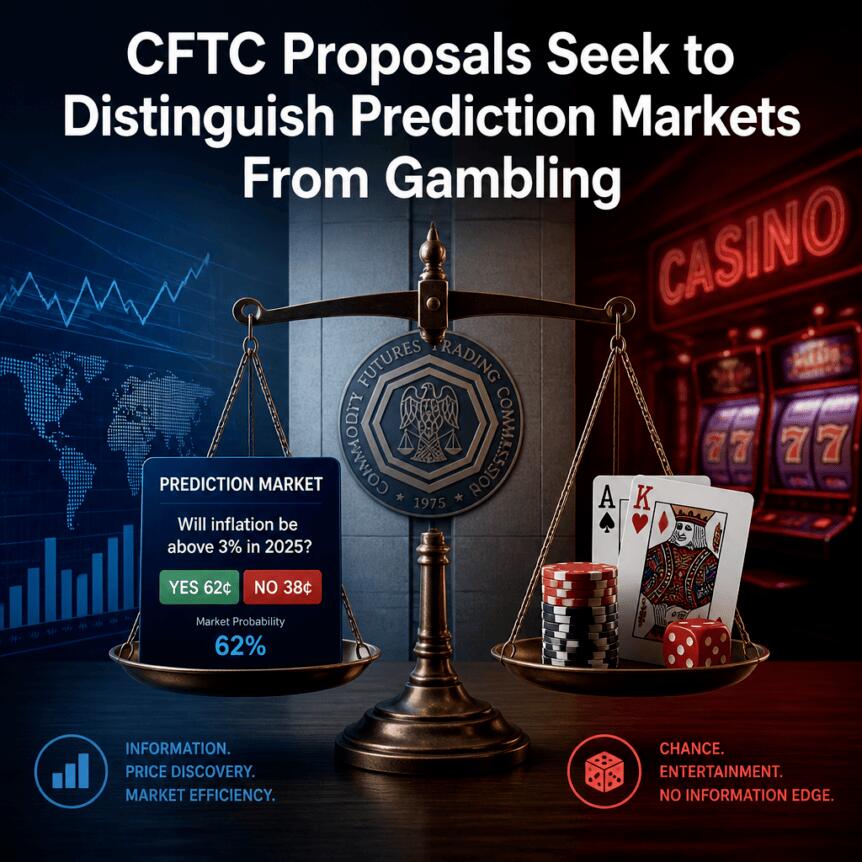
The U.S. Commodity Futures Trading Commission (CFTC) has taken another step toward tightening its regulatory stance on prediction markets. On Friday, the agency issued two proposals that would, respectively, clarify when “event contracts” should be treated as “swaps” under federal law and carve out “casino-style gambling” from that same definition.
The move lands as state regulators continue to challenge prediction-market operators such as Kalshi and Polymarket in court, while the CFTC argues that certain event contracts fall under the Commodity Exchange Act and are therefore governed primarily—if not exclusively—at the federal level. With the industry facing an increasingly likely showdown over federal versus state authority, the new proposals could shape how both regulators and courts frame the core legal question.
Key takeaways
- The CFTC’s first proposal would treat event contracts as “swaps,” aligning them with products the agency says it regulates under the Commodity Exchange Act.
- The second proposal would exclude casino-style gambling products from the “swap” definition, drawing a boundary between derivatives-like event contracts and sportsbook/casino wagering.
- Both proposals were filed on Friday and set a 30-day comment window, giving market participants a direct chance to influence the rulemaking record.
- The proposals are expected to feed into ongoing litigation and may intensify pressure for a final resolution on federal preemption versus state gambling authority.
Why the CFTC is proposing a broader “swap” definition
In its first filing, the CFTC proposed clarifying the statutory definition of a “swap” to include event contracts. According to the agency, event contracts—whether tied to sports, politics, cultural events, or weather—are financial instruments that are commonly treated as swaps in the industry.
The CFTC’s framing is aimed at eliminating ambiguity. In a statement accompanying the proposal, CFTC Chairman Michael Selig said the products at issue are “commodity derivatives squarely within the CFTC’s regulatory remit under the Commodity Exchange Act” and are within the agency’s “exclusive jurisdiction.”
For investors and traders, the practical significance is straightforward: classification determines which regulatory regime applies. If event contracts are treated as swaps, compliance expectations can shift—potentially affecting how platforms structure offerings, how they handle disclosures and risk, and how they engage with regulated markets or market participants.
The CFTC proposal is also a response to a recurring dispute in courts: whether prediction-market products qualify as federally regulated derivatives or instead fit within state-level gambling rules. The agency’s attempt to define terms at the regulatory level may make it easier for the CFTC to argue its case in future proceedings, especially if companies or states claim existing definitions are too unclear.
Where the CFTC draws the line: casino-style gambling excluded
The second proposal simultaneously sets guardrails. While the CFTC wants event contracts treated as “swaps,” it also proposes codifying an exclusion for casino-style gambling products from the “swap” definition.
That carve-out is intended to cover wagers that resemble traditional gambling—explicitly including sportsbook wagers and casino games. Selig characterized the distinction in terms of product type, saying casino-style gambling products are not derivatives and noting the CFTC’s intention to provide clarity similar to how it has historically handled other products regulated by states.
From the standpoint of market operators, this boundary matters because platforms often present offerings that could be described—depending on structure and marketing—as either “event contracts” or gambling products. A formal exclusion could influence how operators design contract terms, match outcomes, and present offerings to users. Even more importantly, it gives a clearer basis for regulators to argue that some products should remain outside federal oversight.
How the proposals connect to current court fights
The CFTC’s filings do not occur in a vacuum. Multiple states have sued prediction-market operators including Kalshi and Polymarket, alleging the companies are running illegal gambling activities. In turn, the CFTC has countersued, maintaining that event contracts fall under federal jurisdiction and that states should not regulate those products as gambling.
The legal contest has already produced a patchwork of outcomes that has kept uncertainty high for the market. Earlier coverage noted that Kalshi lost an appeal in the 6th U.S. Circuit Court of Appeals, where a three-judge panel unanimously sided with Ohio and Tennessee. The court found Kalshi had not shown its sports-event contracts should be considered “swaps” within CFTC jurisdiction.
Yet the broader story is not simply one of a single loss. An April decision by the 3rd Circuit allowed Kalshi to continue operating in New Jersey while its appeal process continued, with the court indicating Kalshi was likely to succeed with an argument that federal law preempts New Jersey’s regulations. That tension—between different circuit outcomes—helps explain why many legal observers view a final resolution as increasingly likely.
Cointelegraph also reported that state lawmakers submitted an amicus brief to the Supreme Court, urging it to address the dispute over whether federal agencies or state authorities control prediction-market jurisdiction. That context aligns with the CFTC’s current rulemaking: the agency is effectively trying to strengthen its interpretation at the administrative level while courts decide how to apply existing law.
What to watch next in the federal–state dispute
The immediate next step is the 30-day comment period for both proposals, which will allow operators, legal experts, and other stakeholders to respond to the CFTC’s proposed definitions of “swap” and its casino-style exclusion. For platforms and users, the record built during that window could become part of the broader legal narrative around how federal statutes should be read.
More broadly, the CFTC’s filings are widely consistent with the agency’s long-running position: event contracts that function like commodity derivatives belong in the federal framework, while casino-style gambling belongs under state oversight. Whether courts accept that framing—especially in a potential Supreme Court setting—remains the key question.
As the Supreme Court debate moves closer to a decisive answer, the industry should focus on how the CFTC’s proposals are interpreted in litigation and whether future rulings treat the agency’s definitions as persuasive guidance or as a formal redefinition of regulatory scope.