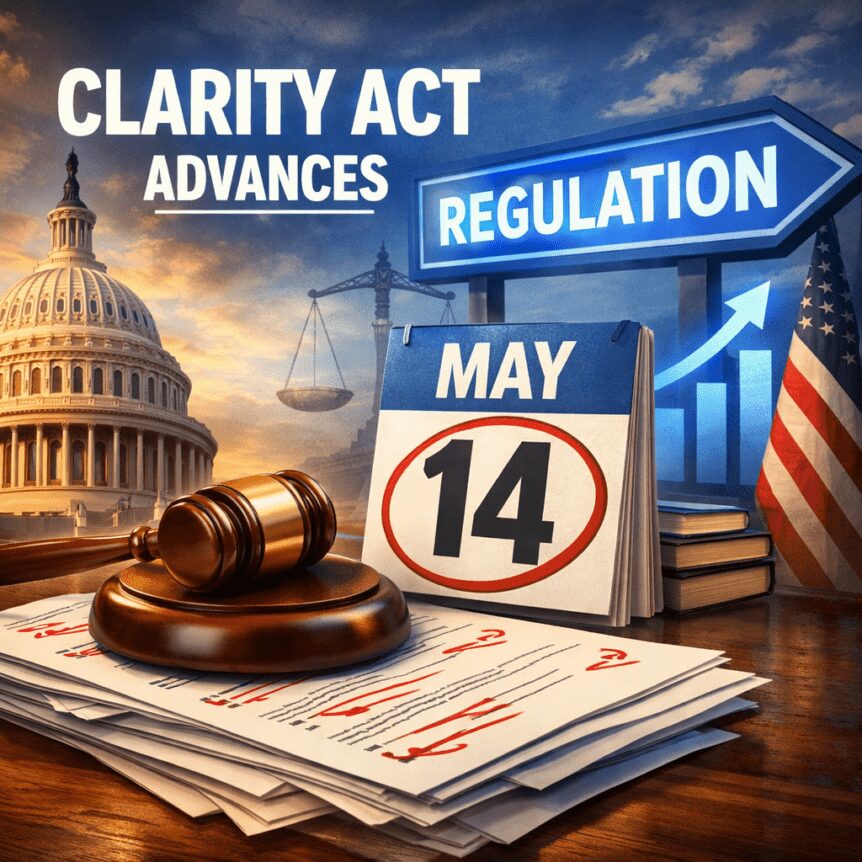
The US CLARITY Act, a bipartisan effort to bring greater regulatory clarity to the crypto sector, is poised for a Senate Banking Committee vote this week. The bill aims to define a clear national framework for digital assets, covering who regulates what, how licenses are issued, and what standards apply to exchanges, issuers, and related financial services providers. After months of momentum stalled by opposing views and concerns, the committee’s markup could signal whether a broader bipartisan path exists for a major overhaul of U.S. crypto regulation.
On Friday, Senate Banking Committee chair Tim Scott confirmed the legislation will proceed to a vote on Thursday, a development that has drawn intense attention from industry participants, policymakers, and compliance teams awaiting a definitive markup date. Introduced in July 2025, the CLARITY Act has been closely watched as a potential backbone for U.S. crypto regulation, though it faced skepticism and calls for refinements from several key players in the ecosystem. In January, Coinbase withdrew its support, citing several unresolved issues including protections for open-source software developers, a prohibition on stablecoin yield, and questions surrounding DeFi regulation. The move underscored the fraught balancing act between fostering innovation and establishing enforceable standards.
“It’s on like Donkey Kong,” Coinbase chief legal officer Paul Grewal said in a post following the announcement.
According to Cointelegraph, the sentiment within the industry reflected a desire for a predictable, enforceable framework that could reduce regulatory uncertainty and encourage compliant innovation in the United States. In parallel, Coinbase’s policy lead characterized the bill as a significant step toward protecting consumers, supporting innovation, and ensuring that the technology develops domestically rather than offshore.
“It’s a big step forward,” said Faryar Shirzad, Coinbase chief policy officer, in a post highlighting the legislative milestone.
Nonetheless, the broader regulatory climate remains unsettled. The Biden administration’s approach to crypto regulation, coupled with ongoing scrutiny from agencies led by the SEC and other enforcement bodies, has kept firms vigilant about how new rules will be implemented in practice. Critics have warned that ambiguity in key provisions could hamper capital formation or push some activity offshore, while supporters argue that a formal framework would avert a regulatory patchwork and establish clearer guardrails for market participants.
Senator Cynthia Lummis, a long-standing crypto advocate, signaled strong support for advancing the CLARITY Act and urged fellow lawmakers to move ahead. Her stance reflects a broader push within the Senate to provide a regulated path forward that can accommodate innovation while addressing investor protections and market integrity. As industry participants weigh the vote, the question remains whether the measure can secure the bipartisan votes needed to overcome potential opposition from quarters wary of expansive regulation.
Key takeaways
- The CLARITY Act is moving toward a markup in the Senate Banking Committee, with a vote scheduled for Thursday, signaling a potential milestone in U.S. crypto regulation.
- The legislation faces a requirement for broad, bipartisan support to pass the Senate—an estimated 60 votes are cited as the threshold for passage, underscoring the political calculus surrounding crypto policy.
- Key objections cited by industry participants include limited protections for open-source software developers, a prohibition on stablecoin yield, and issues related to DeFi regulation—areas that remain points of contention in negotiations.
- Industry leadership has framed the act as a crucial step toward consumer protection, innovation, and domestic development of blockchain technology, while regulators are weighing how to translate high-level intent into enforceable requirements across multiple agencies.
- The policy landscape remains intertwined with broader regulatory themes—MiCA in the EU, ongoing SEC/CFTC/DOJ oversight, AML/KYC standards, licensing regimes, and cross-border implications for banks and traditional financial institutions engaging with crypto services.
Legislative momentum and regulatory context
The scheduled markup arrives after a period of mixed signals from the legislative front. Introduced in mid-2025, the CLARITY Act sought to codify a comprehensive framework for digital assets, aiming to reduce ambiguity surrounding registration, compliance obligations, and enforcement. While momentum had been anticipated earlier in the year, proponents and opponents alike grappled with the bill’s scope—particularly around open-source software protections, stablecoins, and DeFi constructs. The January withdrawal of support from Coinbase highlighted the fragility of political consensus on crypto policy and underscored the need for clarifications that align with the interests of both innovators and investors.
In the current moment, the committee’s vote is widely viewed as a barometer of the administration’s willingness to pursue a formalized path for crypto regulation. Senate leadership and committee members have signaled that a well-structured framework could provide predictable licensing standards, clearer allocation of regulatory authority among federal agencies, and a more coherent approach to cross-border activity. However, the challenge remains to translate high-level policy goals into precise, enforceable rules that can withstand judicial scrutiny and administrative implementation across different market segments.
Industry positions and policy implications
Industry responses to the upcoming markup illustrate the tension between regulatory certainty and the risk of overreach. Coinbase’s decision to withhold support in January underscored concerns about discrete policy choices that could shape the behavior of developers, exchanges, and DeFi protocols. Supporters argue that by clarifying jurisdiction, licensing needs, and consumer protections, the CLARITY Act could stabilize onboarding, reduce the compliance burden for compliant firms, and deter illicit activity without stifling legitimate innovation.
Key lawmakers have framed the act as essential to maintaining U.S. competitiveness in fintech. Senator Lummis emphasized the need for swift action, framing passage as a step toward safeguarding consumers while enabling responsible innovation. For policy insiders, the markup is a test of whether broad bipartisan alignment exists on core principles, including clarity around digital asset custody, the treatment of native tokens, and the regulatory treatment of stablecoins as part of broader financial infrastructure.
From a compliance and enforcement perspective, the proposal’s success would have implications for licensing regimes and ongoing supervision. Institutions—ranging from crypto-native exchanges to traditional banks venturing into crypto services—would be compelled to align with a defined set of standards for registration, consumer protection, and risk management. The alignment with existing frameworks—AML/KYC, anti-fraud measures, and disclosures—will be crucial for mitigating regulatory risk and ensuring that U.S. firms can compete effectively with offshore operators that may benefit from more permissive regimes.
Regulatory landscape and enforcement considerations
Analysts note that the CLARITY Act arrives at a time of intensifying regulatory scrutiny from federal authorities. While the SEC remains a central figure in crypto enforcement, the CFTC and other agencies are increasingly involved in delineating the boundaries of asset classifications, registry requirements, and supervisory expectations. The interagency dynamics will shape how the Act is implemented, particularly in relation to stablecoins, DeFi platforms, and the treatment of cross-border activity. In this context, the bill’s success would likely influence how U.S. policymakers design licensing, risk controls, and consumer protections, with potential ripple effects across banks, custodians, exchanges, and institutional investors seeking compliant on-ramps and off-ramps for digital assets.
Beyond U.S. borders, the Act sits within a broader policy conversation that includes the European Union’s MiCA framework and ongoing discussions about global standardization of digital asset regulation. For financial institutions operating across jurisdictions, a coherent U.S. regime could reduce the compliance overhead associated with fragmented rules and provide a more stable operating environment for regulated entities to participate in the crypto economy. Conversely, a contentious markup could prolong regulatory uncertainty, delaying the deployment of compliant products and impacting investment decisions in the near term.
Practical implications for firms and policymakers
For exchanges, institutions that custody assets, and banks exploring crypto services, the Act’s contours will determine licensing requirements, disclosure standards, and oversight expectations. A clear framework would facilitate risk assessment, capital planning, and governance decisions—elements critical to regulatory compliance programs, internal controls, and external reporting. Open-source developers, a key constituency referenced in the discussion around the bill, stand to gain from explicit protections and clarified liability standards, potentially reducing legal risk for contributors who build interoperable tools that support the wider ecosystem.
Still, questions persist about how specific provisions will be translated into regulation. Areas of ongoing debate include the precise treatment of stablecoins and yield strategies, the scope of DeFi regulation, and the coordination among federal and state authorities. As the markup unfolds, institutions will be monitoring how proposed rules interface with existing AML/KYC regimes, licensing processes, and cross-border compliance requirements. The outcome could bear on whether the U.S. remains a hub for crypto innovation or experiences a shift in capital and activity toward more permissive jurisdictions.
Closing perspective
As the Senate Banking Committee prepares to tackle the CLARITY Act, the central question is whether lawmakers can converge on a framework that protects consumers, fosters innovation, and delivers enforceable standards. The forthcoming vote will illuminate the path forward for a policy environment that directly affects regulated entities, venture-backed startups, and traditional financial institutions engaging with crypto services. In the near term, observers will be closely watching how the bill’s provisions are refined during markup and how enforcement priorities and licensing regimes align with the broader objectives of U.S. financial regulation.