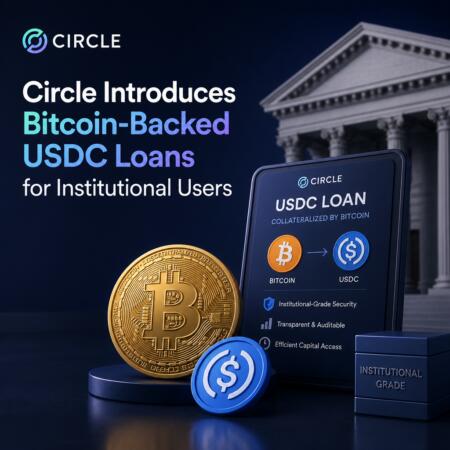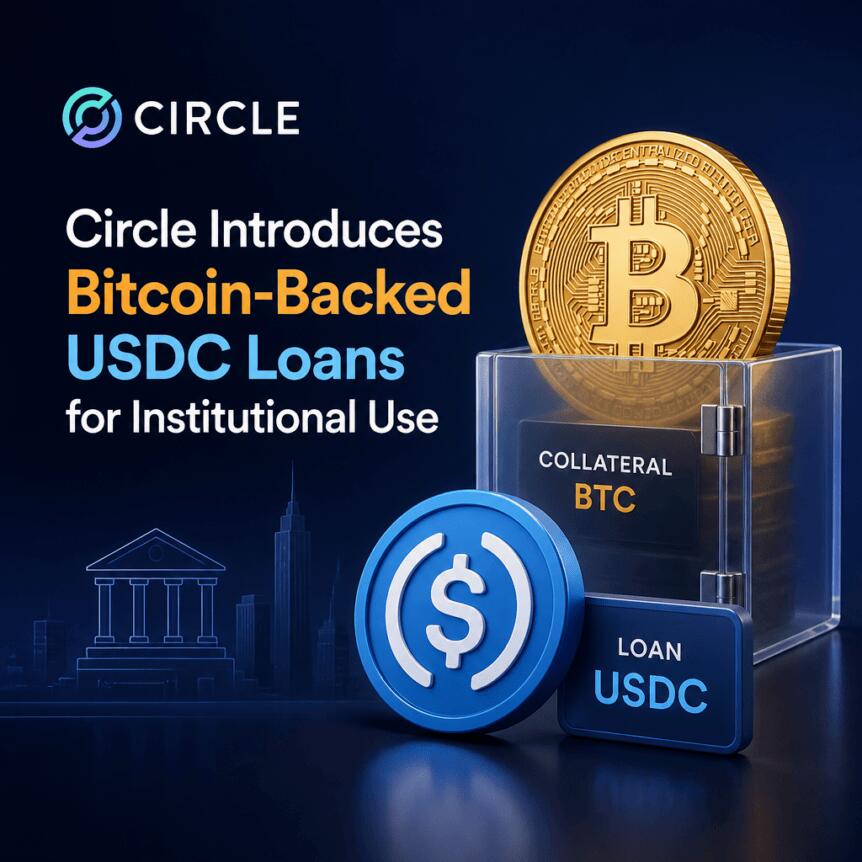
Stablecoin issuer Circle has introduced a Bitcoin-backed borrowing service aimed at institutional users, enabling eligible Circle Mint customers to pledge BTC collateral to borrow USDC via onchain lending markets. The feature is designed to keep borrowers within existing Circle custody relationships while still tapping decentralized liquidity.
Dubbed Digital Asset-Backed Borrowing, the service allows customers to deposit Bitcoin, mint Circle’s wrapped Bitcoin token cirBTC, and then supply that wrapped asset as collateral on supported lending protocols on Arc or Ethereum. Circle says Morpho is the first supported lending venue, with plans to add Aave and other protocols later.
Key takeaways
- Circle Mint users can use Bitcoin as collateral to borrow USDC on supported DeFi lending markets.
- The new workflow converts deposited BTC into cirBTC, which is then posted to lending protocols (starting with Morpho).
- Borrowing terms such as rates, collateral requirements, and liquidation thresholds are set by the third-party lending market, not by Circle.
- Circle says borrowed USDC is credited directly to the customer’s Circle Mint balance.
- New York clients are excluded, and collateral is supplied from a customer-controlled wallet to third-party protocols rather than being lent directly by Circle.
How Circle’s Bitcoin-to-USDC borrowing works
Circle’s announcement frames the product around a practical institutional requirement: getting onchain borrowing exposure without breaking custody workflows. Under Digital Asset-Backed Borrowing, eligible Circle Mint customers begin by depositing Bitcoin. Circle then mints cirBTC—a wrapped Bitcoin token—so it can be used as collateral in DeFi lending.
Customers supply the resulting collateral to third-party lending markets. Circle emphasizes that collateral is provided through a customer-controlled wallet to DeFi protocols, rather than being lent directly by Circle itself. In turn, the lending protocol determines the key parameters that govern the position.
According to Circle, the borrowed USDC is deposited into the customer’s Circle Mint balance. That separation matters for institutional users who may want clearer accounting and settlement paths—particularly where the collateral remains tied to custody processes they already understand.
The rollout is also closely tied to Circle’s wrapped Bitcoin infrastructure. Circle previously launched cirBTC on Ethereum in June, and the token is backed 1:1 by Bitcoin held in custody by Circle National Trust. With this service, that existing wrapped-BTC bridge to lending markets is being converted into an institutional borrowing feature.
Morpho first, with more lending protocols planned
Circle’s borrowing service is not limited to a single DeFi venue. The company says Morpho is the first supported lending protocol for customers using cirBTC collateral. Circle also plans to expand to Aave and additional protocols as the service develops.
Circle also specified that borrowed positions are overcollateralized. Liquidation thresholds and collateral requirements are set by the third-party lending market, reflecting the fact that risk management comes from the protocol where the collateral is deployed.
Operationally, the service supports routes on both Arc and Ethereum, depending on the supported deployment of each lending market. Circle’s approach positions the product to work across its broader stablecoin and onchain payments ecosystem rather than limiting functionality to Ethereum alone.
Arc mainnet timing: cirBTC goes live on Arc
The launch of Bitcoin-backed borrowing comes alongside an important infrastructure milestone for Circle’s wrapped BTC token. Circle says cirBTC is scheduled to be live on Arc on Monday, referencing a separate announcement that the token is now available on the Arc network via Arc’s blog.
This sequencing appears intentional. Circle has been building Arc as a layer-1 blockchain intended for stablecoin payments and financial market use cases. Earlier coverage noted that Circle rolled out Arc mainnet this week, and that the network uses USDC as its native gas token. The same coverage also pointed to Arc’s support for tokenized assets including BlackRock’s BUIDL and Circle’s USYC.
For investors and builders, the practical question is whether new collateral and borrowing routes can gain traction fast enough to matter. By aligning cirBTC availability with lending product rollout, Circle is effectively reducing the friction between “having collateral” and “using that collateral to access liquidity.”
Institutional custody-first borrowing is becoming a market pattern
Circle’s product fits a broader shift in crypto finance: institutions want yield and liquidity options, but they increasingly prefer models that avoid constant collateral movement or custody changes.
Earlier in the year, similar thinking appeared in other offerings. In February, for example, Anchorage Digital partnered with Kamino to enable institutions to borrow against staked Solana (SOL) held at Anchorage. The emphasis there, like Circle’s now, was on accessing onchain liquidity without taking collateral out of qualified custody.
Bitcoin-backed lending followed a comparable theme in March. Lombard partnered with Bitwise to support borrowing against BTC held in custody, with Morpho providing lending infrastructure. The key difference Circle’s rollout highlights is that Lombard’s design aimed to keep underlying Bitcoin in custody without wrapping or bridging it—whereas Circle’s model explicitly relies on converting deposited BTC into cirBTC for collateral use.
Other custody-friendly lending expansions also emerged. In March, BitGo expanded its institutional lending offering with a portfolio-based approach that allows multiple assets to serve as collateral. Circle’s framework is different, but it reinforces the same larger trend: institutional-friendly crypto lending increasingly comes packaged with structured custody and clearer operational boundaries.
Circle’s decision to exclude New York clients underscores that regulatory and eligibility constraints continue to shape which institutional users can access these products.
What to watch next
Circle’s next steps—especially the planned addition of Aave and other lending protocols—will determine how broadly institutions can deploy cirBTC collateral and how competitive borrowing conditions become across venues. For now, the key signal is whether the Arc+cirBTC integration and the Morpho-first rollout can translate into meaningful adoption among eligible Circle Mint customers.