Crypto market participants are watching two very different developments this week: a stalled bid for U.S. regulatory “market-structure” clarity, and new attempts to monetize crypto assets—ranging from layer-2 revenue projections to Ether staking and treasury strategies. While lawmakers failed to move the CLARITY Act forward in the Senate, strategists and companies continued to refine their assumptions about how regulation, onchain finance, and emerging AI risks could reshape incentives.
The legislative snag matters because it directly affects how U.S. crypto exchanges may register, which assets can be traded, and who can participate on platforms—issues that tend to influence both compliance costs and product roadmaps. Meanwhile, corporate and research teams offered fresh forecasts and operational updates, from Standard Chartered’s bullish view on Arbitrum’s economics to Bitmine’s staking revenue outlook and warnings from Phemex’s CEO about AI-driven security pressures.
Key takeaways
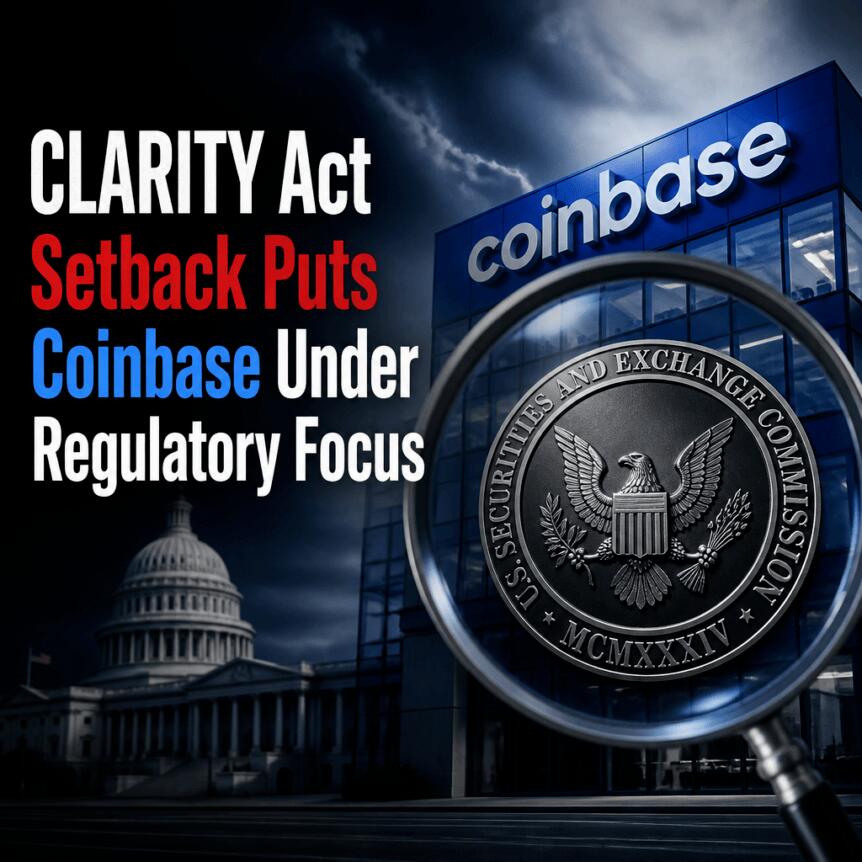
- The U.S. Senate failed to advance the CLARITY Act, falling short of the 60-vote threshold needed to bring it to the floor for debate.
- Saxo Bank strategist Ruben Dalfovo argued Coinbase faces more direct CLARITY Act exposure than many other crypto-linked businesses due to trading market-structure rules.
- Standard Chartered expects Arbitrum to outperform major tokens through 2030, citing revenue-sharing dynamics and expanding onchain activity by traditional finance.
- Bitmine projected $334 million in annualized staking revenue from its Ether holdings, with more than 5 million ETH reportedly staked.
- Phemex CEO Federico Variola said AI is weakening crypto liquidity while escalating the cybersecurity burden and enabling attackers.
CLARITY Act stalls—why the clock is now even tighter
According to the coverage of the vote, the CLARITY Act did not move forward in the U.S. Senate on Tuesday. The bill failed to secure the 60 votes required to proceed to a floor debate, a procedural outcome that narrows the path for legislative action this year. With the U.S. midterm elections scheduled for Nov. 3, the Senate calendar is described as tightening, which increases uncertainty around when (or whether) similar market-structure rules could be revisited.
That timing risk is especially relevant for firms with U.S.-facing trading operations. In a Wednesday note cited in the article, Saxo Bank strategist Ruben Dalfovo highlighted that Coinbase’s exposure is more immediate because new rules could affect registration requirements, the range of tradable assets, and platform participation criteria. In contrast, he characterized other companies as having exposure that is either more indirectly tied to market-structure rules or driven more by different economic variables.
Coinbase highlighted, but equity moves show broader concern
Dalfovo’s framing focused on how trading infrastructure is shaped by regulation. If the CLARITY Act had advanced, it could have clarified how exchanges must operate under U.S. market-structure expectations, potentially reducing compliance friction and enabling clearer product planning. With the bill sidelined, the uncertainty remains, and market pricing appears to have reacted accordingly.
Following the procedural failure, the article reports that shares of Coinbase, Circle, and Strategy declined by roughly 5% to 10%, with weakness continuing into the next day. For investors, that pattern suggests the market is not treating the legislative setback as a narrow corporate-event risk. Instead, it appears to be priced as a broader signal that regulatory clarity may be delayed, which can affect expectations for adoption, institutional participation, and near-term business development in the U.S.
What remains unclear is how long the delay will last and whether the next legislative attempt would prioritize the same market-structure provisions. Traders may also watch for alternative regulatory routes—such as agency guidance or enforcement actions—that could still influence exchange operations even without a new statute advancing.
Standard Chartered’s Arbitrum thesis: onchain finance could change revenue math
While regulation was a headline driver, research teams were also looking forward through the lens of onchain economics. Standard Chartered’s view, as reported, is that Arbitrum could outperform Bitcoin and Ether through 2030, supported by traditional finance firms moving assets onchain and changing how network economics are generated.
In the cited note, Geoff Kendrick—Standard Chartered’s global head of digital assets research—said Arbitrum receives 10% of net protocol revenue from companies building on it. The research points to new activity as a catalyst, especially the Robinhood Chain launch in July, which the report says has materially altered Arbitrum’s economics. The article further claims that September revenue is expected to reach $5 million, described as more than five times the prior level.
Based on that revenue-sharing framework and additional assumptions, Kendrick projected ARB at $10 by 2030. The article frames this as a major jump from levels around $0.14 at the time of reporting, noting that ARB had gained 86% over the preceding month.
Standard Chartered’s broader model also depends on tokenized assets reaching $39 billion and forecasts of $4 trillion by 2028. The key uncertainty for readers is whether those adoption targets arrive fast enough to translate into sustained protocol revenue. Layer-2 revenue can be sensitive to user activity, wallet and exchange integration, and the competitive landscape among scaling networks—so investors treating this as an investment thesis may want to monitor actual growth in net protocol revenue, not just token price performance.
Bitmine leans on staking: projected $334 million annualized from Ether treasury
On the corporate side, Bitmine’s approach centers on earning recurring income from its Ether treasury through staking. The article says Bitmine projects $334 million in annualized staking revenue based on its reported $15.8 billion crypto treasury and indicates that more than 5 million ETH is now staked to generate ongoing income even during volatile market conditions.
Bitmine reportedly added 27,180 ETH last week, bringing holdings to 5.95 million ETH valued at $15.4 billion. The article states that this represents roughly 4.9% of Ether’s circulating supply. It also claims that more than 5.06 million ETH is staked and uses current rates to estimate $334 million in annualized revenue.
The report also compares this strategy with Bitcoin-treasury-style approaches by emphasizing the staking component: unlike holdings that rely primarily on price appreciation, staking revenue provides a recurring cashflow-like mechanic (even though it remains exposed to network conditions and staking dynamics). It cites Grayscale’s Ethereum Staking ETF as having 84.6% of its ETH staked, according to the fund’s webpage.
Separately, the article notes that Strategy—contrasting with treasury staking economics—went a second straight week without buying Bitcoin, using $139.3 million to repurchase preferred stock. That side-by-side distinction matters for investors trying to interpret sector performance: in the same broader “treasury strategy” theme, different firms are effectively betting on different return drivers—token price versus staking yield.
AI’s double-edged impact: liquidity drain and higher cyber risk
The operational risk theme arrived in another segment of the reporting, where Phemex CEO Federico Variola argued that AI has been a “net negative” for crypto. In his comments, he said AI is diverting liquidity away from the industry while also enabling attackers, raising cybersecurity costs—particularly for smaller teams without the resources to respond quickly.
The article ties this warning to an example from July: attackers allegedly drained roughly $116 million in Bitcoin from more than 5,200 addresses associated with a Coldcard hardware wallet flaw. The coverage suggests the flaw was widely believed to have been identified through malicious AI use. It also references Coinkite CEO Rodolfo Novak, who warned that AI-assisted code review can outpace experienced experts.
Variola’s broader takeaway is that AI threats could make self-custody and DeFi less attractive for retail users, potentially pushing the ecosystem toward greater centralization. He said AI agents could still offer practical value for portfolio building and trading decision-making, but he argued they would not fully replace human judgment. The article also includes a counterpoint from CertiK’s Natalie Newson, who said AI can be “one of the biggest defenses.”
For readers, the near-term question is not whether AI will impact crypto security, but how quickly defenses and operational practices will adapt. Expect ongoing focus on secure development processes, faster incident response, and whether security tooling keeps pace with attacker tooling—especially as attackers increasingly automate discovery and exploitation.
Going forward, the most important watch items are whether future legislative attempts revive parts of the CLARITY Act framework before the midterms, and whether onchain and corporate revenue strategies—like L2 revenue sharing and Ether staking—can prove resilient despite regulatory uncertainty and rising AI-linked security threats.