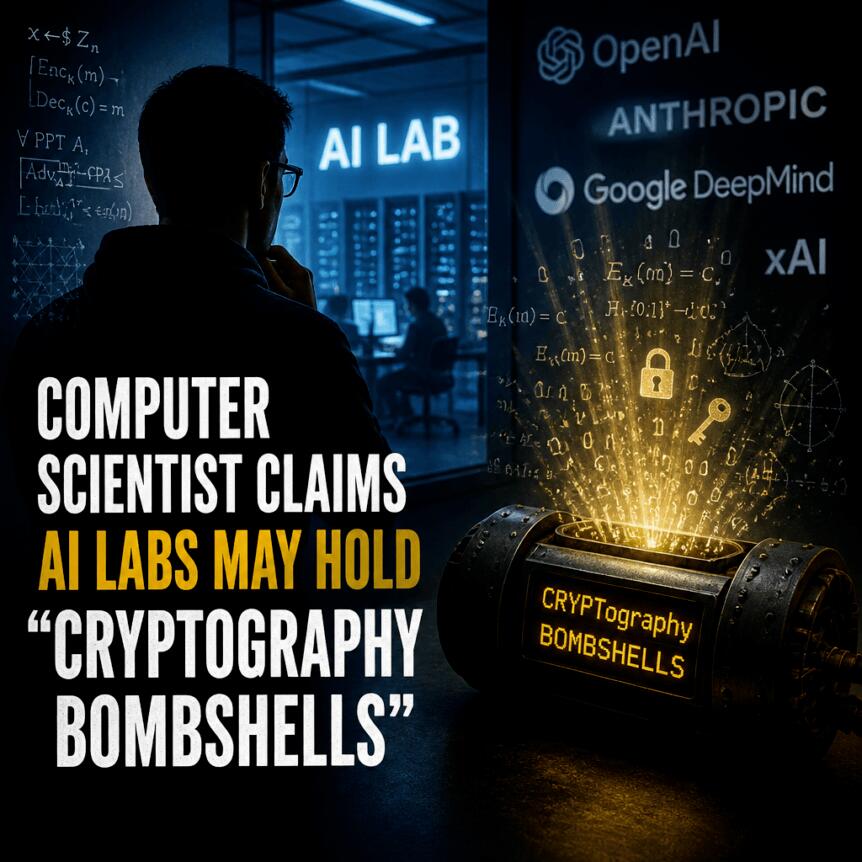
Prominent theoretical computer scientist Scott Aaronson says leading AI labs may have uncovered cryptographic breakthroughs that could eventually render today’s widely used security methods obsolete. In a blog post published Wednesday, Aaronson—an Austin-based professor and a former OpenAI researcher—warned that algorithms emerging from AI-driven mathematical progress are likely to break cryptosystems that currently protect digital wallets and blockchain transactions.
While Aaronson did not provide specifics about what the “bombshells” might be, he said he is “virtually certain,” based on multiple reliable sources, that major AI organizations are working from results with potentially serious implications for cryptography. The comments build on earlier concerns raised this year by prominent figures in the Ethereum ecosystem about whether AI advances could outpace current assumptions behind wallet security.
Key takeaways
- Scott Aaronson says AI labs may have undisclosed cryptography breakthroughs that could eventually undermine systems used to secure crypto wallets.
- Aaronson provided no technical details, and he said he’s less confident about what exactly the breakthroughs are until specifics are confirmed.
- Recent AI-assisted math work—including proofs of major open problems—illustrates how quickly AI can progress in fields relevant to cryptographic security.
- Rumors about faster factoring algorithms have circulated, though Aaronson declined to confirm any claims about specific signature schemes being broken.
Why Aaronson’s warning lands now
Aaronson’s argument is less about immediate exploitation and more about the direction of progress. He suggested that AI labs are likely in possession of breakthroughs from applied and theoretical work that, over time, could weaken the mathematical assumptions undergirding modern encryption and signatures.
The uncertainty in his message is also the point: Aaronson explicitly said he has not seen details and has not heard direct confirmations from insiders about what the results actually are. That distinction matters for readers because it separates a broad risk—AI could make certain hard problems easier—from a concrete timeline for any specific crypto vulnerability.
The concern is not new in the crypto world. Earlier this year, Ethereum co-founder Vitalik Buterin and researcher Justin Drake raised similar worries, according to earlier coverage noted in the original post, arguing that accelerating AI capabilities could eventually challenge assumptions used to protect wallet security.
AI’s momentum in formal math proofs
One reason Aaronson’s warning resonates is that the past weeks have shown AI systems tackling problems that many researchers previously believed would take years—or might remain out of reach for conventional approaches alone.
In one recent example, Anthropic mathematician Levent Alpöge released an AI-assisted proof of the Generalized Riemann Hypothesis, described as one of the most famous unsolved problems in mathematics. The proof, according to the source, was developed using an unreleased version of Claude over roughly six weeks, spanning 17 million lines of Lean code. It was later verified as correct by Lean FRO and the Mathlib Initiative.
In the same general period, both Anthropic and OpenAI released proofs related to the VP versus VNP conjecture. The conjecture is often framed as an algebraic cousin of the long-standing P versus NP question in theoretical computer science. The releases were shared as preprints, and they reflect the same pattern: AI-assisted reasoning combined with formal systems that can be independently checked.
The underlying editorial takeaway is that these aren’t only “machine guesses.” The work described in the source includes formal verification steps, which is exactly the sort of rigor that can make theoretical progress more credible for downstream applications—cryptography among them.
From “mathocalypse” to cryptographic assumptions
The source points to the pace of AI math output more broadly, referencing OpenAI’s release of hundreds of AI-generated math manuscripts on GitHub in October—content that has since been nicknamed the “mathocalypse.” Aaronson compared the current period to the start of a much larger shift, saying that the recent week “is very much like” how he would have imagined the beginning of an “AI singularity” would look and feel.
Within that rapid progress, rumors have begun to circulate about whether AI teams have solved specific problems that would matter for cryptography. In particular, Aaronson mentioned a rumor about “Factoring in P,” referring to a polynomial-time factoring algorithm. If such an approach were real and practical at scale, it would challenge the security basis of cryptographic schemes that rely on the difficulty of factoring large integers—an area that has long been associated with RSA.
The original post also notes that AI commentator Andrew Curran and Carnegie Mellon University researcher Aran Nayebi said they had heard similar rumors. However, Aaronson declined to validate or expand on these claims, and he did not offer confirmation about specific cryptographic breakages.
What Aaronson wouldn’t confirm: ECDSA and wallet risk
Crypto users often focus on whether a particular signature scheme has already been broken, and the source shows that this pressure was part of the surrounding discussion. Aaronson said he does not want the cryptography aspect to overshadow the broader intellectual significance of what AI systems are doing in mathematics.
When asked or pressed about whether ECDSA—a digital signature scheme used by Bitcoin—had been broken, Aaronson declined to provide insight. He also cautioned that if someone’s main worry is their Bitcoin wallet, they should look elsewhere for rumors about whether ECDSA is broken or other claims about specific algorithms.
This response highlights the asymmetry readers should keep in mind. Even if AI can dramatically accelerate certain proofs or theoretical results, it does not automatically follow that every rumor corresponds to an implementable attack, that it works within real-world constraints, or that it is already affecting deployed systems.
In practical terms, Aaronson’s stance is a reminder that cryptographic risk requires confirmation, technical feasibility, and an understanding of how long it takes to move from a theoretical breakthrough to a usable exploit. The source does not provide that level of confirmation for any particular crypto primitive.
For now, what matters most is the combination of two trends: AI systems demonstrating rapid, verifiable progress in formal mathematics, and the emergence of uncertainty—sometimes rumor-driven—about what that progress could mean for cryptographic hardness assumptions. Readers should watch for concrete, reproducible results that connect theoretical math breakthroughs to specific cryptographic primitives, and for any formal assessments that clarify what is real risk versus speculation.