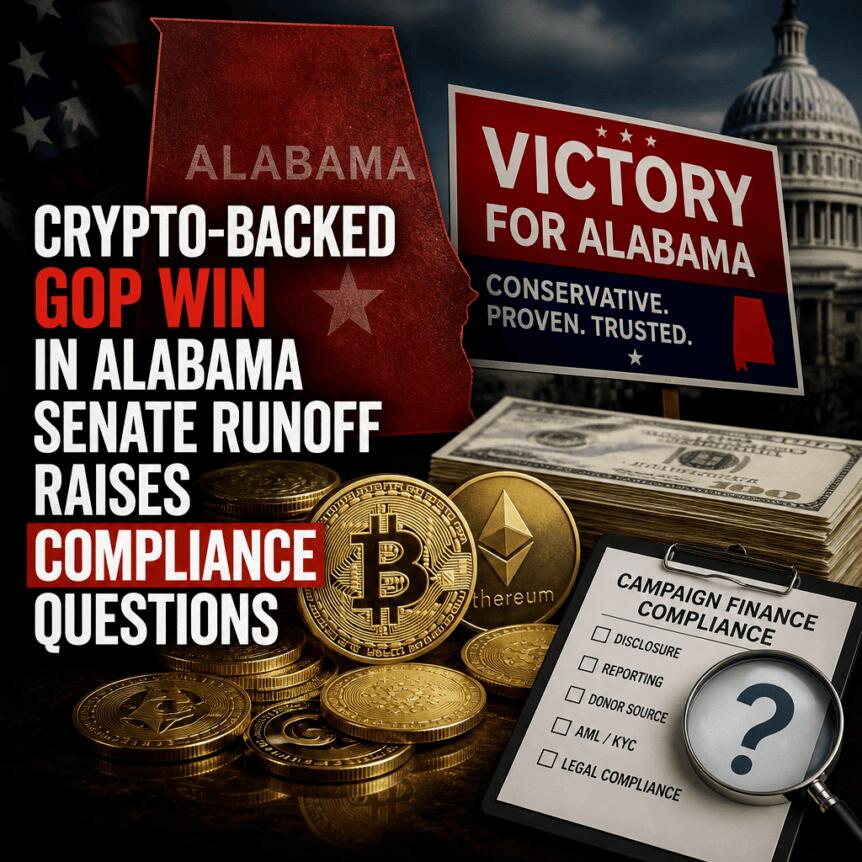
Barry Moore won the Republican primary runoff for Alabama’s U.S. Senate seat on Tuesday, defeating Democrat Everett Wess by securing 55.8% of the vote, according to NBC News. The race became necessary after neither candidate received a majority in the May 19 contest. Moore is set to take the seat held by outgoing Republican Senator Tommy Tuberville, in a development that is drawing heightened attention from the crypto political ecosystem.
Federal Election Commission (FEC) disclosures indicate that pro-crypto political committees backed by Fairshake—an advocacy group associated with cryptocurrency companies—spent more than $12 million on media and advertising to support Moore across the May 19 primary and the Tuesday runoff. Compliance-focused observers are likely to see the election as another example of how crypto-aligned political spending is scaling in U.S. federal contests, raising questions about transparency, regulatory oversight, and cross-border policy alignment.
Key takeaways
- Moore won the Alabama Republican Senate runoff against Everett Wess with 55.8% of the vote, according to NBC News.
- FEC filings show Defend American Jobs PAC—affiliated with Fairshake—spent more than $12 million on media and ads for Moore.
- Advocacy organization Stand With Crypto rated Moore “strongly supports crypto” based on public statements and his voting record in Alabama’s 1st Congressional district.
- Fairshake-related committees may have spent over $40 million across multiple states to support candidates described as “pro-crypto,” according to a Fairshake spokesperson’s remarks reported in the coverage.
FEC-backed crypto political spending in the Alabama runoff
The Alabama Senate runoff is the latest instance of large-dollar involvement by industry-aligned political committees. In this case, FEC reports attribute more than $12 million in media and ad spending to Defend American Jobs PAC, which is described as affiliated with Fairshake, during the May 19 primary and the subsequent runoff.
For institutional compliance and governance teams, the practical significance lies in the mechanics of political spending: FEC reporting requirements create a documented paper trail, but the broader network of affiliated committees and advocacy groups can complicate attribution and risk assessment. Analysts monitoring policy exposure may also view such disclosures as an early indicator of how crypto industry stakeholders anticipate legislative priorities in the next congressional session.
Cointelegraph reported that Stand With Crypto assessed Moore as “strongly supports crypto,” citing public statements and his voting record. That rating matters in compliance terms because it signals how industry groups evaluate candidates not only for their rhetoric, but for recorded legislative behavior—an approach that can inform risk frameworks for regulated entities interacting with government counterparts.
Fairshake’s scale and the “pro-crypto” strategy
Fairshake spokesperson Geoff Vetter said that the committee’s “biggest spend of the cycle” helped deliver another candidate characterized as a “pro-innovation champion,” and referenced nearly $150 million in cash available for future efforts. The statement, as reported in the coverage, also suggests an intention to expand pro-crypto legislative influence via what the spokesperson framed as a sizable “pro-crypto caucus.”
While political messaging is not itself regulatory conduct, large-scale campaign activity is often examined by policymakers and enforcement agencies in broader discussions about lobbying, political influence, and disclosure. For regulated crypto firms, the governance question is whether political engagement aligns with internal compliance expectations around transparency, conflicts of interest, and reputational risk.
Beyond Alabama, the same reporting describes Fairshake and related affiliates as potentially spending more than $40 million across several states to back candidates they consider favorable to crypto policy goals. According to the article, Defend American Jobs PAC reported holding a $193 million war chest as of January. Even without drawing conclusions about intent, such figures underscore why election-related spending is increasingly treated as a compliance and policy monitoring matter rather than a purely political story.
Industry PAC activity across multiple states
The Alabama runoff follows a pattern of multi-state, pre-general-election spending by crypto-aligned committees, including in states with scheduled primaries before the November election. The coverage notes that industry PAC spending has been visible in upcoming contests in South Carolina, Texas, California, South Dakota, and New Jersey.
In addition to Defend American Jobs PAC, the reporting highlights Protect Progress—described as a Fairshake affiliate—as having reported media buys for House-related races. Specifically, it referenced FEC disclosures for spending tied to Maryland Democrat Adrian Boafo and New York Democrat Ritchie Torres ahead of primaries set for June 23.
From a regulatory perspective, these disclosures matter because they may affect how compliance teams map political influence into policy outcomes—particularly around areas central to crypto regulation such as stablecoin frameworks, exchange oversight, market structure, and AML/KYC expectations. In the U.S., these issues span the SEC’s remit, the CFTC’s commodity and derivatives authority, and DOJ enforcement priorities, while in Europe, the MiCA framework continues to shape cross-border compliance strategies for issuers and service providers.
Institutional observers may also treat this as a reminder that U.S. political dynamics can affect timelines for implementation and rulemaking—even when the formal rulemaking process is independent. Large political spending may contribute to a favorable legislative environment, but uncertainty remains as to how quickly, and in what form, policy changes would be translated into enforceable regulatory requirements.
What happens next before the November election
With additional primaries scheduled for next week, the Alabama outcome is likely to feed into broader attention on crypto-aligned political strategy. Further FEC filings may offer clearer visibility into how affiliated committees allocate resources and how those allocations correspond to candidate positions on crypto policy.
For compliance monitoring, the key near-term focus should be on subsequent disclosure updates, candidate policy commitments, and any legislative momentum that could impact enforcement posture or regulatory priorities—particularly as lawmakers in the next Congress weigh areas ranging from campaign-finance related scrutiny to the regulation of digital asset markets.