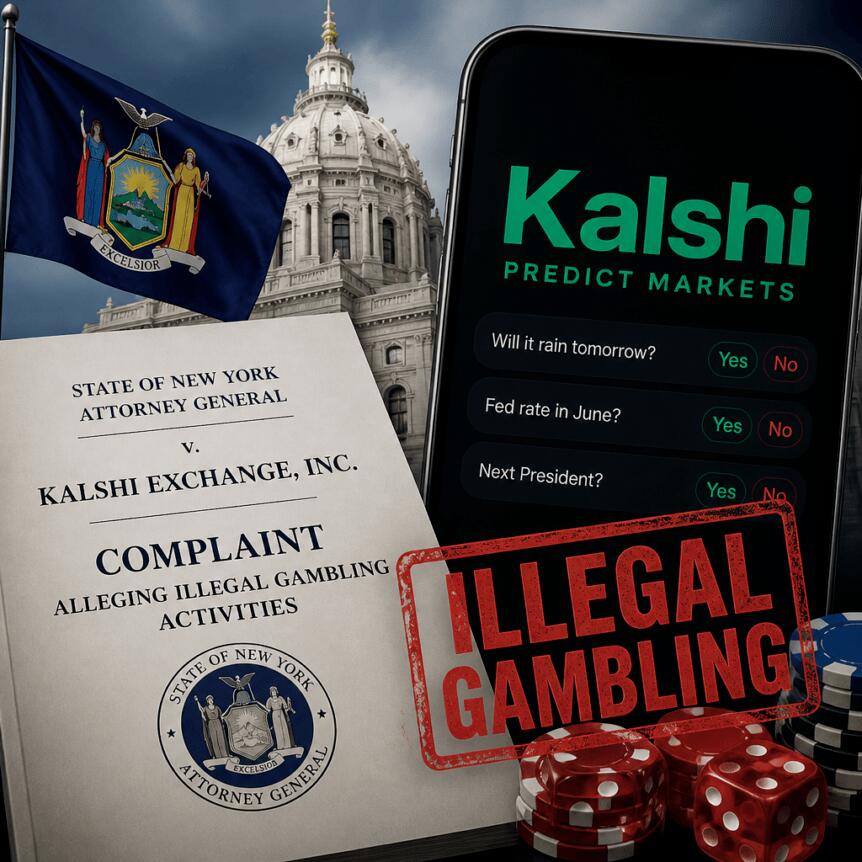
New York has filed a lawsuit against prediction market platform Kalshi, arguing the company operates an illegal, unlicensed gambling business in the state by offering contracts tied to outcomes such as sports events and elections. The case seeks to halt Kalshi’s alleged activity, recover money described as illegal gains, and impose civil penalties.
New York Attorney General Letitia James said in a statement that “no matter what they call themselves, prediction markets like Kalshi are gambling platforms, plain and simple,” adding that the state is acting to enforce its laws and protect residents. The complaint also follows regulatory action by the New York State Gaming Commission, which previously issued a cease-and-desist order.
Key takeaways
- New York is suing Kalshi to stop what it characterizes as unlicensed gambling conducted through “event contracts” tied to outcomes including elections and sports.
- The lawsuit seeks forfeiture of alleged illegal gains, restitution to users, and civil penalties stated as three times those gains.
- The dispute reflects a wider U.S. jurisdiction fight over whether states can enforce gambling laws against event contracts listed by federally regulated exchanges.
- The CFTC has argued—through emergency court filings in connection with the case—that it holds exclusive authority under the Commodity Exchange Act.
- Regulatory pressure on prediction markets comes as the segment grows, including through blockchain-based products and large-scale event-driven trading activity.
New York’s claims against Kalshi
According to the lawsuit, New York’s core position is that Kalshi’s prediction products amount to gambling under state law because they allow users to wager on outcomes. The state is asking the court for multiple remedies: an order stopping the alleged illegal operation, forfeiture of illegal gains, restitution to affected users, and civil penalties equal to three times those gains.
New York’s filing also follows earlier enforcement steps. The New York State Gaming Commission issued Kalshi a cease-and-desist order in October 2025. Kalshi responded by suing the regulator in federal court.
As described in the lead-up to the new lawsuit, a judge denied Kalshi’s request for a preliminary injunction in July, and an appeals court later rejected Kalshi’s attempt to block enforcement while its appeal continues.
Kalshi disputes New York’s framing. Elisabeth Diana, the company’s head of communications, said the action is “political theater,” arguing that states cannot simply shut down a federally licensed exchange, and warning that such a move would push users “offshore.”
CFTC says federal oversight should control
New York’s case sits within a broader legal contest about regulatory authority over prediction markets. In the days leading up to the lawsuit, the Commodity Futures Trading Commission (CFTC) filed an emergency motion in federal court seeking to block New York’s enforcement efforts.
The CFTC argued that New York’s approach interferes with the agency’s exclusive authority under the Commodity Exchange Act to regulate designated contract markets, including platforms such as Kalshi. Put differently, the federal regulator is asserting that once an exchange is operating within the CFTC’s framework, state gambling laws should not be used to restrict the same kinds of event contracts.
The CFTC has taken similar stances in disputes involving multiple states, positioning the conflict as an issue of federal supremacy and consistent commodities oversight. The regulator’s concern, as reflected in its court filings, is that allowing individual states to prohibit event contracts listed by federally regulated venues would create conflicting rules and “undermine federal commodities regulation.”
This framing matters for participants because it affects where prediction market activity can legally occur and how compliant operators must be. It also has practical implications for platform design and market access: if a state can apply its gambling rules regardless of federal designation, exchanges could face uneven compliance burdens across jurisdictions.
Prediction markets and mainstream momentum
Prediction markets operate by allowing participants to buy and sell contracts tied to future outcomes, with contract prices intended to reflect the market’s estimate of the probability that an event will occur. In recent years, this model has attracted increased attention—especially around high-profile events that draw large audiences.
Kalshi is not the only major player facing regulatory scrutiny. Polymarket, another prominent prediction market, has also encountered challenges abroad, with reporting noting restrictions and investigations tied to gambling and licensing concerns.
Meanwhile, the sector has continued to experiment with blockchain-based infrastructure. Kalshi began expanding into blockchain-based infrastructure in December 2025, launching tokenized prediction markets on Solana and later adding support for multiple blockchain networks. That shift underscores how prediction market operators are adapting product delivery, potentially changing how users access contracts and where trading activity occurs.
On-chain prediction markets have also shown signs of scale around major global events. According to analytics firm Chainalysis, blockchain-based prediction markets processed about $20 billion in trading tied to the 2026 FIFA World Cup, with more than 400,000 wallets participating—an example of the demand that can emerge when widely watched events create an appetite for probability-based trading.
What to watch as the legal fight advances
For market participants, the key question is whether the courts treat event-contract regulation as primarily a matter of federal commodities oversight—or whether states retain meaningful authority to apply their gambling laws to prediction platforms operating within (or near) federally regulated structures. The CFTC’s emergency motion and New York’s pursuit of enforcement remedies suggest the case could be used to clarify that boundary.
Readers should watch next for how federal courts address the CFTC’s arguments about exclusive jurisdiction, and whether any interim rulings change Kalshi’s ability to offer specific event contracts within New York while the broader appeal process plays out.