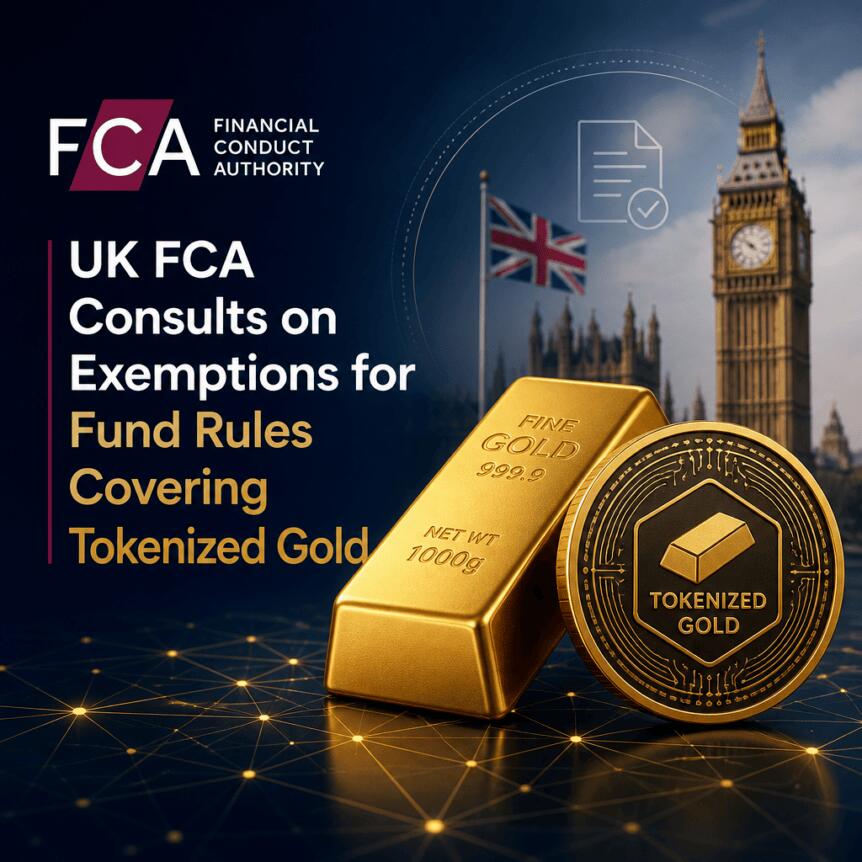
The UK Financial Conduct Authority (FCA) has opened a consultation seeking feedback on whether certain tokenized gold products should be exempt from parts of the UK’s fund rules. The move comes as regulators weigh how tokenization could reshape elements of wholesale market plumbing, including trading, transfer, pledging and custody.
In a call for input published Monday, the FCA said it is specifically looking at tokenized products that represent ownership of physical gold, with transparent backing, clearly defined ownership rights and redemption arrangements designed to function reliably. The consultation runs until Oct. 23.
Key takeaways
- The FCA is assessing whether some tokenized gold products fall within the UK’s collective investment scheme (CIS) or alternative investment fund (AIF) perimeter, a classification that could materially affect market participation.
- Regulators are concerned that uncertainty around fund-rule scope may slow development of tokenized gold use cases, including potential wholesale collateral applications.
- The FCA may respond to industry feedback by clarifying existing rules, creating recognized regulatory classifications, or considering targeted rule or legislative changes.
- The consultation is part of a broader UK push on wholesale tokenization, running alongside work involving the FCA and the Bank of England.
Why tokenized gold classification is central
A key driver behind the FCA’s consultation is the risk that tokenized gold products—depending on their structure—could be treated as a CIS or AIF, or that it may be unclear whether they meet those thresholds. The regulator warned that if the product’s classification is uncertain, it may affect whether investors are willing or even able to hold the tokens.
For market participants, classification determines the regulatory expectations that follow, including what compliance frameworks must be applied. That can influence product design, distribution plans, and the willingness of institutional investors to use tokenized instruments in real-world settlement and collateral workflows.
The FCA said it may consider multiple policy approaches based on what it hears from industry. These include clarifying how existing rules apply, developing a recognized classification for particular regulatory purposes, and assessing whether targeted rule changes—or, if needed, legislative adjustments—are required.
It also left open the possibility of a bespoke regime specifically for tokenized gold or tokenized commodities, should stakeholders indicate that the current framework does not fit the mechanics of tokenization in wholesale settings.
Wholesale tokenization: regulators signal progress, with collateral in focus
The FCA’s consultation arrives alongside a separate feedback statement from the FCA and the Bank of England on tokenization in wholesale financial markets. In that statement, regulators said they received 123 responses to a May call for input and that firms were broadly supportive of the UK’s work on wholesale tokenization.
Collateral emerged as the most frequently discussed use case in responses. Firms asked for greater clarity on eligibility for tokenized collateral, explicitly mentioning tokenized money market funds, gold and stablecoins. That focus aligns with the FCA’s current query about tokenized gold being used not just as a tradable asset, but potentially as collateral in wholesale arrangements.
Looking ahead, the FCA and the Bank of England said they intend to publish a tokenization roadmap later this year, laying out details and target dates across different workstreams. For investors and builders, this matters because roadmaps typically indicate whether guidance will come in the form of clarifications, new categories, exemptions, or other regulatory pathways that can unlock product development.
London’s gold market remains a backdrop to UK policy
The policy debate takes place against a backdrop where London plays a dominant role in global gold trading. According to the World Gold Council, London accounts for about 70% of global notional trading volume in over-the-counter gold markets. In practice, that means changes to how gold is represented and mobilized—such as via tokenized formats—could have ripple effects across participants who rely on wholesale market infrastructure.
The FCA has also been discussing the idea of a tokenized gold framework with banks and other market participants, following earlier reporting that highlighted the regulator’s engagement with the sector. The latest consultation effectively extends that effort from discussion into a formal feedback process about regulatory fit.
The wider UK regulatory landscape further includes ongoing work related to stablecoins and central-bank digital currency experiments. Separately, the Bank of England has been testing digital pound interoperability in cross-border payments. While those efforts are not the same as tokenized gold, they reflect an incremental, multi-track approach to tokenized finance that spans both asset issuance and settlement.
What happens next for tokenized gold projects
With the consultation open until Oct. 23, the immediate question for developers and issuers is how they can design tokenized gold products—particularly those intended for wholesale collateral—so that regulatory classification is clearer and confidence is higher. If the FCA concludes that parts of the existing fund-rule framework do not align well with physically backed tokenized gold, the regulator may move toward clearer guidance, targeted exemptions, or a more tailored regime.
Readers should watch the industry response as well as the FCA’s subsequent roadmap signaling later this year, because the practical impact will depend on whether regulators can reduce classification ambiguity without undermining investor protections. The outcome could influence how quickly tokenized gold products scale from pilots into broader wholesale use.