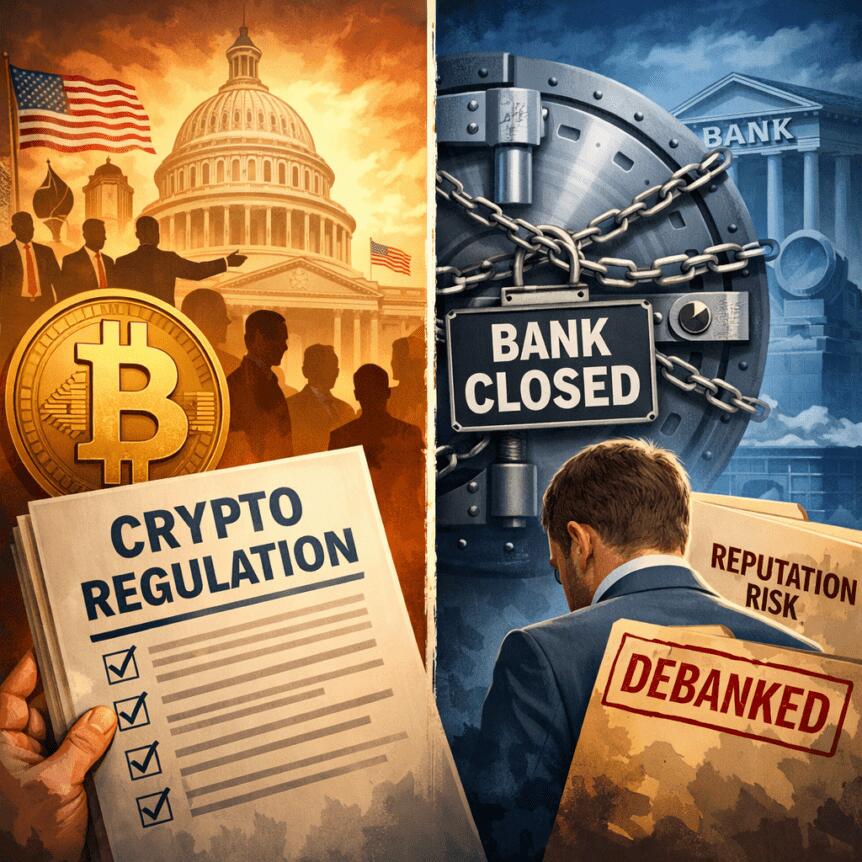
The Blockchain Association has publicly supported the Federal Reserve’s proposal to formalize the removal of “reputation risk” from its bank supervision framework. In a comment letter submitted in response to the Fed’s request for input, Ashok Pinto, the association’s executive vice president of legal and government relations, argued that reputation risk should be codified as a permanent rule. The group notes that reputation risk was already removed as a component of examination programs in June 2025 and urged the Fed to finalize the change promptly. According to Cointelegraph, the move would anchor supervisory standards in objective criteria rather than political considerations.
The association’s position emphasizes that regulation should protect the integrity of the financial system without privileging particular industries or business models. Pinto stated that regulated entities deserve consistent, predictable standards, and that reputation risk has offered neither.
Source: Blockchain Association
Reputation risk has historically been cited in justifications for revoking banking access for crypto firms, a phenomenon some observers have linked to what critics described as “Operation Chokepoint 2.0.”
Key takeaways
- The Federal Reserve is considering codifying the removal of reputation risk from its supervisory programs, following prior iterations where the concept was de-emphasized in examination frameworks.
- The Blockchain Association argues that formal codification would deliver administration-neutral, objective standards for regulated entities, reducing politically influenced enforcement.
- Regulatory harmonization is a central theme, with the OCC and FDIC having already finalized rules to remove reputation risk from their supervision, creating a potential model for the Fed to align with.
- Analysts note that reputation risk has been used in the past to justify debanking actions against crypto firms, underscoring the importance of clear, neutral criteria in supervision.
- There is an ongoing policy context surrounding banking access for digital-asset businesses, with implications for compliance regimes, licensing, and cross-agency oversight.
Regulatory alignment and policy rationale
The Federal Reserve’s request for comment centers on codifying the removal of reputation risk from its supervisory framework. The aim is to establish durable, administration-neutral standards that would apply to all entities operating within the U.S. financial system. The proposal follows recent moves by other federal agencies that have similarly codified the exclusion of reputation risk from supervisory programs, signaling a broader federal push toward standardized, objective criteria in oversight. The Blockchain Association’s Ashok Pinto urged the Fed to move quickly to finalize and codify the change, arguing that regulation should safeguard the integrity of the financial system without entrenching winners or losers based on shifting political climates.
“Codifying its removal is a durable, administration-neutral protection for any American business operating lawfully within our financial system.”
The push for formalization aligns with a larger regulatory trend toward harmonization across agencies. The Office of the Comptroller of the Currency (OCC) and the Federal Deposit Insurance Corporation (FDIC) recently issued a final rule to codify the removal of reputation risk from their supervisory programs. Proponents argue that a consistent standard across federal agencies would provide regulated entities with greater clarity and predictability, thereby supporting safer and more stable financial intermediation.
“As supervision is grounded in objective, measurable standards, the public’s confidence in the impartiality and integrity of the regulatory process is strengthened,” Pinto wrote. A unified framework—across the Fed, OCC, and FDIC—could help ensure that enforcement remains anchored to verifiable criteria rather than discretionary political considerations.
Historical context and practical implications
Debanking concerns have long surrounded the crypto sector in the United States. Critics point to cases where firms contend that government pressure, rather than risk-adjusted banking policies, influenced access to banking services. The Cato Institute, in its analysis from January, suggested that the majority of debanking cases stem from governmental influence rather than private-bank policy alone, underscoring the need for a neutral, codified standard widely applicable across agencies.
In the current policy milieu, a harmonized approach to reputation risk could influence several practical domains. For banks and payment providers, it would mean applying a consistent risk framework to decisions about onboarding and continuing relationships with crypto firms. For crypto firms, it could translate into more predictable licensing processes and fewer abrupt interruptions to access banking rails. For regulators and supervisors, it could reduce the room for ad-hoc penalties or bans that stem from politically charged interpretations of risk.
Regulators have emphasized that any framework must support financial-system safety and soundness while maintaining confidence in impartial supervision. The push for alignment across the Fed, OCC, and FDIC reflects a broader policy objective: to create a stable, compliant environment for digital-asset activities that can withstand changes in political leadership and administration.
Implications for institutions, licensing, and oversight
For financial institutions, the codification of reputation risk removal could simplify compliance architectures. Institutions would rely on a unified, objective standard when assessing crypto-related risk, potentially reducing the incidence of sudden debanking actions that disrupt legitimate activities. For crypto firms, clearer rules governing supervisory practices could translate into more predictable licensing and ongoing regulatory interaction, aiding risk management, AML/KYC procedures, and cross-border operations. For regulators, a consistent standard supports more transparent supervision and enables comparability across agencies and jurisdictions.
Looking ahead, the Fed’s final rule—when issued—may be positioned to mirror the OCC and FDIC approach, creating a coherent national framework. Such alignment would be particularly relevant for banks seeking to balance crypto exposure with prudent risk controls, as well as for policymakers assessing the resilience of the U.S. financial system amid evolving digital-asset developments.
In sum, the Blockchain Association’s stance reinforces a growing consensus around administration-neutral, rules-based supervision. If adopted, the codified removal of reputation risk could become a cornerstone of a more stable, predictable regulatory environment for crypto enterprises and their banking interfaces.
Closing perspective: The consolidation of reputation-risk governance across federal regulators remains a live regulatory question, with outcomes likely shaping the trajectory of institutional compliance, banking access for crypto firms, and cross-border policy alignment in the near term.