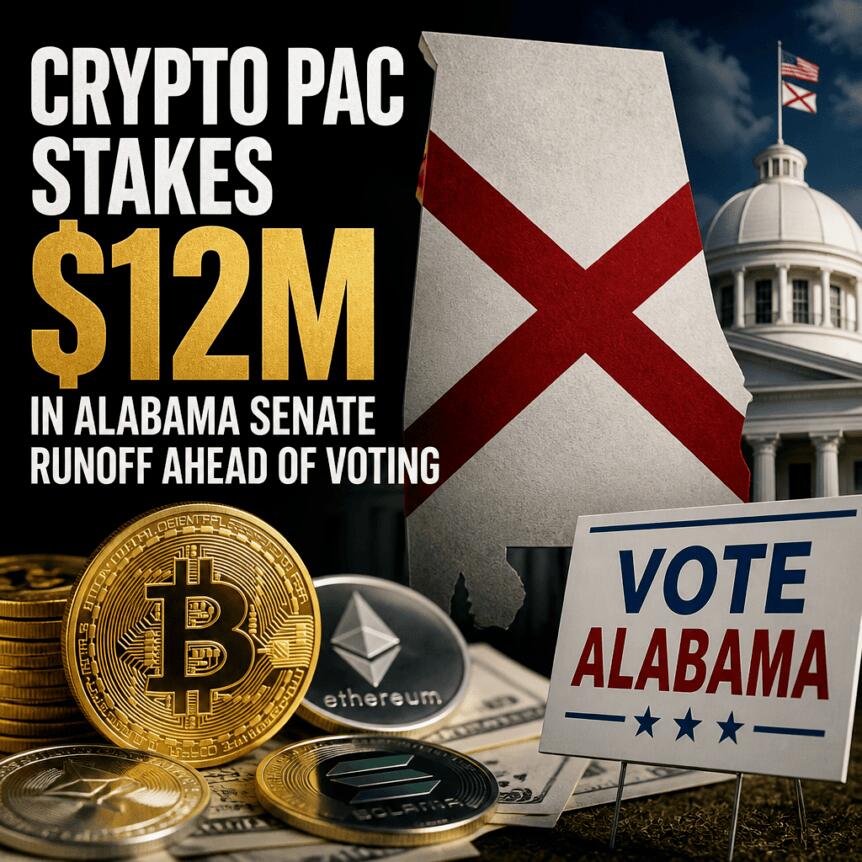
Defend American Jobs, a crypto-linked political action committee affiliated with Fairshake, has spent more than $4.7 million on media and advertising to back Republican Sen. candidate Barry Moore in Alabama’s Tuesday primary runoff, according to Federal Election Commission (FEC) filings. The spending brings the PAC’s total investment in Moore’s campaign to more than $7.4 million when combined with earlier expenditures reported ahead of the May 20 primary.
Moore is competing in the Alabama runoff for one of the state’s U.S. Senate seats against fellow Republican Jared Hudson. Moore has also received an endorsement from U.S. President Donald Trump. Hudson, meanwhile, has been described by crypto-focused advocacy group Stand With Crypto as “neutral” on crypto policy, while Moore is characterized as “strongly supports crypto.”
Key takeaways
- Defend American Jobs spent over $4.7 million in Alabama runoff media and ads, per FEC filings reviewed as of Tuesday.
- Moore’s campaign support totals more than $7.4 million across the primary and runoff periods, according to the same FEC reporting.
- Stand With Crypto rates Hudson “neutral” on crypto policy and Moore “strongly supports crypto,” citing public statements and voting history.
- Fairshake-aligned PAC spending extends beyond Alabama: similar media buys are tied to Maryland and New York later this month.
- Control of Congress matters for crypto legislation, including the CLARITY Act, which has already passed the House but has faced Senate delays.
Alabama runoff becomes another test for crypto political influence
The Alabama runoff is shaping up as a high-profile benchmark for how aggressively crypto-aligned political groups are willing to deploy capital in closely watched races. In Tuesday’s contest, Defend American Jobs is backing Barry Moore with large-scale media spending, a continuation of the broader strategy Fairshake and its affiliates have used across multiple states.
FEC filings show the PAC’s runoff spending—more than $4.7 million—was aimed at supporting Moore’s Senate bid in Alabama. The same reporting framework indicates the PAC previously spent $7.4 million ahead of the May 20 primary, underscoring that the effort did not slow after the first election round.
Moore’s matchup against Jared Hudson is also notable for the difference in how crypto policy positions are being characterized publicly. Stand With Crypto, a Coinbase-affiliated advocacy organization, rated Hudson “neutral” compared with Moore’s “strongly supports crypto” stance. Those assessments are said to be based on public statements and Moore’s voting record while representing Alabama’s 1st Congressional district.
How each candidate is positioned on crypto policy
Stand With Crypto’s comparison suggests the race is being framed as more than a general party primary—at least in the eyes of crypto political advocates. The group’s assessment points to Moore’s track record as more supportive of crypto than Hudson’s approach.
The article also notes that Hudson publicly acknowledged that “Big Crypto” did not back his candidacy. Still, he has supported a crypto market structure bill being considered in the U.S. Senate, which helps explain why advocacy groups may describe his stance as neutral rather than outright hostile.
For voters and market participants, these distinctions matter because crypto legislation in Washington often turns on committee timelines and floor votes. Even without a candidate being the top “pro-crypto” cheerleader, support for specific bills can influence how legislation advances once Congress moves toward final consideration.
Fairshake-aligned spending schedule: from Alabama to later races
Alabama is not the endpoint for this political spending push. After Tuesday’s vote, Fairshake-aligned PACs are reported to have stakes in Maryland and New York later this month, backing Democrats Adrian Boafo and Ritchie Torres. The reported media buys include about $5 million for the Maryland House race and roughly $500,000 for New York’s House contest.
This broader pattern echoes earlier media buys in other primary states—particularly investments made ahead of Texas and California primaries—suggesting a deliberate cycle of spending that follows sequential election dates.
Other crypto-related political groups are also part of the ecosystem. The Blockchain Leadership Fund, described as a hybrid PAC backed by Anchorage Digital and Chainlink, announced support for Moore in May; however, the reporting indicates that FEC filings showed no related expenditures as of Tuesday. Meanwhile, another PAC, the Fellowship PAC—backed by $11 million from Cantor Fitzgerald and Anchorage—disclosed $350,000 in spending to support Moore’s run.
Taken together, the filings and reported allocations reflect how multiple entities with overlapping objectives can operate in parallel: some groups spend immediately and at scale, while others may announce support without showing expenditures by a specific reporting date.
Why Senate control remains a central issue for crypto markets
Beyond individual races, the stakes highlighted in the report connect directly to the legislative environment in Washington. The article notes that Democrats have been in the minority in both the House and Senate during the current Congress session, while Republicans currently hold a slim majority in both chambers, giving them agenda-setting power.
In this context, the report points to the Digital Asset Market Clarity (CLARITY) Act. The bill passed the House in July 2025 but has faced delays in the Senate, with debate reportedly touching on issues such as stablecoin rewards, ethics, and tokenized equities.
The underlying implication is straightforward: if control of Congress shifts—particularly in 2027—crypto-related bills could move faster or face new scrutiny depending on the composition and priorities of committees and leadership.
According to the article, Fairshake had reported holding a $193 million war chest as of January, aligning with the group’s public position that it intends to “oppose anti-crypto politicians and support pro-crypto leaders” through media and advertising. While a war chest does not guarantee legislative outcomes, it often correlates with sustained political engagement during periods when election results can reshape how quickly bills progress.
With Alabama’s runoff decided Tuesday and additional media buys scheduled in Maryland and New York later this month, the next thing investors and election watchers should track is whether these PAC strategies translate into measurable changes in candidate momentum—and, more importantly, how the election outcomes affect the Senate path for crypto legislation like the CLARITY Act. The timing of Senate action remains uncertain, but the political groundwork being laid through these campaigns could determine how soon unresolved issues reach final votes.