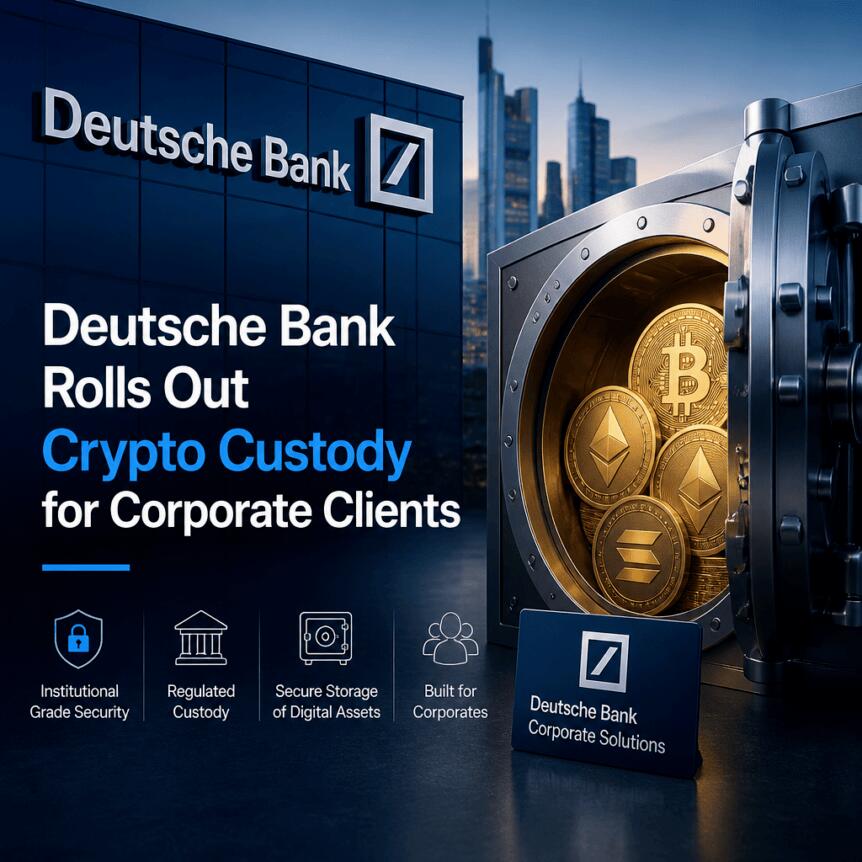
Deutsche Bank has begun offering crypto custody for institutional and corporate clients, marking a fresh step in the German lender’s push to bring digital assets into mainstream financial services. The bank said the service launched Wednesday, according to information shared with Cointelegraph.
Alongside the custody rollout, Deutsche Bank also signed a memorandum of understanding with Deutsche Asset Management to explore how tokenized products—such as money market funds—could be paired with crypto-linked offerings including crypto asset exchange-traded commodities and stablecoins.
Key takeaways
- Deutsche Bank launched its crypto custody service for institutional and corporate clients on Wednesday.
- The bank is also working with Deutsche Asset Management on potential collaborations involving tokenized money market funds and stablecoin-related initiatives.
- The custody offering initially supports Bitcoin, Ether, and select stablecoins including Circle’s USDC and EURC, plus AllUnity’s EURAU.
- Deutsche Bank’s EU crypto custody activities are tied to the Markets in Crypto-Assets Regulation (MiCA) framework, with BaFin listed as the relevant regulator.
Custody goes live under MiCA-linked preparations
Deutsche Bank previously outlined plans to offer crypto custody and related transfer services to institutional and corporate clients in Europe on Sept. 16, subject to regulatory clearance. Cointelegraph reports that the bank’s EU listing for these activities under MiCA is dated Oct. 12 and identifies Germany’s financial regulator, BaFin, as the oversight authority.
That timeline matters for clients because custody availability often depends on compliance milestones rather than purely operational readiness. With the service now launched, corporate treasurers, asset managers, and other institutions that require regulated custody can more readily evaluate Deutsche Bank as a partner for holding and managing selected digital assets.
What assets are included at launch
The initial scope of Deutsche Bank’s custody service includes Bitcoin and Ether, along with a limited set of stablecoins. The bank’s announcement, as relayed to Cointelegraph, specifies Circle’s USDC and EURC, plus AllUnity’s EURAU.
Limiting the initial supported assets can signal a risk-managed rollout. Stablecoins are frequently positioned as tools for liquidity management and tokenized finance workflows, but institutions typically expect custody providers to start with a narrower menu of assets while operational controls, custody procedures, and compliance frameworks are tested and refined.
How this fits Deutsche Bank’s broader digital-asset strategy
Deutsche Bank’s custody launch follows years of preparation. In 2023, the bank partnered with crypto infrastructure provider Taurus to develop custody services, after it applied for a digital asset custody license in Germany. Those steps align with the broader industry pattern in which traditional banks build custody capabilities through specialized infrastructure partners before expanding the product offering.
Earlier reporting also pointed to an expansion plan beyond Germany. According to Reuters, Gerald Podobnik—co-head of Deutsche Bank’s corporate bank—said in October that the lender aimed to launch in Germany first before expanding to Asian financial centers in 2027.
Deutsche Asset Management talks: tokenized funds and stablecoin-linked products
Beyond custody, Deutsche Bank and Deutsche Asset Management have signed a memorandum of understanding to explore collaboration on tokenized money market funds, crypto asset exchange-traded commodities, and stablecoins.
For investors, the interest here is less about custody alone and more about product integration—how digital assets could be used alongside traditional investment structures. Tokenized money market funds, in particular, are often discussed as a bridge between conventional liquidity products and blockchain-based settlement. If the collaboration moves from exploration to concrete offerings, it could provide institutional market participants with additional regulated pathways to access tokenized instruments.
However, the MoU framework also means the next steps remain uncertain. Readers should watch for whether the talks translate into specific, regulated products and which jurisdictions and asset types will be prioritized as the bank and its asset management partner operationalize the idea.
What to watch next
With Deutsche Bank’s custody service now live for a defined set of assets, the immediate question is how quickly it will expand supported tokens and deepen integrations with tokenized investment products. Regulatory conditions under MiCA will continue to shape what’s possible, while client demand will determine whether Deutsche Bank’s stablecoin and tokenized-fund ambitions progress from memorandums to market-ready services.