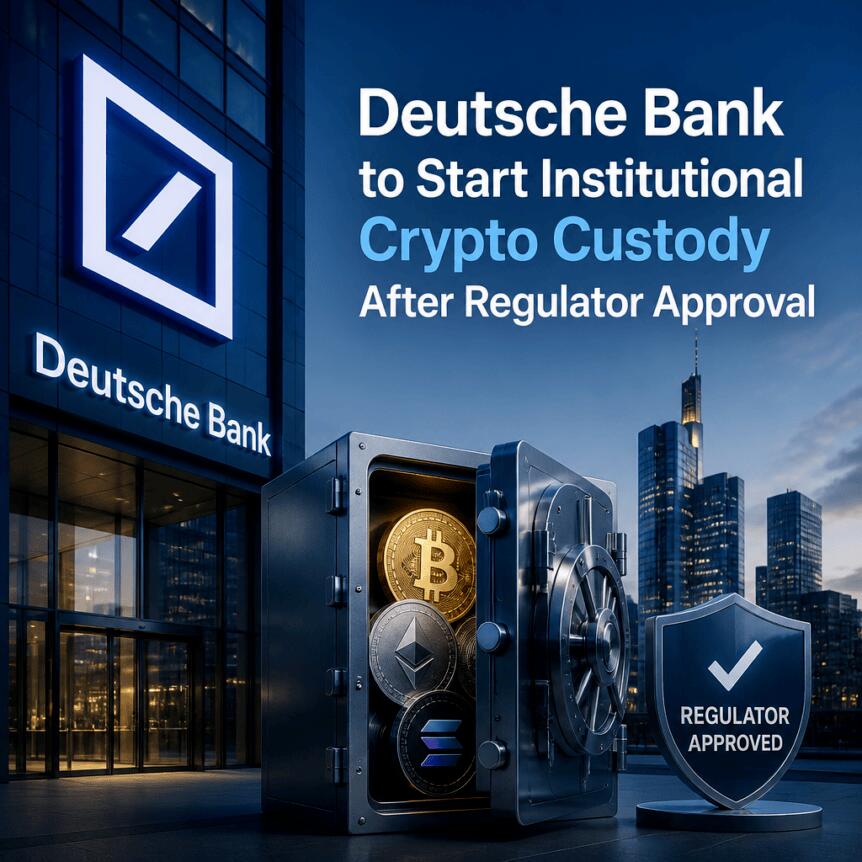
Deutsche Bank says it is preparing to launch regulated digital-asset custody for institutional and corporate clients across Europe, with the first customers expected to be onboarded this year once the bank completes the required regulatory process.
In an announcement made Wednesday, the Germany-based lender said the custody offering will initially support Bitcoin and Ether, along with select regulated stablecoins—Circle USDC, Circle EURC, and AllUnity EUR (EURAU). The bank also flagged that support for tokenized financial instruments will come later.
Key takeaways
- Deutsche Bank is moving toward an MiCA-regulated custody rollout for institutions, not consumer trading products.
- The initial asset set is focused: Bitcoin, Ether, and a defined list of stablecoins (USDC, EURC, EURAU).
- Tokenized financial instruments are planned for a later phase rather than the first launch.
- The bank expects to receive the necessary license in October, aligning its timeline with the EU Markets in Crypto Assets (MiCA) framework.
- MiCA’s full enforcement on July 1 is expected to widen the pace of crypto service approvals among European banks.
Regulatory path and what Deutsche Bank is offering
Deutsche Bank’s plan hinges on obtaining regulatory approval under the EU’s MiCA framework. The bank expects to receive the custody license in October, according to comments from Heinrich Frömsdorf, a spokesperson for Deutsche Bank, to Cointelegraph.
The scope of the offering is tailored to institutional needs. The bank said it will provide custody services for Bitcoin, Ether, and specified stablecoins—USDC, EURC, and EURAU—at launch. It did not frame the rollout as a broader trading or market-making service, but rather as an infrastructure layer designed to help corporate and institutional clients hold digital assets under compliant custody arrangements.
Deutsche Bank also indicated that tokenized financial instruments would be added at a later point, signaling that the service roadmap extends beyond crypto-native assets into the emerging tokenized-assets ecosystem.
Why MiCA timing matters for European banks
The bank’s move comes at a moment when Europe’s regulatory perimeter for crypto is tightening. The source notes that the broader push among German banks to offer crypto services is expected to accelerate after MiCA reached full enforcement on July 1.
For market participants, this timing is important because institutional adoption has often depended on clarity around custody, licensing, and operational requirements. A bank-scale custody product can reduce friction for entities that need regulated settlement and controls, particularly when they are moving from pilots or indirect exposure to direct custody arrangements.
Deutsche Bank’s stated October licensing expectation suggests it is aligning product readiness with the maturation of MiCA’s supervisory structure, rather than attempting to launch permanently “under the radar” or relying purely on earlier, less harmonized rules.
From partnership-era exploration to MiCA-aligned rollout
Deutsche Bank’s latest step builds on earlier groundwork. Cointelegraph previously reported on the bank’s development of crypto custody services, and the new announcement effectively confirms that ongoing effort.
According to earlier coverage referenced by Cointelegraph, Deutsche Bank began revealing its intentions well before this custody launch, including exploration of stablecoins and even the possibility of issuing a token. In June, the bank’s head of digital assets, Sabih Behzad, was cited as disclosing that Deutsche Bank was considering entry into the stablecoin market, including the idea of issuing its own token—an ambition that fits the larger pattern of banks exploring how stablecoins and tokenized deposits could integrate with traditional finance.
More specifically on custody, Deutsche Bank first revealed plans to launch crypto custody solutions in 2023 as part of a partnership with Taurus, shortly after applying for a digital asset custody license in Germany. That sequence—license application, partnership-driven buildout, and eventual MiCA licensing timeline—shows a longer operational runway than “one-off” product launches that often follow market hype cycles.
Germany’s broader banking push into crypto custody
Deutsche Bank is not operating in isolation. The source points to other German institutions moving toward crypto services in parallel.
In April 2024, Landesbank Baden-Württemberg—described as Germany’s largest federal bank—began offering crypto custody solutions after partnering with Austria-based Bitpanda for its institutional custody platform. Later, DZ Bank said in December 2025 that it received authorization from Germany’s regulator BaFin under MiCA to operate its meinKrypto platform.
Taken together, these moves indicate that crypto custody is becoming a competitive capability among major European banks, with different institutions choosing different routes—some through partnerships with crypto infrastructure providers, others by standing up regulated platforms directly under MiCA-aligned authorization.
Deutsche Bank’s position as a Global Systemically Important Bank, as listed by the Financial Stability Board, adds another layer: institutions of this scale may face particularly heavy scrutiny, so their approvals and timelines are likely to carry industry weight.
What to watch next
Investors and institutions should focus on whether Deutsche Bank’s October licensing process stays on track, how quickly it expands beyond the initial asset list after launch, and whether its later addition of tokenized financial instruments becomes a meaningful bridge between traditional securities workflows and on-chain custody.