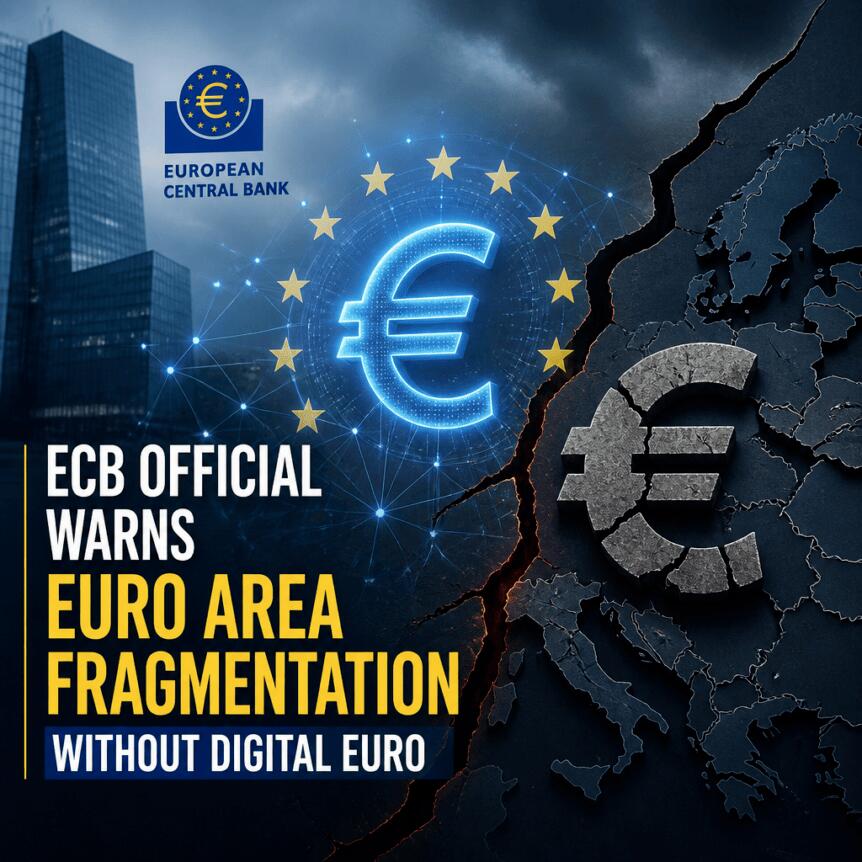
A senior European Central Bank (ECB) executive has warned that the digital-euro project could be undermined if other payment providers build competing tokenized payment rails before the central bank launches its own pan-European solution. In remarks delivered on an MNI Connect Webcast, ECB executive board member Piero Cipollone argued that the absence of a widely interoperable digital euro risks intensifying fragmentation across tokenization platforms—potentially weakening Europe’s “resilience and monetary sovereignty.”
While the ECB has not yet decided whether to issue a digital euro, Cipollone said the central bank intends to wrap up the legislative process by the end of 2026. He also described a possible timeline that would include a 12-month pilot starting in the second half of 2027, with the possibility of issuance in 2029.
Key takeaways
- Cipollone warned that without a pan-European digital payment option, tokenized payment systems may fragment across platforms.
- The ECB has not confirmed whether it will issue a digital euro, but plans to complete the legislative process by end-2026.
- Under the current roadmap, a 12-month pilot could begin in H2 2027, with potential issuance in 2029.
- The ECB’s stated aim is not to replace banks, but to provide infrastructure that would help banks and other providers compete digitally.
- Previous ECB proposals framed the digital euro as a complement to cash for digital payments, though critics have raised privacy and surveillance concerns.
Why the ECB is concerned about “fragmentation”
Speaking Monday on the MNI Connect Webcast, Cipollone emphasized a specific risk: if there is no pan-European digital payment solution capable of handling everyday transactions, alternative offerings could emerge outside the ECB’s framework. In his view, these separate approaches could increase fragmentation across tokenization platforms.
The concern is less about technology in isolation and more about interoperability and coordination. Without a universally accepted central-bank-issued option designed to work across the banking system, the market could end up with multiple tokenized ecosystems that don’t exchange seamlessly for routine payments.
That framing matters for both users and institutions. For consumers and merchants, fragmentation can translate into inconsistent payment availability, varying user experiences, or additional friction in cross-provider use. For banks and payment firms, it can mean higher integration and compliance costs if they must support multiple competing tokenized systems rather than standardizing around a shared baseline.
ECB’s stated goal: a digital euro exchangeable across banks
Despite the critique about sovereignty and resilience, Cipollone stressed that the ECB’s objective is not to displace banks. “Our objective is not to take over the role of banks,” he said, adding that a digital euro would instead “equip banks with the infrastructure they need to compete in the digital age” and help them broaden the reach and use cases of their own solutions.
This approach positions the digital euro as an infrastructure layer rather than a retail payment provider. In practical terms, that would mean focusing on making the digital euro usable for day-to-day payments while remaining exchangeable across banking institutions.
It also clarifies the ECB’s political and market stance: rather than substituting private payments with a central-bank monopoly, the ECB appears to be aiming for a baseline payment capability that private actors can build around.
Timeline: legislative process, pilot window, and possible issuance
Cipollone said the ECB has not yet decided whether it will issue a digital euro. However, he indicated the institution’s intention to complete the legislative process by the end of 2026, which would determine whether the project advances from planning into implementation.
If lawmakers and the ECB proceed, Cipollone described a possible implementation path that would include a 12-month pilot program beginning in the second half of 2027. He further suggested that issuance could come in 2029, contingent on the pilot and subsequent steps.
These dates are important not only for policy watchers but also for market participants that would need to plan integrations, governance, and operational readiness. Even though the ECB has not finalized its decision, the existence of a roadmap means that timeline risk—where private alternatives accelerate while central-bank planning remains undecided—could still become a live competitive issue.
Background: the digital euro proposal and continuing debate
The ECB first proposed introducing a digital euro in October 2020, initially positioning it as a central bank digital currency (CBDC) designed to complement cash as a digital payment option.
Critics have argued that such a system could enable EU authorities to surveil or potentially control residents’ spending, raising concerns that extend beyond technology into privacy, oversight, and governance.
In separate remarks delivered in September 2025 at an event hosted by the Bank for International Settlements (BIS), Cipollone said: “the digital euro will ensure that all Europeans can pay at all times with a free, universally accepted digital means of payment, even in case of major disruptions.” That statement ties the project to contingency planning—aiming to maintain payment access during periods of disruption, when private systems could be stressed or unevenly available.
Read together, the two lines of argument—Cipollone’s warning about fragmentation and his earlier emphasis on universal availability—outline a consistent policy narrative: the ECB appears focused on maintaining a durable, interoperable payment option across the euro area, while also ensuring it does not undermine banks’ role in competing services.
What to watch next
For investors and builders, the central watchpoint is not just whether the ECB eventually chooses to issue a digital euro, but whether its legislative process and pilot timeline can keep pace with private tokenization efforts—before those alternatives harden into fragmented standards. The ECB’s end-2026 legislative goal and the proposed H2 2027 pilot window will likely shape how quickly banks and payment providers plan around a potential interoperable benchmark rather than multiple competing rails.