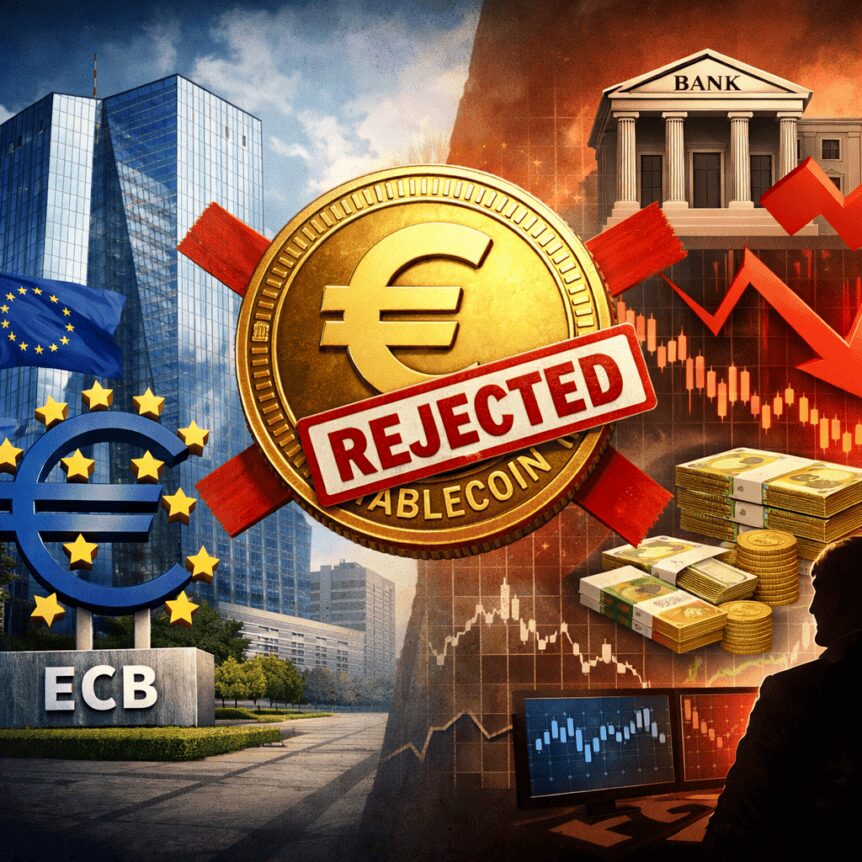
The European Central Bank (ECB) signaled serious caution on proposals to widen euro stablecoin issuance, warning that such moves could weaken bank lending and complicate the conduct of monetary policy. The concerns emerged as Brussels-based think tank Bruegel published a policy paper ahead of an informal gathering of EU finance ministers, urging lighter liquidity requirements for stablecoin issuers and even potential access to ECB funding to help euro-denominated tokens compete with dollar-backed rivals.
According to Bruegel’s analysis, Europe accounts for about 38% of global stablecoin activity, yet euro-denominated tokens represent roughly 0.3% of total supply. Circle’s EURC, the largest euro stablecoin, sits around 12th in the global ranking by market size, according to CoinMarketCap. The policy paper was presented during a two-day informal meeting of the Economic and Financial Affairs Council in Nicosia, Cyprus, and has since drawn a pointed response from the ECB leadership.
The central question debated in Nicosia was whether Europe should close the euro-stablecoin gap by extending central-bank-style support to issuers. For now, the ECB’s position appears resistant to such a shift.
Key takeaways
- ECB officials publicly warned that broadening euro-stablecoin issuance could undermine traditional banking models and complicate monetary policy transmission.
- Bruegel proposed easing liquidity requirements for stablecoin issuers and granting them access to ECB funding to spur euro-stablecoin competitiveness against dollar tokens.
- European stablecoins handle a substantial share of global activity (38%), but euro-denominated tokens remain a small fraction of supply (about 0.3%), with EURC ranking 12th globally by market size.
- ECB President Christine Lagarde led the opposition to central-bank-backed stability facilities for issuers, highlighting risks to bank deposits, disintermediation, and higher funding costs for banks.
- The debate sits within a broader policy framework, including MiCA regulation, the US GENIUS Act, and ongoing consideration of tokenized financial infrastructure backed by central-bank money.
Policy proposals and regulatory context
The Bruegel paper presented at the Nicosia meeting advocates a more permissive stance toward euro-stablecoin issuers, arguing that easing liquidity requirements and providing potential ECB funding access would help euro tokens compete with dollar-dominated equivalents. Proponents contend that an integrated, euro-backed stablecoin market could bolster EU financial sovereignty and efficiency in cross-border payments, while leveraging the ECB’s balance-sheet capacity to support liquidity needs in times of stress.
ECB leadership, however, has signaled a different path. In the discussions surrounding the paper, ECB officials underscored potential destabilizing effects of stablecoin issuance on traditional banks, particularly through the displacement of deposits from banks to stablecoin issuers. At scale, this disintermediation could raise bank funding costs and hamper the central bank’s ability to steer policy through traditional channels. Reuters reported that Lagarde and fellow policymakers questioned whether the ECB should assume a lender-of-last-resort role for stablecoin firms—a function currently reserved for regulated banks—thereby challenging a core aspect of the euro-area financial safety net.
The broader regulatory backdrop includes the EU’s Markets in Crypto-Assets framework, or MiCA, which is under review as the bloc weighs how to adapt rules for stability tokens. MiCA already imposes requirements on stablecoin issuers to hold substantial reserves in liquid assets, a regime that contrasts with the more permissive posture seen in some other jurisdictions, such as the US GENIUS Act. The Bruegel position raises a legal and policy question: should EU policy converge toward centralized funding and explicit backstops for stablecoins, or should it preserve sharper distinctions between digital assets and fiat-backed money?
Banking stability, monetary policy, and market structure
Central bankers at the Nicosia gathering largely dismissed the Bruegel notion of extending an ECB lender-of-last-resort facility to stablecoin issuers. The ECB’s stance reflects a precautionary calculus: stablecoins can alter the balance between banks and non-bank funding channels, potentially reducing the resilience of the traditional banking system and weakening monetary policy transmission mechanisms. Lagarde’s comments emphasize that, while euro-stablecoins could stimulate demand for euro-area safe assets, the associated trade-offs—especially financial stability risks, redemption pressures, and diminished policy effectiveness—outweigh the perceived benefits.
Beyond stability concerns, Lagarde has repeatedly highlighted the importance of building tokenized financial infrastructure with central-bank money at its core. She pointed to Europe’s ongoing initiatives—such as the Eurosystem’s Pontes project for wholesale settlement and the Appia roadmap for interoperable tokenized finance—as more predictable avenues for modernizing payments and settlement without compromising monetary sovereignty. This stance aligns with a policy preference for regulated, assets-backed digital finance that retains direct anchorage to central bank money, rather than broad market expansion of private-issued stablecoins.
At the same time, Bruegel’s authors cautioned that stricter EU rules relative to the United States could hasten digital dollarization, pushing stablecoin activity beyond the bloc’s borders. While some participants acknowledged the risk, others argued for targeted measures to manage redemptions from European-issued stablecoins and to limit reserve runs, thereby shielding the euro-area financial system from abrupt shifts in liquidity.
EU regulatory landscape and international considerations
The ongoing MiCA review sits at the center of EU policy discussions about crypto regulation, with implications for issuers, exchanges, and institutional players operating across European borders. A stricter regime—potentially complemented by efforts to restrict redemptions of both US- and EU-issued stablecoins within the bloc—could offer a bulwark against reserve runs but may also dampen innovation and competitiveness in a global market where dollar-backed tokens have established a deep liquidity pool.
Comparative regulatory dynamics are evident in the US framework, where the GENIUS Act and other legislative developments reflect a more permissive stance toward certain digital assets, albeit under ongoing oversight. Proponents of the euro-area approach argue that clear, robust requirements—aligned with MiCA—are essential for safeguarding financial stability and ensuring that any expansion of euro-stablecoin activity remains within the ECB’s reach to guard against macroeconomic spillovers.
Institutional implications extend to licensing, supervisory oversight, and cross-border cooperation. As European institutions weigh the balance between fostering a competitive euro-stablecoin market and preserving the integrity and resilience of the banking system, firms operating in the space should assess how MiCA provisions, any future ECB facilities, and potential liquidity or redemption controls could shape European operations, capital planning, and compliance programs.
Closing perspective
EU policymakers are navigating a delicate equilibrium between unlocking the strategic benefits of euro-stablecoins and maintaining robust financial stability and monetary policy effectiveness. The debate in Nicosia reflects deeper questions about the role of central-bank money in a digitized payments landscape and the institutional safeguards required to prevent destabilizing shifts in liquidity. As MiCA modernization progresses and cross-border dynamics evolve, banks, issuers, and institutional investors should monitor regulatory alignments, potential lender-of-last-resort considerations, and the trajectory of Europe’s tokenized-finance infrastructure—alongside ongoing assessments of how these policy choices will affect cross-border payments, reserve management, and compliance frameworks.